


California requires OSFM-listed smoke alarms installed in every sleeping room, in hallways adjacent to sleeping areas, on each story of a home, and in basements, all wired per the manufacturer’s instructions. New construction and many permitted renovations require hardwired, interconnected alarms or OSFM-listed units with sealed long-life batteries under SB 745. Owners and landlords must deliver operable alarms at move-in and fix reported defects promptly under California Health and Safety Code §13113.7, while tenants carry the duty to report a unit that stops working.
- Required locations: every sleeping room, adjacent hallways, each story, basements
- Device standard: OSFM approved and listed, installed per manufacturer instructions
- Responsibility split: owners maintain and repair, tenants report failures promptly
Key Takeaways
California law requires OSFM-listed smoke alarms in every sleeping room, adjacent hallway, and story of a home, with owners responsible for keeping them operable and tenants responsible for reporting failures.
| Point | Details |
|---|---|
| Buy OSFM-listed devices | Confirm the listing number and SB 745 markings before installing any new alarm. |
| Install in every required zone | Place alarms in each bedroom, adjacent hallways, every story, and basements. |
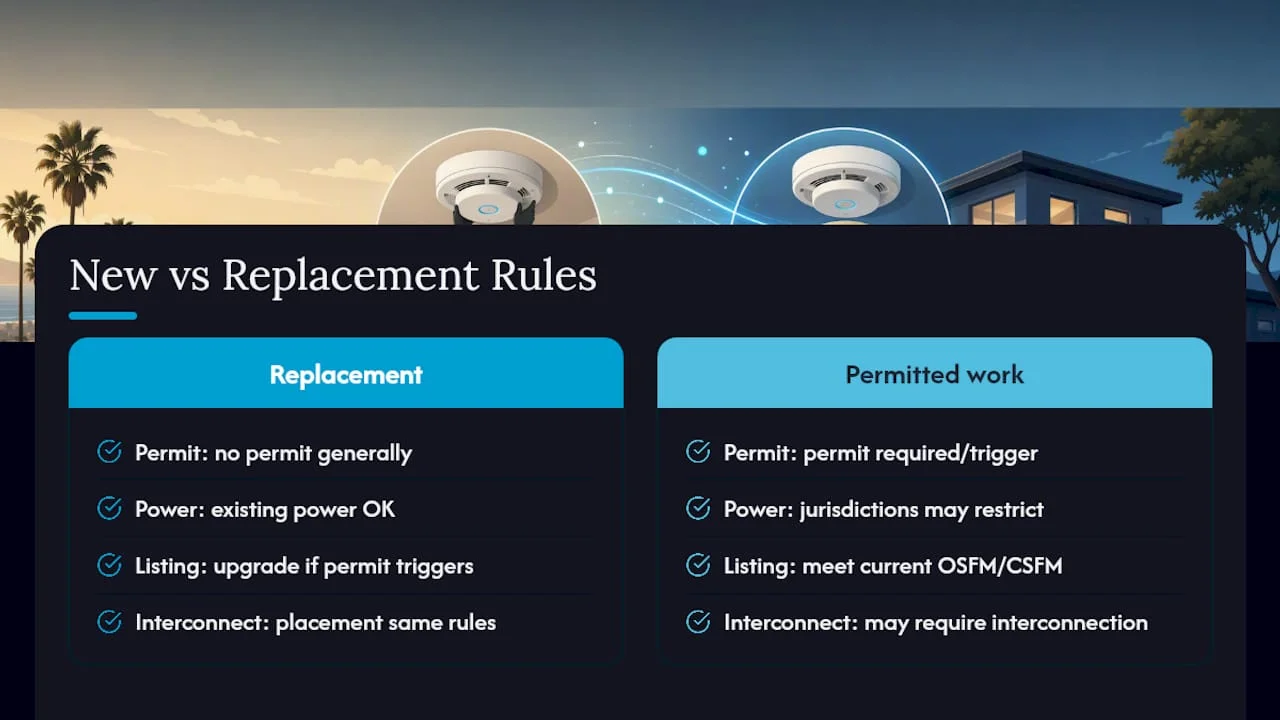
| Match power source to project type | New construction needs hardwired, interconnected alarms; existing homes may keep battery units absent a triggering permit. |
| Know the responsibility split | Owners maintain and repair; tenants must report a failed or missing alarm promptly. |
| Replace at the 10-year mark | Check the manufacture date and swap out alarms before they reach end of life. |
Table of Contents
- Smoke Detector Requirements California: Devices That Meet State Law
- Where To Install Smoke Detectors and CO Alarms in a California Home
- New Construction vs. Existing Homes: Power Source and Permit Rules
- Landlord and Tenant Duties for Testing, Repairs, and Access
- Replacement Timelines and a Quick Compliance Checklist
- Why Alarm Compliance Matters When You’re Selling in Silicon Valley
- What Homeowners Get Wrong About Smoke Alarm Rules
- Frequently Asked Questions About California Smoke Alarm Laws
- Sources
Smoke Detector Requirements California: Devices That Meet State Law
Not every smoke alarm sold nationally satisfies California’s smoke alarm regulations. The state requires devices approved and listed by the California Office of the State Fire Marshal, and that listing status matters at resale, during permit inspections, and any time a local fire department reviews a property.
Senate Bill 745 rewired the rules for battery-powered units. Here’s what changed:
- Sealed 10-year battery. Any smoke alarm sold in California that runs solely on battery power must use a nonreplaceable, nonremovable battery rated to power the unit for at least a decade.
- Manufacture-date marking. Every OSFM-listed alarm must display its date of manufacture directly on the device.
- Installation-date field. The unit must include a spot where the installer records the date it went into service, which matters later when you calculate replacement timing.
- Hush and end-of-life features. Listed alarms need a hush button for nuisance alarms and a distinct signal when the unit reaches the end of its service life, per OSFM Information Bulletin 14-007.
Combination smoke and carbon monoxide units are common in newer homes, but they fall under separate CSFM listing categories depending on the sensor technology inside. Standalone CO alarms must meet ANSI/UL testing standards under the Carbon Monoxide Poisoning Prevention Act, so pairing a listed CO alarm with a listed smoke alarm satisfies both rules without guesswork.
Pro Tip: Check the back of the alarm for the OSFM listing number before you buy. If it’s missing, the device won’t satisfy California’s smoke detector installation rules, no matter how good the packaging looks.
Where To Install Smoke Detectors and CO Alarms in a California Home
Placement rules aren’t arbitrary. They come straight from the 2022 California Building Code, the California Residential Code, and the California Fire Code, and they’re built around how smoke actually travels through a house while people sleep.
- Install a smoke alarm inside every sleeping room, not just in the hallway outside it.
- Place one in the hallway or common area immediately adjacent to each cluster of bedrooms.
- Cover every story of the home, including basements, even stories with no bedrooms.
- Skip unfinished attics and unheated garages, where temperature swings can disable sensors or trigger false alarms.
- Keep alarms roughly 10 feet from cooking appliances to cut down on nuisance triggers from normal cooking smoke.
When a home needs more than one smoke alarm, state code requires them to be interconnected, meaning one alarm sounding sets off every other alarm in the house. That’s a meaningful safety upgrade over a single isolated unit in the hallway, since a fire in a back bedroom won’t go unnoticed by someone sleeping two rooms away. Carbon monoxide alarms follow a similar logic: install one on each level of the home and near sleeping areas, particularly in any home with an attached garage or a fuel-burning furnace, water heater, or fireplace.
New Construction vs. Existing Homes: Power Source and Permit Rules
The power source requirement depends heavily on when the wiring went in and whether current work needs a permit. New construction and additions must connect alarms to the building’s primary electrical system, with battery backup, and interconnect them per CBC 907.2.11 and CRC R314/R315.
Here’s how the trigger points typically break down for existing homes:
- No permit, no trigger. A home with functioning battery alarms installed before current rules took effect generally doesn’t need to swap them out just because they’re older.
- Permitted repairs over $1,000 often trigger upgrades. Many California jurisdictions require bringing smoke alarms up to current OSFM-listed standards once a permit crosses that threshold, even if the underlying project is unrelated to fire safety.
- New electrical circuits bring AFCI requirements. Under CEC 210.12, new or extended bedroom circuits typically need arc-fault circuit interrupter protection, which inspectors often review alongside alarm compliance during the same visit.
- Local jurisdictions can go further. Some Bay Area cities interpret interconnection and power-source rules more strictly for older multifamily buildings, requiring hardwired upgrades during electrical work even where the state minimum would allow battery units.
Landlord and Tenant Duties for Testing, Repairs, and Access
California draws a fairly clean line between who installs and who reports. Owners and landlords must ensure every required smoke alarm is present and operable at the start of a tenancy, and they must repair or replace a defective unit within a reasonable time once they know about it, under HSC §13113.7.
- Landlords aren’t automatically in violation for an alarm that fails silently between inspections. The law protects owners who genuinely didn’t know a unit had stopped working.
- Tenants carry the responsibility to notify the landlord as soon as an alarm chirps, fails a test, or goes dark.
- Owners or their agents may enter a unit to install or repair an alarm with reasonable written notice. Twenty-four hours is generally presumed reasonable, though emergencies waive that notice period entirely.
- Rental property owners had until January 1, 2016, to install any additional alarms needed to meet current placement standards. Alarms already compliant and functioning didn’t need replacement just because the deadline passed.
Pro Tip: If you’re a landlord, put the alarm testing request in writing and give tenants a simple way to report failures, like a maintenance email or portal. It closes the “we didn’t know” gap on both sides and keeps you square with California home safety guidelines.
Replacement Timelines and a Quick Compliance Checklist
Ten years is the number to remember. Manufacturers rate most smoke alarms for a decade of service, and California’s rules treat that manufacture date as the clock that starts the countdown, not the installation date.
- Check the manufacture date stamped on the unit. Replace it once ten years have passed, even if it still seems to work.
- Test every alarm monthly. Press the test button and confirm the sound is clear and full volume.
- Record installation dates on the unit’s date field so future owners, inspectors, or buyers can verify compliance at a glance.
- Watch for end-of-life chirps. OSFM-listed alarms are built to signal when they’ve reached the end of their service life, and that signal means replace now, not later.
- Run this checklist before listing a home for sale, since a buyer’s inspector will flag missing dates, expired units, or non-OSFM devices almost every time.
Why Alarm Compliance Matters When You’re Selling in Silicon Valley
Smoke and carbon monoxide alarms rarely make headlines in a listing, but they routinely show up as a line item on inspection reports across Santa Clara County. A pre-sale inspection that flags a missing OSFM listing or an alarm without SB 745 markings can stall escrow while the seller scrambles to swap units days before closing.
- Confirm every newly installed alarm carries proper OSFM markings and record the installation date before you list.
- Check whether your city, San Jose, Mountain View, or Fremont among them, imposes stricter placement or power-source rules than the state minimum requires.
- Fix inoperable or outdated alarms before a buyer’s inspector finds them, not after.
Pro Tip: Sellers who address alarm compliance during pre-listing prep almost never see it resurface as a buyer request during negotiations, it’s one of the cheapest fixes with the biggest downside if skipped.
Working with an agent who treats these details as part of transaction strategy, not an afterthought, is part of what separates a smooth close from a delayed one. Laxmitoprealtor builds pre-sale inspection review into every listing preparation process across Santa Clara County.
What Homeowners Get Wrong About Smoke Alarm Rules
Most homeowners treat smoke alarm compliance as a one-time install and forget it. That’s the biggest gap between what the statutes actually require and what happens in practice. HSC §13113.7 doesn’t just set an installation standard, it creates an ongoing maintenance obligation that outlasts any single inspection or move-in date.
The conventional advice, “just put alarms in every bedroom,” undersells the interconnection requirement. A house full of standalone battery units technically covers each room but misses the point of the code: one alarm should wake the whole house, not just the room where the fire started.

If you’re prioritizing one thing, prioritize the manufacture date check. SB 745’s 10-year sealed battery rule and end-of-life signaling exist because alarms silently lose sensitivity long before most people think to replace them. A functioning-looking alarm that’s 11 years old isn’t compliant, and it isn’t reliable, regardless of what the test button tells you.
For sellers, this isn’t a box to check the week before listing. It’s a detail that either supports a clean, on-time closing or becomes the reason escrow slips a week.
Frequently Asked Questions About California Smoke Alarm Laws
Do I need a permit to replace an existing smoke alarm in my California home?
Generally no, swapping a like-for-like alarm doesn’t require a permit. But if you’re doing permitted electrical or remodeling work, that permit can trigger a requirement to upgrade to current OSFM-listed standards.
Are combination smoke and carbon monoxide alarms legal in California?
Yes, combination units are common and legal, provided they carry the proper CSFM listing for both the smoke-sensing and CO-sensing components under SB 183.
How often do smoke alarms need to be replaced under California smoke detector requirements?
Replace them 10 years from the date of manufacture stamped on the unit, not from the installation date, and immediately if the device signals end of life.
Who pays for smoke alarm repairs in a rental unit?
The landlord or owner is responsible for repairing or replacing a defective alarm once notified, per HSC §13113.7, though the landlord isn’t in violation for a defect they genuinely didn’t know about.
Do multifamily buildings and apartments follow different smoke alarm rules than single-family homes?
The placement and listing requirements are largely the same, but some Bay Area jurisdictions apply stricter interconnection or power-source rules to older multifamily buildings during electrical or structural work.
If you’re preparing to sell in Santa Clara County and want a pre-listing review that catches alarm compliance issues before a buyer’s inspector does, get in touch with Laxmitoprealtor to start your free comparative market analysis.
This article is general information, not a substitute for advice from a qualified lawyer. Consult a qualified legal professional about your own circumstances before acting on anything here.
Sources
- California Health and Safety Code §13113.7
- Smoke and Carbon Monoxide Alarms for the Home and Rental Units
- RESIDENTIAL SMOKE & CARBON MONOXIDE ALARMS (Contra Costa County guidance)
Recommended
- Homeowners Insurance in California: What Has Changed
- Natural Hazard Disclosure California: Buyer & Seller Guide
- California TDS Form: What Sellers and Buyers Must Know
- Home Inspection Contingency Explained (Smart 2026)

Laxmi Penupothula
Top 1% Realtor SCCAOR, RealTrends Verified (2021–2025) • CA DRE #02047105
SCCAOR Top 1% Santa Clara County • Intero Chairman Circle 2023–2025 • \$650M+ Closed • 570+ Transactions
Silicon Valley & Bay Area Specialist — Cupertino, San Jose, Fremont, Milpitas, Sunnyvale & surrounding cities.
Get a Free Home Valuation →