


San Jose suits renters, buyers who want a larger inventory and urban variety. Santa Clara suits households and buyers who can absorb a higher purchase price for a smaller, more polished suburban footprint. Both cities post nearly identical one-bedroom rents, so the real fork in the road appears the moment you start shopping to buy.
- Santa Clara’s population sits around 130,000, while San Jose is several times larger and functions as Silicon Valley’s anchor city.
- Read the housing section for the price gap, the commute section if daily drive time matters most, and the schools section if you’re relocating with kids.
Key Takeaways
Rent parity makes San Jose and Santa Clara interchangeable for renters, while a higher median home price in Santa Clara makes the ownership decision the real fork in the road.
| Point | Details |
|---|---|
| Rent is nearly identical | One-bedroom rents run comparably in both cities, so renters can choose based on lifestyle alone. |
| Santa Clara costs more to buy | Santa Clara carries a notably higher median home price tied to school demand and campus proximity. |
| San Jose offers more inventory | A larger, more varied housing stock gives buyers more room to negotiate. |
| Schools drive Santa Clara’s premium | Consistently nearby school information support Santa Clara’s tighter, higher-priced market. |
| Milpitas is a real middle ground | Transit access to both cities makes staying in Milpitas worth weighing before you commit to either market. |
Ready to see which market fits your budget and timeline? Explore Santa Clara real estate options with Laxmitoprealtor, or start with a free consultation on Bay Area buying and selling to map out your next move.
Table of Contents
- San Jose vs Santa Clara: The Core Differences at a Glance
- Neighborhoods and Lifestyle Differences You’ll Feel Day to Day
- Cost of Living and Housing: What the Numbers Mean for Buyers and Renters
- Commute and Transit: Which City Gets You to Work Faster?
- Schools and Family Suitability: Why Households Pay a Premium
- Safety and Community: Reading the Numbers vs. Living the Streets
- Sports, Culture, and Community Anchors
- Verdict by Persona: Which City Fits You?
- What a Top Local Realtor Sees in San Jose vs Santa Clara
- Economic Outlook and Development Plans in Both Cities
- Tax Rates and Municipal Fees: What Homeowners Actually Pay
- Weather and Climate: A Subtle but Real Difference
- Historical and Cultural Background of Each City
- An Editorial Take on Choosing Between San Jose and Santa Clara
- Sources
San Jose vs Santa Clara: The Core Differences at a Glance
The two cities sit next to each other on the map but feel different the moment you cross the border. San Jose is the sprawling urban core of Silicon Valley; Santa Clara is a compact, tech-adjacent suburb with a stronger sense of containment and community. Here’s how they stack up on the numbers that actually change your day-to-day life.
| Metric | San Jose | Santa Clara |
|---|---|---|
| Population/size | Much larger, Silicon Valley’s anchor city | Roughly 130,000, urban-suburban mix |
| Median home price | Lower than Santa Clara | Notably higher, per cost-of-living data |
| 1BR rent | Comparable to Santa Clara | Comparable to San Jose |
| Commute advantage | Better for intra-city job hopping | Shorter for several major tech campuses |
| Schools reputation | Strong in select neighborhoods | Consistently high-rated, per Niche |
| Vibe | Varied, sprawling, more nightlife variety | Tighter, residential, event-driven |
| Best for | Renters, buyers wanting inventory | Households, buyers prioritizing schools and polish |
Neighborhoods and Lifestyle Differences You’ll Feel Day to Day
San Jose’s scale gives you options Santa Clara simply can’t match. Downtown San Jose delivers walkable nightlife, SAP Center concerts, and a growing food scene, though parking and street noise are common complaints. Willow Glen feels almost like its own small town, with a tree-lined main street of boutiques and cafes. North San Jose skews toward newer condos and easy freeway access, appealing to tech commuters who want modern construction over character.
Santa Clara plays a different game entirely. Its neighborhoods cluster around Levi’s Stadium and major employers like Intel and Nvidia. This means shorter drives for a specific slice of the workforce. Family amenities are dense: youth sports leagues, community pools, and well-kept city parks show up in nearly every neighborhood.
- Weekend dining in San Jose: Japantown’s family-run restaurants, the Alameda’s growing craft scene.
- Weekend dining in Santa Clara: Rivermark’s walkable retail corridor and casual eateries near the stadium district.
- Parks: Santa Clara’s Central Park versus San Jose’s larger, more varied Kelley Park.
Pro Tip: Tour both cities on a Saturday afternoon and a weekday evening. Santa Clara feels notably residential after 7 p.m. outside of game days, while San Jose’s energy barely dips.
Cost of Living and Housing: What the Numbers Mean for Buyers and Renters
If you’re renting, the two cities are nearly a coin flip. One-bedroom rents run effectively the same in both markets, so renters can choose based on commute and lifestyle without paying a premium either way.
Buying is where the math changes. Santa Clara carries a notably higher median home price than San Jose, driven largely by tight inventory near nearby schools and major employers. That premium buys you a smaller, more predictable market with less price variance between neighborhoods, but it also means more competitive bidding on well-priced listings.
San Jose’s larger inventory gives buyers more room to negotiate or find a project home, though quality and price can swing dramatically from one neighborhood to the next.
If you’re deciding where to search first, work through this order:
- Rank your must-have commute. If a specific tech campus dictates your schedule, map drive times before touring homes.
- Set your school priority. If school catchment zones matter, Santa Clara’s tighter boundaries simplify the search but narrow your budget flexibility.
- Confirm your ceiling price. Santa Clara’s premium can push otherwise-qualified buyers out of contention faster than in San Jose’s broader inventory.
Commute and Transit: Which City Gets You to Work Faster?
Both cities sit along Highway 101 and Interstate 880, but proximity to specific employers changes the math. Santa Clara often wins for workers headed to Intel, Nvidia, or Applied Materials, since those campuses sit minutes from residential streets. San Jose offers more intra-city job variety, particularly downtown and in North San Jose’s growing office corridors.
VTA light rail runs through both cities, and Santa Clara’s Caltrain station adds a direct line toward San Francisco and the Peninsula.
- Milpitas residents heading to Santa Clara often skip 101 entirely and use VTA light rail during peak hours.
- If your job is downtown San Jose, Interstate 880 to 87 tends to beat surface streets during rush hour.
Schools and Family Suitability: Why Households Pay a Premium
Santa Clara’s public schools consistently earn strong marks, and Niche rates the city as a well-regarded urban-suburban mix with reliable school performance. That reputation is baked directly into the home price premium households accept when they buy there. San Jose’s school information varies more by neighborhood, meaning research matters more before you commit to a zip code.

Family amenities lean toward youth sports leagues, well-maintained parks, and community events in both cities, though Santa Clara’s smaller footprint makes those amenities feel closer and more frequently used.
Before choosing a neighborhood, ask:
- What’s the actual boundary map for this school, not just the district name?
- How does this school’s rating compare to others within a 10-minute drive?
- Are there active parent or community groups tied to local parks?
- What’s the realistic commute for after-school activities?
Safety and Community: Reading the Numbers vs. Living the Streets
Before settling on a neighborhood, do your own homework:
- Visit during the day and again after dark.
- Pull recent police blotter reports for the specific street, not just the city.
- Ask neighbors directly what’s changed in the last two years.
Pro Tip: A residential daytime visit tells you nothing about a street’s evening pattern. Always double back after sunset.
Sports, Culture, and Community Anchors
Santa Clara’s identity runs through Levi’s Stadium, home to major NFL games and large-scale concerts that turn ordinary weekends into destination events for the whole region. San Jose counters with a broader cultural footprint: the Sharks, multiple cultural festivals, and a dining scene shaped by decades of immigrant communities.
- The Earthquakes’ California Clasico rivalry with the LA Galaxy remains a genuine regional touchstone for soccer fans.
- Stadium event days reshape Santa Clara’s traffic and hospitality patterns noticeably.
- San Jose’s festival calendar draws from a wider mix of cultural communities year-round.
Verdict by Persona: Which City Fits You?
- Family buyers should lean toward Santa Clara for school consistency, accepting the home price premium as the trade-off.
- Buyers and renters can choose either city freely since rent parity removes the financial pressure.
- Value-focused buyers often do better in San Jose, where larger inventory creates more negotiating room.
- Tech commuters tied to a specific Santa Clara campus should prioritize that city for the shorter drive.
- Milpitas residents weighing a move should treat their current city as a real compromise: it offers VTA access to both markets without committing to either one’s price tier. A closer look at Milpitas living can clarify whether staying put beats moving.
What a Top Local Realtor Sees in San Jose vs Santa Clara
- Top 1% of SCCAOR REALTOR® Members in Santa Clara County, 2025 Real Awards
- $650M+ in closed sales across 570+ transactions over 8 years in Bay Area real estate
- RealTrends Verified Top 1% Realtor nationally, five consecutive years (2021 through 2025)
Laxmi Penupothula has watched Santa Clara’s school-zone demand consistently shorten time-on-market for well-priced single-family homes near top-rated elementary catchments. San Jose’s wider inventory, by contrast, gives patient buyers more leverage, particularly in neighborhoods still catching up to their surrounding comps.
Buyers touring both cities should schedule inspections before writing an offer in Santa Clara’s tighter market. Fast-moving listings near school zones rarely give you a second look once an offer is accepted.
Economic Outlook and Development Plans in Both Cities
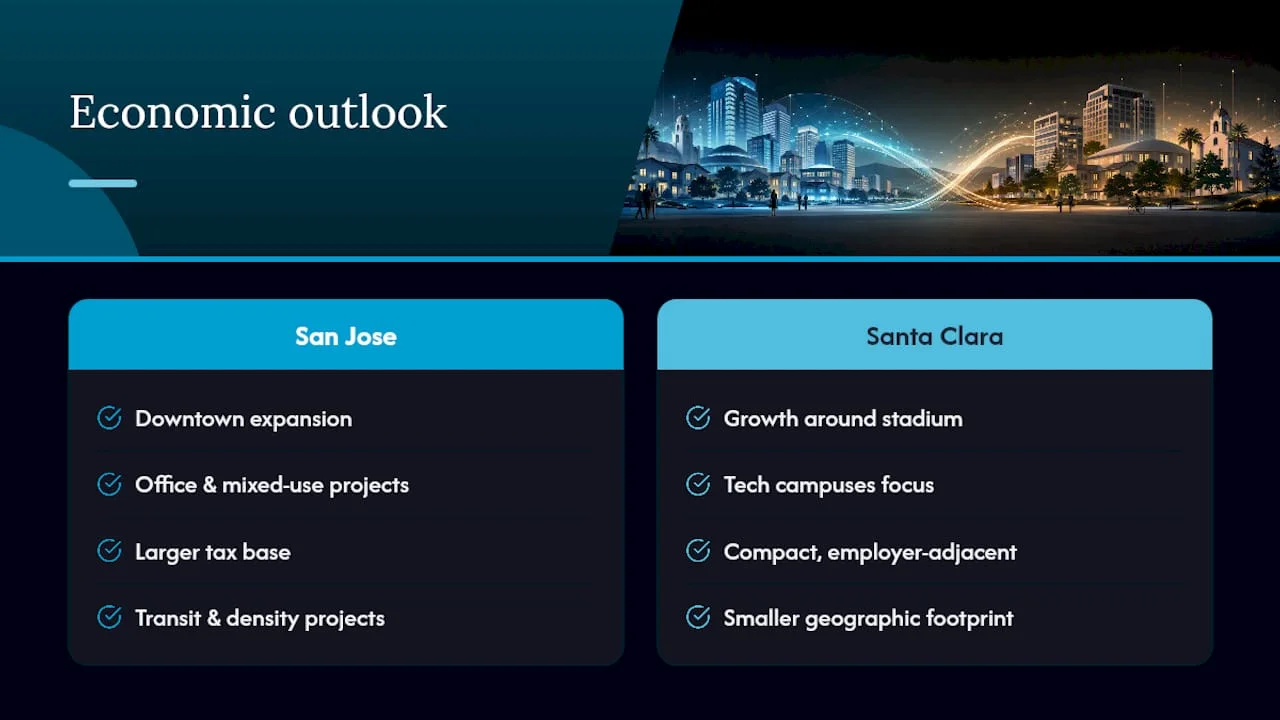
San Jose continues to expand its downtown core, with ongoing office and mixed-use development aimed at capturing more of the region’s tech workforce without pushing everyone into car commutes. The city’s larger tax base supports broader infrastructure projects, from transit expansion to housing density initiatives near job centers.
Santa Clara’s growth strategy looks different. Much of its development activity clusters around the stadium district and existing tech campuses, reinforcing the city’s identity as a compact, employer-adjacent suburb rather than a sprawling urban center. Both cities benefit from Silicon Valley’s overall economic gravity, but Santa Clara’s smaller geographic footprint limits how much new housing it can realistically add compared to San Jose’s broader development pipeline.
For buyers watching long-term value, San Jose’s ongoing downtown investment could support appreciation in currently undervalued neighborhoods. Santa Clara’s more constrained development pipeline tends to keep its existing inventory in high demand, reinforcing the price premium buyers already pay to get in.
Tax Rates and Municipal Fees: What Homeowners Actually Pay
Property tax rates across Santa Clara County follow the same statewide framework, with California’s Proposition 13 capping the base rate near 1% of assessed value, plus local voter-approved bonds and assessments that vary by city and school district. San Jose and Santa Clara both add municipal bond measures on top of that base rate, so your actual bill depends on which specific parcel and district you’re buying into, not just which city.
Where the cities diverge more visibly is in local fees: business licenses, utility rates, and permit costs. Santa Clara operates its own municipal electric utility, Silicon Valley Power, which can mean different utility cost structures than San Jose residents see through PG&E. Buyers should always confirm the specific assessed parcel’s tax rate and bond obligations before closing, since two homes a few blocks apart can carry different effective rates.
Weather and Climate: A Subtle but Real Difference
Both cities share the Mediterranean climate that defines the South Bay: dry summers, mild wet winters, and minimal humidity year-round. Temperature differences between San Jose and Santa Clara are small, generally a degree or two, since they sit in the same valley floor.
Santa Clara’s slightly more inland position can produce marginally warmer summer afternoons, while San Jose’s larger footprint means some neighborhoods near the foothills run a few degrees cooler than others closer to the valley center. Neither city sees significant fog compared to San Francisco, making both attractive for buyers who want consistent sunshine without coastal chill.
Historical and Cultural Background of Each City
San Jose traces its roots to 1777 as California’s first civilian settlement, later growing into the agricultural heart of the Santa Clara Valley before the tech boom transformed it into Silicon Valley’s largest city. That long history shows up in neighborhoods like Downtown and Japantown, where layers of immigrant communities have shaped the food and cultural scene over generations.
Santa Clara’s history centers on Mission Santa Clara de Asís, founded in 1777, and the city grew alongside Santa Clara University, one of California’s oldest institutions of higher learning. That university presence still shapes the city’s character today, blending academic culture with the tech-employer identity that Levi’s Stadium and nearby campuses reinforce.
An Editorial Take on Choosing Between San Jose and Santa Clara
Most comparison guides treat this decision like a spreadsheet exercise, weighing median prices against square footage until a winner emerges. That approach misses what actually drives buyer regret: people underestimate how much a city’s pace matters until they’ve lived in it for a year. Santa Clara’s contained, event-driven rhythm suits people who want predictability. San Jose’s sprawl suits people who thrive on variety and don’t mind hunting for it.
The conventional advice to “buy where you can afford the nearby schools” also oversimplifies things. School information matters, but Santa Clara’s premium reflects scarcity as much as performance, and some San Jose neighborhoods offer comparable education at a real discount. Readers should prioritize their actual weekly routine, commute, errands, and weekend habits, before school information or headline price gaps. The city that fits your life on a random Tuesday will always matter more than the one that looks best on paper.
Sources
Recommended
- Santa Clara Real Estate Guide: Neighborhoods, Schools, Commute & Home Prices – Laxmi Penupothula
- Where to Live in Silicon Valley: A Guide to Fremont, Milpitas, San Jose & the East Bay – Laxmi Penupothula
- San Jose Real Estate Guide: Neighborhoods, Schools, Commute & Home Prices – Laxmi Penupothula
- Difference Between Mission San Jose and Weibel Neighborhoods Fremont – Laxmi Penupothula

Laxmi Penupothula
Top 1% Realtor SCCAOR, RealTrends Verified (2021–2025) • CA DRE #02047105
SCCAOR Top 1% Santa Clara County • Intero Chairman Circle 2023–2025 • \$650M+ Closed • 570+ Transactions
Silicon Valley & Bay Area Specialist — Cupertino, San Jose, Fremont, Milpitas, Sunnyvale & surrounding cities.
Get a Free Home Valuation →