


A California listing agreement is the written contract that gives a licensed broker the legal authority to market your home and find a buyer — and it is a binding obligation you sign with the brokerage, not just the individual agent. Under California Civil Code section 2079.13, a listing agreement authorizes the broker to sell the property or locate a buyer, and it takes several forms depending on how much exclusivity you grant.
Before you sign, check three clauses first:
- Term and expiration date. The listing must state a definite end date. Per DRE guidance on required contract provisions, a well-drafted listing expires at 11:59 PM on a specified day. Vague or open-ended terms create enforceability risk.
- Compensation clause. Confirm the commission rate or flat fee, who pays it, and whether a broker protection period survives expiration. This clause can create financial obligations even after you cancel.
- MLS/marketing authorization. Verify whether the agreement requires MLS submission or gives you the option to opt out using the SEL form (Seller Instruction to Exclude Listing From the MLS).
Once signed, make a dated copy for your records, confirm whether the brokerage has a manager-approval window (typically five days), and request a countersigned copy after that window closes.
Pro Tip: Request the exact C.A.R. form name and revision date before the appointment. If the agent hands you a form labeled “RLA, Revised 12/18,” you can review a clean copy in advance and arrive with specific questions rather than reading it cold at the kitchen table.
Key Takeaways
A California listing agreement is a binding contract with the brokerage that governs your entire sale — the term, compensation, MLS access, and cancellation rights all live in that document, and every clause is worth reviewing before you sign.
| Point | Details |
|---|---|
| Contract is with the brokerage | The listing binds you to the brokerage, not the individual agent; disputes go to the managing broker first. |
| Check three clauses first | Verify the exact expiration date (11:59 PM), the compensation and protection period, and the MLS authorization before signing. |
| Management approval matters | The C.A.R. RLA typically includes a five-day broker approval window; request a countersigned copy after it closes. |
| Cancellation requires broker sign-off | Use C.A.R. Form COL to cancel; the broker or authorized manager must sign — an agent signature alone is not sufficient. |
| Laxmitoprealtor offers free review | Laxmi Penupothula provides a no-obligation listing consultation and CMA for Santa Clara County sellers at laxmitoprealtor.com/sell. |
Table of Contents
- What a California listing agreement actually does
- Types of listing agreements you will encounter in California
- Key clauses to verify before you sign
- Required disclosures and the C.A.R. forms you will see
- How long listings last and how to cancel one in California
- How compensation works and what you can negotiate
- Questions to ask your broker before signing
- Typical timeline from signing to closing escrow
- Where to find official California listing forms
- How Laxmi Penupothula helps sellers review and negotiate listing agreements
- What most sellers get wrong about listing agreements
- Ready to review your listing agreement with a specialist?
- Sources
What a California listing agreement actually does
The listing agreement gives the broker authority to market your property, submit it to the Multiple Listing Service, place signage, cooperate with other brokers, and accept deposits on your behalf. It is a bilateral contract: you grant the broker the right to work, and the broker commits to perform specific services in exchange for the possibility of earning compensation.
What the broker typically cannot do under a standard listing: sign sale documents on your behalf, accept an offer without your written approval, or modify the listing price without your written instruction. The C.A.R. Form RLA spells out these boundaries in its authorization and compensation sections.
A listing agreement is a contract with the brokerage as a whole — not solely with the individual agent who shows up at your door. If a dispute arises with that agent, your first step is to raise it with the managing broker or office manager, which often resolves the issue without triggering a formal cancellation and its associated costs.
When a listing is missing required elements — a definite term, an accurate property description, or proper signatures from all owners — it may be unenforceable. Pause and seek clarification from the broker or a real estate attorney before proceeding if any of those elements are absent.
Types of listing agreements you will encounter in California
California Business & Professions Code section 10018.14 recognizes three primary listing types, and understanding which one you are signing determines your commission exposure and marketing flexibility.
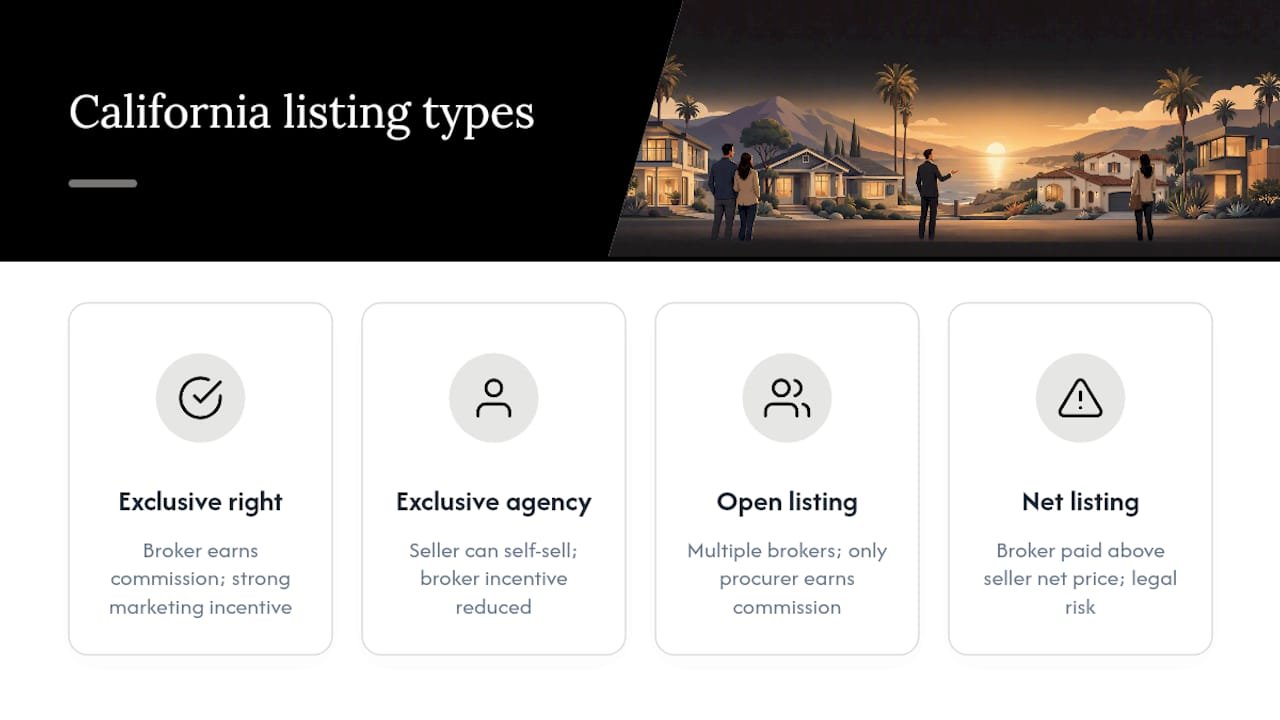
Exclusive right to sell (C.A.R. Form RLA) is the standard for California residential transactions. The broker earns the commission regardless of who finds the buyer — including you. This gives the broker the strongest incentive to invest in marketing, and it is what most sellers sign.
Exclusive agency grants the broker the right to represent you, but you retain the right to sell the property yourself without owing a commission. The broker’s marketing effort may be more limited because their compensation is not guaranteed.
Open listing allows you to engage multiple brokers simultaneously; only the broker who produces the buyer earns the commission. Open listings rarely appear in residential MLS-driven markets because brokers have little incentive to invest resources without exclusivity.
Seller-reserved or net listings are rare and carry legal risk in California. A net listing pays the broker everything above a seller-specified net price, which creates a conflict of interest that the DRE scrutinizes closely.
Pro Tip: The listing type directly affects your negotiating position. An exclusive right-to-sell agreement gives the broker MLS access and full cooperating-broker cooperation, which typically produces more buyer exposure. If you are considering an exclusive agency arrangement to preserve a private sale option, get the exact terms of your self-sale rights written into the agreement before signing.
Key clauses to verify before you sign
A clause-level review of your home listing agreement takes about 20 minutes and can prevent months of disputes. Work through these in order:
- Term and end date. Confirm the exact calendar date and that it ends at 11:59 PM. Watch for automatic extension language that rolls the listing forward without a new signature.
- Listing price and seller authority. The agreement should confirm that you — not the broker — set the price and retain the right to accept or reject any offer.
- Compensation clause. Note the rate or flat fee, who pays (typically the seller through escrow), and whether the broker can assign that compensation to a third party. Understand the broker protection period: this clause can require you to pay a commission to the listing broker even after the listing expires, if a buyer the broker introduced during the listing term later closes a deal with you directly.
- MLS authorization. Standard language requires MLS submission within a set number of days. If you want to delay or exclude the listing, request the SEL form in writing before signing.
- Authority to accept deposits. Confirm how earnest money is handled and where it is held (typically in the broker’s trust account or escrow).
- Management approval clause. The C.A.R. RLA commonly includes a five-day window during which a broker or manager must approve the listing before it becomes final. Request a signed copy after that window closes.
- Amendment language. Changes to the listing must be made in writing using C.A.R. Form MT (Modification of Terms Authorization) or a signed addendum. Verbal agreements to modify terms are not enforceable.
- Signature blocks. All owners of record must sign. If the property is held in a trust or LLC, the authorized signatory must sign in their representative capacity and provide documentation of that authority.
Pro Tip: Use the seller net proceeds calculator to model how the commission rate and closing costs in your listing agreement affect your actual take-home amount before you agree to terms.
The management-approval window is one of the most overlooked clauses. Until the broker or manager countersigns within the management-approval period, the listing is not fully executed — which means your property may not be in the MLS yet, and you may not have a binding agreement.
Required disclosures and the C.A.R. forms you will see
California law requires the broker to present you with a Disclosure Regarding Real Estate Relationships (C.A.R. Form AD) at or before the time you sign the listing. This form explains agency relationships — who the broker represents, what dual agency means, and what your rights are. Signing it does not mean you consent to dual agency; it means you received the disclosure.
The DRE’s reference on contract provisions and disclosures identifies the standard C.A.R. forms used in California residential transactions. Here is what each one does:
| C.A.R. Form | Full Name | When You See It |
|---|---|---|
| RLA | Residential Listing Agreement (Exclusive) | At listing appointment — the primary contract |
| ESP | Estimated Sellers Proceeds | At listing; updated before close |
| AD | Disclosure Regarding Real Estate Relationships | At or before signing the listing |
| MT | Modification of Terms Authorization | Any time a term needs to change |
| SEL | Seller Instruction to Exclude Listing From MLS | If you want to delay or waive MLS submission |
| COL | Cancellation of Listing | If you and the broker agree to terminate early |
| RPA-CA | Residential Purchase Agreement and Joint Escrow Instructions | When a buyer submits an offer |
| NBP | Notice to Buyer to Perform | During escrow if a buyer misses a deadline |
The RPA-CA is the purchase contract that follows your listing once a buyer is found. Reviewing its contingency and closing timeline language before you receive offers helps you respond quickly and confidently.
One caution: agents should not rewrite standard form language. Modifications belong in an MT form or a signed addendum. Substantial rewrites of pre-printed C.A.R. language can create unauthorized-practice-of-law exposure for the agent and ambiguity for you.
How long listings last and how to cancel one in California
A listing must state a definite term. Most residential listings in California run 30–90 days, though Bay Area sellers in competitive markets often start with 30–45 days and extend if needed. The listing expires at 11:59 PM on the stated end date unless both parties agree in writing to extend it using the MT form.
The five-day management-approval window means the clock on your listing’s term does not truly start until the broker or manager countersigns. Confirm that date explicitly.
To cancel a listing early, both you and the broker must agree. The standard vehicle is C.A.R. Form COL (Cancellation of Listing). Per guidance from LegalClarity on the COL form, the cancellation is not effective until the broker or an authorized manager signs it. An agent’s signature alone is not sufficient.
Practical steps to cancel cleanly:
- Request an itemized list of marketing expenses before agreeing to any reimbursement figure in the COL form.
- Insist that the broker or office manager (not just the listing agent) signs the COL.
- Deliver the signed COL by a method that creates a paper trail — email with read receipt or certified mail.
- Confirm in writing that the MLS status has been updated to “Canceled” or “Withdrawn.”
As noted by Broker Risk Management, cancellations commonly include release, reimbursement, confidentiality, and non-disparagement provisions. Read each one before signing. The protection period — the window after expiration during which the broker can still claim a commission on buyers they introduced — is often negotiable at cancellation.
Pro Tip: If you are canceling because of a dispute over services, document every communication before approaching the broker. A written record of unmet commitments strengthens your position when negotiating reimbursement or a shortened protection period.
If the broker disputes the cancellation or claims a commission you believe is unwarranted, consult a California real estate attorney before responding in writing.
How compensation works and what you can negotiate
Commission in a California listing agreement is almost always expressed as a percentage of the final sale price, though flat-fee arrangements exist. The seller typically pays the total commission through escrow at closing, and the listing broker then splits a portion with the cooperating broker (the buyer’s agent) per the MLS offer of compensation.

The C.A.R. RLA form includes an assignment-to-escrow provision, meaning the broker’s compensation is formally assigned to be paid through the closing statement rather than directly by you at the table.
Key negotiation points and red flags:
- Protection period length. Ask for the shortest period the broker will accept and request a written list of protected buyers at the time of expiration or cancellation.
- Marketing cost caps. If the agreement includes reimbursable marketing expenses, ask for a written cap and itemized receipts before agreeing to any amount.
- Cooperative compensation. Confirm what percentage the listing broker is offering to cooperating brokers in the MLS. A below-market offer can reduce buyer-agent interest in your property.
- Dual commission risk. Watch for language that could create an obligation to pay two commissions — for example, if you accept an offer from a buyer introduced by a different broker during the protection period while also owing the listing broker a fee.
- Ambiguous math. Any clause that calculates compensation as a percentage of something other than the final sale price (gross proceeds, list price, or an undefined “value”) deserves a direct question before you sign.
Understanding how seller closing costs in California interact with the commission clause helps you model your net proceeds accurately before committing to a rate.
Questions to ask your broker before signing
Arriving at the listing appointment with specific questions signals that you are an informed seller and often produces better contract terms. These are the questions worth asking:
- Who at the brokerage must sign to make this listing final, and when will I receive that countersigned copy?
- Which MLS will my property be submitted to, and within how many days of signing?
- What specific marketing services does the brokerage pay for, and which costs could be passed to me?
- If a cooperating broker brings the buyer, what percentage of the total commission goes to that broker?
- What is the protection period, and how will I receive the protected-buyer list at expiration?
- Under what circumstances can I cancel without owing a reimbursement fee?
- If I disagree with the listing agent, who is the managing broker I should contact?
If an agent cannot answer “Who signs the cancellation?” without hesitation, that is a signal worth noting. The answer should always be: the broker of record or an authorized manager — not the listing agent alone.
Red flags to watch for: an agent who avoids discussing the manager-approval clause, vague promises about marketing that are not written into the agreement or an addendum, and protection periods longer than 90 days without a documented buyer list to justify them.
Pro Tip: Ask the agent to write any verbal marketing commitment into a signed addendum before you leave the appointment. “We’ll do professional photography and a 3D tour” means nothing if it is not in the agreement.
Typical timeline from signing to closing escrow
Understanding the sequence of events helps you prepare disclosures, inspections, and staging in parallel rather than sequentially.
- Days 1–2 after signing: Listing goes live in the MLS (subject to the management-approval window closing first).
- Days 1–7: First showings begin; prepare the property for immediate access.
- Days 7–21: First offers typically arrive in active markets; timeline varies significantly by neighborhood and price point.
- Day of acceptance: Escrow opens; the RPA-CA governs from this point forward.
- Days 1–17 of escrow: Buyer inspection and investigation contingency period (standard RPA-CA window).
- Days 1–21 of escrow: Financing contingency period; appraisal typically ordered within the first week.
- Days 30–45: Typical close of escrow for a standard residential transaction in California.
Contingencies, appraisal gaps, and lender delays are the most common causes of timeline extension. Order your pre-sale inspection and complete your seller disclosures before the listing goes live — buyers who receive complete disclosure packages upfront tend to submit cleaner offers with fewer contingency extensions. The home staging and prep guide covers how to overlap staging and inspection scheduling to avoid unnecessary delays.
Where to find official California listing forms
Reliable sources for California listing forms, in order of preference:
- Your broker’s office or transaction platform. Most California brokerages use zipForm Plus or a comparable secure platform that distributes current C.A.R. forms directly to agents. These copies carry the correct revision date and unaltered standard language.
- California Association of REALTORS® (C.A.R.). C.A.R. members access standard forms through the C.A.R. forms library. If you want to review a form before your appointment, ask your agent to send you the specific form name and revision date.
- California Department of Real Estate (DRE). The DRE publishes reference materials and guidance documents at dre.ca.gov that explain required contract provisions and disclosure obligations, though the DRE does not distribute fillable transaction forms directly to consumers.
- Third-party template services host downloadable California listing agreement PDFs, but as noted by Esign, these copies may not reflect the most current C.A.R. revisions or may have altered standard language. Use them for reference only, not for execution.
Pro Tip: Before your listing appointment, ask the agent for the exact form names you will sign: RLA, ESP, AD, and SEL if applicable. Request the revision date on each. If the agent cannot tell you the revision date, that is a reasonable follow-up question for the managing broker.
How Laxmi Penupothula helps sellers review and negotiate listing agreements
Laxmi Penupothula is a licensed REALTOR® with Intero Real Estate Services, ranked in the Top 1% of real estate agents in the United States by RealTrends Verified for five consecutive years (2021–2025) and a recipient of the SCCAOR REAL Award — Top 1% of Santa Clara County REALTORS® by sales volume — every year from 2021 through 2025. With more than $650 million in closed sales across 570+ transactions, she brings a level of contract familiarity that most sellers encounter only once or twice in a lifetime.
For sellers reviewing a California listing agreement, Laxmi provides:
- Line-by-line contract review, with plain-English explanations of compensation, protection period, and management-approval clauses
- Negotiation of commission terms, marketing cost caps, and MLS authorization language
- Guidance on cancellation procedures and COL form execution when a listing relationship needs to change
- MLS management, including SEL form coordination for sellers who want to delay public marketing
- Protected-buyer list documentation at expiration to reduce post-listing commission disputes
Laxmi’s background as an IT consultant — managing complex, high-stakes projects with precision and accountability — translates directly into how she manages a listing from contract to close. Sellers in Cupertino, Sunnyvale, San Jose, Saratoga, Fremont, and Milpitas can request a free comparative market analysis and a no-pressure listing consultation at Laxmitoprealtor.
What most sellers get wrong about listing agreements
The most common mistake is treating the listing agreement as a formality rather than a negotiable contract. Sellers often focus entirely on the commission rate and overlook the protection period, the management-approval window, and the reimbursement clause — three provisions that can create real financial exposure after the listing ends.
A second overlooked reality: the listing is a contract with the brokerage, not with the agent. If the agent leaves the brokerage mid-listing, your agreement stays with the brokerage. That distinction matters when you want to cancel or transfer to a different agent within the same office.
The sellers who navigate listing agreements most effectively are the ones who ask for written confirmation of every verbal commitment, request the manager-countersigned copy within the approval window, and review the ESP form before accepting any offer. The seller net proceeds explained resource walks through exactly how those numbers connect to the compensation clause you signed at the start.
Ready to review your listing agreement with a specialist?
Signing a California listing agreement without a thorough review is one of the most avoidable risks in a home sale. Laxmitoprealtor offers sellers a free, no-obligation consultation to walk through the RLA, ESP, and AD forms, explain every clause in plain English, and help you negotiate terms that reflect your actual priorities.

Whether you are preparing to list in San Jose, Cupertino, Sunnyvale, or anywhere across Santa Clara County, the process starts with a free Comparative Market Analysis and a direct conversation about what the listing agreement should say before you sign it. Sellers who arrive informed close with fewer surprises and stronger results. Visit Laxmitoprealtor to request your free CMA and listing consultation, or browse the real estate FAQ for answers to the most common seller questions in the Bay Area.
Sources
When you need authoritative language beyond what an agent can provide, these are the primary sources:
- Civil Code section defining listing agreement (excerpt)
- Basic contract provisions and required contents guidance (DRE reference)
- Cancelling a Listing Agreement – Broker Risk Management
- California Business & Professions Code excerpt defining listing agreement types (FindLaw)
- Free California Real Estate Listing Agreement | PDF | Word
When to call a real estate attorney rather than relying on your agent: disputed commission claims after expiration, alleged breach of the listing agreement, questions about signature authority for trust- or entity-held property, and any situation where the broker asserts you owe compensation you believe is not owed. An agent can explain the forms; an attorney can advise you on enforceability.
This article provides general information about California listing agreements and is not a substitute for legal or professional real estate advice. Confirm current form versions and legal requirements with the California DRE, C.A.R., or a qualified real estate attorney.
Recommended
- Making a Competitive Offer in the Bay Area (Smart 2026)
- Out-of-State Investor’s Guide to Buying Bay Area Property
- Selling in California? Here’s How to Use School Ratings to Your Advantage – Laxmi Penupothula
- Seller Closing Costs in California: What They Are and What They Run – Laxmi Penupothula

Laxmi Penupothula
RealTrends Verified Top 1% REALTOR® Nationwide (2021–2025) • CA DRE #02047105
SCCAOR Top 1% Santa Clara County • Intero Chairman Circle 2023–2025 • \$650M+ Closed • 570+ Transactions
Silicon Valley & Bay Area Specialist — Cupertino, San Jose, Fremont, Milpitas, Sunnyvale & surrounding cities.
Get a Free Home Valuation →