


A comparative market analysis, or CMA, is an agent-prepared estimate of a home’s current market value, built by comparing it to similar homes that have recently sold nearby. It’s the tool sellers use to set a listing price and buyers use to gauge whether an offer makes sense. Three rules matter most: agents typically prepare CMAs (not appraisers), the strongest reports lean on three to five recently sold comps plus a couple of active or pending listings for context, and those comps should have closed within the last 30 to 90 days. What follows is the step-by-step method, a worked example with real numbers, and a Bay Area case study you can learn from.
- A CMA is not an appraisal, and it carries no legal weight with a lender.
- Expect 3–5 sold comps and 2–3 active or pending listings in a solid report.
- Recency matters: comps older than 90 days lose reliability fast in a moving market.
Key Takeaways
A comparative market analysis works because it translates recent, comparable sales into a defensible price range instead of a guess.
| Point | Details |
|---|---|
| CMA defines strategy, not law | It sets listing and offer prices but carries no lending weight, unlike a licensed appraisal. |
| Comp count and recency rule | Aim for 3–5 sold comps and 2–3 active/pending listings, ideally sold within 30–90 days. |
| Adjustments make or break accuracy | Dollar adjustments for size, beds, baths, and features turn raw sale prices into a fair comparison. |
| Quality beats quantity in comps | Three tightly matched comps outperform seven loosely related ones for reliability. |
| Local expertise sharpens the range | Laxmitoprealtor builds CMAs from live Santa Clara County data and offers one free with full seller services. |
Table of Contents
- What Is a Comparative Market Analysis, and When Do You Need One?
- What Goes Into a Solid CMA Report
- How Agents Actually Build a CMA, Step by Step
- Choosing Comps That Actually Hold Up
- CMA vs. Appraisal vs. Automated Valuation Models
- How Accurate Is a CMA, and What Goes Wrong
- Can You Build Your Own CMA?
- A Worked Example: Reading the Numbers
- A Bay Area Case Study: Precision Pricing in Action
- Turning CMA Numbers Into a Pricing or Offer Strategy
- Perspective: What Most CMA Advice Gets Wrong
- Ready to Put a CMA to Work for Your Home?
- Frequently Asked Questions
- Sources
What Is a Comparative Market Analysis, and When Do You Need One?
A comparative market analysis estimates what a property is worth right now by lining it up against similar homes that recently sold in the same area. Real estate agents prepare CMAs, drawing on MLS access that public listing sites don’t offer. Sellers, buyers, and sometimes brokers handling estate or divorce situations all rely on the same underlying method.
The practical use cases stack up quickly:
- Setting a listing price before a home goes on the market.
- Building an offer strategy as a buyer, so you know if a list price is inflated or fair.
- Prepping a home for sale by identifying which upgrades comps show pay off.
- Contesting a property tax assessment with recent sale evidence.
- Running a sanity check before a refinance application.
A CMA is a strategic pricing tool, not a formal valuation, and most agents include it free as part of listing or buyer representation. If you pay for one independently, expect $200 to $400.
What Goes Into a Solid CMA Report
A CMA that’s worth trusting includes a specific set of components, not just a list of nearby sale prices. The subject property overview comes first: address, square footage, bed and bath counts, year built, and any notable upgrades or condition issues.
From there, a complete CMA report layers in:
- Recently sold comps, ideally three to five, weighted toward the most similar and most recent.
- Active and pending listings for context on where current competition is priced.
- Expired listings, which reveal what the market has already rejected at a given price point.
- Dollar adjustments for differences in size, bedrooms, bathrooms, and standout features.
- A market trends summary showing whether prices are climbing, flattening, or softening.
- A price recommendation presented as a range, not a single number.
- Visual elements: a map showing comp locations and a side-by-side comparison table.
Sold comps should generally fall within 30 to 90 days of the analysis date. In slower markets, agents widen that window and say so explicitly in the report.
How Agents Actually Build a CMA, Step by Step
The math behind a CMA is straightforward once you see it laid out. Here’s the sequence a competent agent follows.
- Gather subject-property facts. Pull square footage, lot size, bed/bath count, year built, and recent upgrades from county records and the seller’s own documentation. Cross-reference against MLS history if the home has sold before.
- Find candidate comps. Start with closed sales in the immediate neighborhood, then layer in active and pending listings for current-market context. Proximity and recency both matter; a comp four blocks away and 20 days old beats one a mile away and 100 days old.
- Make dollar adjustments. If the subject property has a pool and a comp doesn’t, add value to that comp before comparing. If a comp has an extra bedroom the subject lacks, subtract accordingly. In many Bay Area markets, agents adjust roughly $10,000 to $25,000 per bedroom and $15,000 to $30,000 for a finished basement or bonus room, depending on the submarket. Once adjusted, dividing each comp’s adjusted price by its square footage gives you a comparable price-per-square-foot figure across properties of different sizes.
- Reconcile into a range. Average the adjusted comps, then weight the most recent and most similar ones more heavily. Agents present a range instead of a single figure because no two comps are identical, and a range gives the seller room to negotiate without appearing over- or under-priced.
Pro Tip: Call the listing agent on your top comp directly. MLS data won’t tell you if the sale included a rent-back, seller concessions, or a rushed closing, and any of those can quietly skew the number you’re relying on.
When a market is heating up fast, agents weight the most recent sales more heavily and may discount a comp from even six weeks ago as stale.
Choosing Comps That Actually Hold Up
Not every nearby sale qualifies as a usable comp. The filters that separate a reliable comp from a misleading one come down to four things: location, size, age, and condition. A home in the same school district, within a comparable square footage range (typically within 10 to 15%), built in a similar era, and in similar condition will produce a far more honest comparison than a home that merely shares a zip code.
- Prefer sold comps within the last 30 to 90 days in active markets; expand the window in slow or rural areas and note why.
- Favor proximity, but recency wins if you have to choose between a close-but-stale sale and a farther-but-fresh one.
- Three strong, well-matched comps beat five loosely related ones. Quality over volume, every time.
- If the subject property is unique (a custom build, an oversized lot, a rare floor plan), expand the search radius or timeframe and document the reasoning in the report itself.
CMA vs. Appraisal vs. Automated Valuation Models
These three tools answer different questions, and mixing them up leads to real pricing mistakes.
- CMA: Prepared by a real estate agent, used for pricing strategy, carries no legal or lending weight, and typically costs nothing when bundled into representation.
- Appraisal: Performed by a licensed appraiser following formal standards such as USPAP, required by lenders for mortgage underwriting, and treated as an authoritative valuation in that transaction.
- AVM (automated valuation model): Software-generated estimate pulled from public records and algorithms, fast and free, but blind to local nuance like a busy street or a recent kitchen remodel.
A lender will never accept a CMA in place of an appraisal because a CMA is an informal estimate, not a licensed, standards-based valuation. Many agents run an AVM as a rough starting point, then refine it heavily with a hands-on CMA before presenting a number to a client.
How Accurate Is a CMA, and What Goes Wrong
A well-built CMA gets you close to market value, but it’s still an estimate shaped by human judgment, and that means errors creep in. The most common ones: poorly chosen comps that don’t actually match the subject property, hidden defects a comp’s sale price didn’t account for, incomplete data on sale terms (concessions, rent-backs, distressed sales), volatile market swings between comp sale dates and today, and sellers overvaluing cosmetic upgrades that buyers don’t pay a premium for.
- Use multiple comps rather than anchoring to one favorite sale.
- Prioritize the most recent closed sales over older ones, even if the older one seems like a “better” match.
- Verify sale terms through MLS remarks or a direct call, not just the closing price.
- Document every adjustment so the logic can be checked later.
Pull both reports and compare which sales each one relied on.*
That’s also why credible agents present a range and flag caveats, rather than a single confident number.
Can You Build Your Own CMA?
Yes, to a point. A DIY CMA works well as a preliminary check before you talk to an agent.
- Collect subject-property facts: square footage, beds, baths, year built, condition.
- Find three to five sold comps using county records and public listing portals.
- Note two to three active or pending listings nearby for current context.
- Compute price per square foot for each comp and adjust for major differences.
- Reconcile the adjusted figures into a realistic price range.
For tools, county assessor websites and public listing portals cover the basics; a simple spreadsheet template handles the adjustment math fine. Some third-party CMA software packages exist for agents and serious investors, but they generally require an MLS login to unlock their full value.
- Public data often lacks sale-term details, like concessions or rent-backs, that MLS data reveals.
- MLS-only data captures listing history and expired listings that public sites frequently omit.
- A professional CMA earns its keep in a competitive or unusual market where subtle comp differences swing the number by tens of thousands of dollars.
A Worked Example: Reading the Numbers
Say your subject property is a 1,800 square foot, three-bedroom, two-bath home built in 1985.

Averaging the adjusted price-per-square-foot lands around $542, which applied to the subject’s 1,800 square feet suggests roughly $975,000. The final recommended range might run $960,000 to $990,000 rather than landing exactly on that average, because Comp B’s sale happened 85 days ago in a market that’s since cooled slightly, pulling the reconciled number toward the lower end.
A Bay Area Case Study: Precision Pricing in Action
A CMA-driven pricing strategy played out clearly in a recent Fremont 94539 listing, where a rigorous comp analysis identified a pricing window that generated intense buyer competition rather than a single flat offer. The result: the home closed $250,000 over its asking price.
- The CMA revealed that recent sold comps had significantly outpaced the previous quarter’s listings, signaling room to price assertively.
- That data informed a marketing and staging plan built to match buyer expectations set by the comps themselves.
- A similar approach drove a $100,000-over-asking result in Almaden, reinforcing that comp-driven pricing outperforms guesswork even in a challenging market.
The gap between a good outcome and a record-breaking one almost always traces back to how the comps were read, not how the home was marketed.
With 570+ closed transactions and more than $650 million in career sales volume, Laxmi Penupothula has built pricing strategies around exactly this kind of comp analysis across Santa Clara County.
Turning CMA Numbers Into a Pricing or Offer Strategy
The CMA is only useful once you act on it. Here’s how sellers and buyers each put it to work.
- Sellers deciding on strategy: If the CMA shows tight inventory and multiple recent comps selling above list, price to generate competing offers rather than pricing for your ideal net number upfront.
- Sellers weighing timing: If comps show slowing days-on-market, price closer to the middle of the range and consider staging investments the CMA suggests buyers are rewarding.
- Buyers checking a listing: Compare the list price against your own read of recent closed sales. If it sits well above the top comp with no clear justification, that’s your opening for a lower offer.
- Buyers building an offer: Use pending sales as a signal for where the market is heading, not just where it’s been.
- Bring the CMA itself as evidence in negotiations, comp addresses included.
- Push for repair credits when a defect surfaces in inspection; reserve price renegotiation for cases where the CMA itself was clearly off.
- If a lender’s appraisal comes in below your CMA and agreed price, you’ll need to renegotiate, cover the gap in cash, or challenge the appraisal with your own comp evidence.
Sellers working through pricing decisions can find deeper local guidance in this pricing strategy breakdown.
Perspective: What Most CMA Advice Gets Wrong
Most guides treat a CMA like a formula: pull comps, average them, done. That’s backwards. The real skill is knowing which comps to throw out, and most sellers (and plenty of newer agents) don’t do that well enough. A comp with a rushed rent-back closing or an unusual concession will quietly drag your number in the wrong direction if nobody calls the listing agent to check.
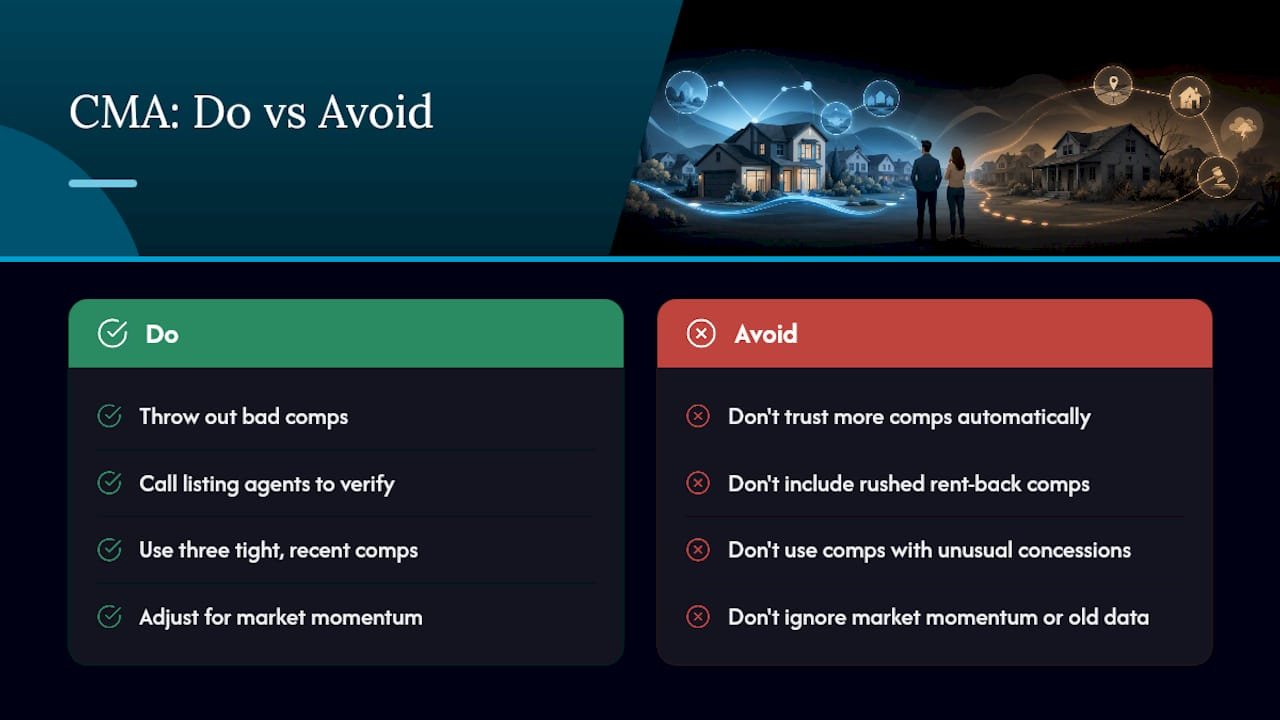
The other overrated idea is that more comps automatically mean more accuracy. Three tightly matched, recently closed comps beat seven loosely related ones almost every time. Volume creates a false sense of rigor while diluting the signal from the sales that actually matter.
What actually moves outcomes is reading market momentum correctly. A CMA built on data from two months ago in a market that’s accelerating will underprice a home. One built during a cooling phase without adjusting for it will overprice it and stall the listing. The number on the page matters less than whether the person building it understood which direction the market was moving when they built it.
Ready to Put a CMA to Work for Your Home?
Laxmi Penupothula builds every CMA around live Santa Clara County data, not a generic algorithm pulled from a national database. That distinction matters in a market where a busy street, a school boundary, or a single recent sale can shift a home’s value by tens of thousands of dollars, something an automated estimate simply can’t weigh the way an agent who closed 570+ local transactions can.

If you’re preparing to list in Santa Clara County, Cupertino, Sunnyvale, San Jose, Saratoga, Fremont, or Milpitas, a professional CMA is the first concrete step. Laxmi provides one free as part of her full seller services, including pre-sale inspections, staging, and professional marketing. Request your free CMA and pricing consultation to see exactly where your home stands against current comps before you set a number.
Frequently Asked Questions
What is a CMA in real estate?
A CMA, or comparative market analysis, is an agent-prepared estimate of a home’s market value based on recently sold, comparable properties nearby.
How is a CMA different from an appraisal?
A CMA is an informal pricing tool agents use for strategy; an appraisal is a formal, licensed valuation lenders require for mortgage underwriting.
How many comps should a good CMA include?
Most solid reports use three to five recently sold comps plus two to three active or pending listings for market context.
Do real estate agents charge for a CMA?
Many agents provide a CMA free as part of listing or buyer representation; paid, standalone CMAs typically run $200 to $400.
How accurate is a CMA compared to an appraisal?
A well-built CMA usually lands close to appraised value, but accuracy depends heavily on comp selection, adjustment accuracy, and how current the sales data is.
Sources
- What Is a Comparative Market Analysis (CMA)? | Chase
- How to do a comparative market analysis (CMA) report | HousingWire
- What is a CMA in real estate? | Rocket Mortgage
Recommended
- Pricing Strategy & Days on Market: How to Price a Bay Area Home to Sell – Laxmi Penupothula
- How to Price Your Home in San Jose CA for Maximum Sale Price
- What Affects Your Home’s Value in the Bay Area (7 Factors That Move Your Number) – Laxmi Penupothula
- Mountain View Townhouse Sale Case Study | 2071 Plymouth St

Laxmi Penupothula
RealTrends Verified Top 1% REALTOR® Nationwide (2021–2025) • CA DRE #02047105
SCCAOR Top 1% Santa Clara County • Intero Chairman Circle 2023–2025 • \$650M+ Closed • 570+ Transactions
Silicon Valley & Bay Area Specialist — Cupertino, San Jose, Fremont, Milpitas, Sunnyvale & surrounding cities.
Get a Free Home Valuation →