


Yes, seller (owner) financing is legal in California, but it must be structured with the right documents, notices, and disclosures to hold up if the deal goes sideways. Three things determine whether a carryback sale is safe: lien position (first versus second), the exact notice timing for balloon payments on owner-occupied 1 to 4 unit homes, and the protection sellers get, and lose, under California’s purchase-money anti-deficiency rule, Civil Code §580b.
Seller financing still accounts for a small slice of California transactions, but interest has been climbing as mortgage rates squeeze buyers out of conventional lending. One report puts it at roughly 6% of the market, with an increase noted between 2023 and 2024.
- Lien position determines who gets paid first if the property is ever sold or foreclosed on.
- Balloon-payment notice timing is not optional for owner-occupied 1 to 4 unit dwellings, and missing it can cost a seller the right to collect.
- Civil Code §580b usually blocks a seller from chasing a personal deficiency judgment after foreclosure, so pricing and down payment have to account for that risk from day one.
Truth in Lending Act rules and California Department of Real Estate (DRE) guidance also shape who can structure these deals and how. The rest of this guide walks through both.
Key Takeaways
Seller financing works in California when the deed of trust is recorded, balloon notices meet statutory timing, and the down payment gives the seller a real equity cushion.
| Point | Details |
|---|---|
| Confirm it’s legal, but conditional | Owner financing is allowed statewide, but enforceability depends on proper documents and notice timing. |
| Lien position drives risk | First-position deeds of trust protect sellers far better than second-position carrybacks behind a bank loan. |
| Balloon notices are mandatory | Owner-occupied 1 to 4 unit homes require specific written notice before a balloon payment can be enforced. |
| Anti-deficiency limits seller recovery | Civil Code §580b usually blocks personal deficiency judgments, so price and terms should reflect that risk. |
| Get local representation | Laxmitoprealtor helps Santa Clara County sellers and buyers structure, negotiate, and close carryback deals safely. |
Primary Sources and Further Reading
- California Civil Code §580b explainer for statutory background on anti-deficiency protection.
- DRE reference materials for licensing thresholds and regulatory guidance.
- NAR’s seller financing resource page for practitioner-level mechanics and checklists.
- Owner financing legal structures for title insurance and protection strategies.
Table of Contents
- How Does Seller Financing Work in California?
- What California Laws Govern Seller Financing Agreements?
- What Are Typical Seller Financing Terms in California?
- What Risks Should Buyers and Sellers Watch For?
- How Do You Set Up a Seller-Financed Sale Step by Step?
- Do You Need a License to Offer Seller Financing?
- Why Local Real Estate Expertise Matters in a Carryback Sale
- What the Conventional Advice Gets Wrong About Seller Financing
- Ready to Structure a Seller-Financed Sale the Right Way?
- Frequently Asked Questions
- Sources
How Does Seller Financing Work in California?
At its simplest, owner financing means the seller acts as the bank. The buyer signs a promissory note promising to repay the seller over time, and that note is secured by a deed of trust recorded against the property, the same instrument a bank would use. Some California sellers instead use an installment land contract (also called a contract for deed), where the seller keeps legal title until the buyer pays off the balance. Land contracts are legal in California, but they carry more risk for buyers since title doesn’t transfer until the final payment, and lenders and title companies scrutinize them more closely.
Three structures show up most often. A full carryback means the seller finances the entire purchase price. A partial carryback has the seller take a second-position loan behind a bank’s first mortgage, common when a buyer needs to bridge a down payment gap. Less commonly, a buyer takes the property “subject to” an existing loan or negotiates an assumption, though most conventional loans include due-on-sale clauses that complicate this.
Seller financing tends to work best when the seller doesn’t need full cash at closing and wants to spread out capital gains through installment reporting, rather than take one large taxable hit in the year of sale.
Pro Tip: If you’re arranging financing for more than an occasional sale, or collecting a fee for putting deals together, you may need to look at MLO licensing requirements before you go further. That threshold gets covered in detail later in this guide.
What California Laws Govern Seller Financing Agreements?
A handful of statutes and required disclosures separate an enforceable carryback deal from a legal headache. Budget time and legal review for each of these before you sign anything.
- Civil Code §580b limits a seller’s ability to pursue a personal deficiency judgment against the buyer after foreclosure, when the deed of trust secures the original purchase price. This protects buyers, but it also means sellers should structure down payments and lien priority defensively.
- Civil Code §§2924i and 2966 govern balloon-payment notices on owner-occupied 1 to 4 unit dwellings. Sellers must deliver a specific written notice, with defined content and lead time, before a balloon payment comes due. Skip this step and you may lose your right to enforce the balloon.
- The C.A.R. Seller Financing Addendum & Disclosure (SFA) applies when an agent or broker arranges the credit, spelling out loan terms, disclosures, and each party’s obligations.
- TILA disclosure triggers, high-cost mortgage rules, and late-fee caps on owner-occupied property all come into play depending on how the loan is structured, and whether the seller counts as a covered “creditor” under federal rules.
- If the seller is a foreign person, FIRPTA withholding requirements apply regardless of financing structure, and the IRS Applicable Federal Rate (AFR) sets a floor for interest rates to avoid imputed-interest tax problems.
A promissory note by itself creates no lien. Without a properly recorded deed of trust, a seller has no security interest and no clean path to nonjudicial foreclosure if the buyer stops paying.
What Are Typical Seller Financing Terms in California?
Deal terms vary by neighborhood, property type, and how motivated each side is, but market data shows consistent patterns. Down payments commonly run 10% to 25%, with 20% being the level that gives sellers a real equity cushion. Interest rates tend to sit 1 to 3 percentage points above conventional mortgage rates, compensating the seller for the risk of acting as lender. Most deals run 3 to 10 years, often with a shorter amortization schedule ending in a balloon payment rather than a full 30-year payout, according to consumer-facing market guides.
| Loan Size | Typical Down Payment | Sample Rate Range | Common Term | Balloon Timing |
|---|---|---|---|---|
| — | 10-25% | 6.5%-8.5% | 5–7 years | End of term |
| — | 20-25% | 6.5%-8.5% | 5–10 years | End of term or year 5 |
| Over $1M | 20-25%+ | Negotiated, often 1-3% over conventional | 3–7 years | Often earlier, year 3-5 |
- A fully amortizing note eliminates balloon risk but means lower monthly payments to the seller for longer.
- A shorter-term balloon note gets the seller their cash sooner but shifts refinance risk onto the buyer.
Pro Tip: Sellers who insist on first-position liens and a meaningful down payment rarely regret it. That equity cushion is what protects you if the market softens before the note matures.
What Risks Should Buyers and Sellers Watch For?
The biggest risk for sellers is standing behind an existing mortgage. If a seller carries a second-position note behind a bank’s first loan and the buyer defaults, the bank forecloses first and the seller’s lien can get wiped out entirely, a scenario known as being “sold out junior.” Buyers face different exposure: title defects, undisclosed liens, or a seller who never properly recorded the deed of trust in the first place.
- Confirm lien position in writing before signing anything, and understand exactly where you sit if the property has other debt against it.
- Require a substantial down payment and record the deed of trust immediately, don’t wait until after move-in.
- Order title insurance and a full title search before closing to catch encumbrances neither party may know about.
- Consider a third-party loan servicer to handle payment collection, escrow impounds, and recordkeeping, which reduces disputes and keeps a clean paper trail.
- Watch for due-on-sale clauses on any senior loan still attached to the property, since triggering one can accelerate the entire balance.
Nonjudicial foreclosure in California typically takes several months from notice of default to sale, and legal costs add up quickly if the paperwork wasn’t done right the first time. Civil Code §580b limits a seller’s recovery options after foreclosure, which is exactly why lien position and down payment size matter so much upfront.
Pro Tip: Late payments happen. Build a defined grace period and a clear default remedy into the promissory note itself, rather than deciding informally after the fact when emotions are already high.

How Do You Set Up a Seller-Financed Sale Step by Step?
A seller-financed deal closes cleanly when the paperwork and timeline are locked down before escrow opens.
- Negotiate core terms: price, down payment, interest rate, amortization, and balloon timing.
- Order a title search and resolve any liens or encumbrances before drafting the purchase agreement.
- Draft the purchase agreement plus a seller financing addendum spelling out the loan terms.
- Prepare the promissory note and deed of trust, then record the deed of trust with the county.
- Open escrow, issue instructions, and secure title insurance for both parties.
- Set up a loan servicer if the seller wants payments handled by a third party.
- Complete post-closing tax reporting, including installment-sale treatment if applicable.
Escrow on a seller-financed deal typically runs similarly to a conventional sale, often 30 to 45 days, though recording and notice requirements can add time if balloon terms are involved. Budget for title and recording fees, attorney review, escrow charges, and servicer setup costs alongside the usual closing costs a California seller already expects to pay.
Do You Need a License to Offer Seller Financing?
Most one-off owner-financed sales don’t require any special lending license. DRE guidance draws the line at being “in the business” of lending, occasional private financing on your own home is treated differently than someone repeatedly arranging loans for compensation.
An MLO endorsement can become necessary once you cross that activity threshold, and TILA disclosure and ability-to-repay rules kick in more forcefully on owner-occupied 1 to 4 unit properties than on investment property. Watch for high-cost mortgage triggers, ECOA fair-lending obligations, and adjustable-rate disclosure requirements if the note’s terms shift over time.
If you’re arranging more than a handful of seller-financed loans a year, or getting paid to structure them for others, that activity likely needs review against DRE licensing thresholds before you go further.
Why Local Real Estate Expertise Matters in a Carryback Sale
Structuring a seller-financed deal correctly takes more than a template note downloaded online. Laxmi Penupothula has closed more than $650 million across 570-plus transactions in Santa Clara County and the greater South Bay, and ranks in RealTrends Verified’s Top 1% nationally for five consecutive years.
In a carryback transaction, an experienced agent prices the home to preserve the seller’s equity cushion, negotiates lien position, coordinates with escrow and title, and brings in qualified counsel and servicers before problems surface, not after. Laxmi’s team works with sellers and buyers throughout Santa Clara County on exactly these structures.
Always confirm current credentials and local transaction experience directly before hiring any agent or attorney for a seller-financed deal.
What the Conventional Advice Gets Wrong About Seller Financing
Most seller-financing guides treat the promissory note as the whole story. It isn’t. The note is a promise to pay; the deed of trust is what actually protects the seller if that promise breaks. Too many sellers focus on negotiating the interest rate and skip past lien position entirely, and that’s backward. A seller holding a well-secured first-position note at a modest rate is in a far stronger spot than one holding a high-rate second position behind an existing bank loan.
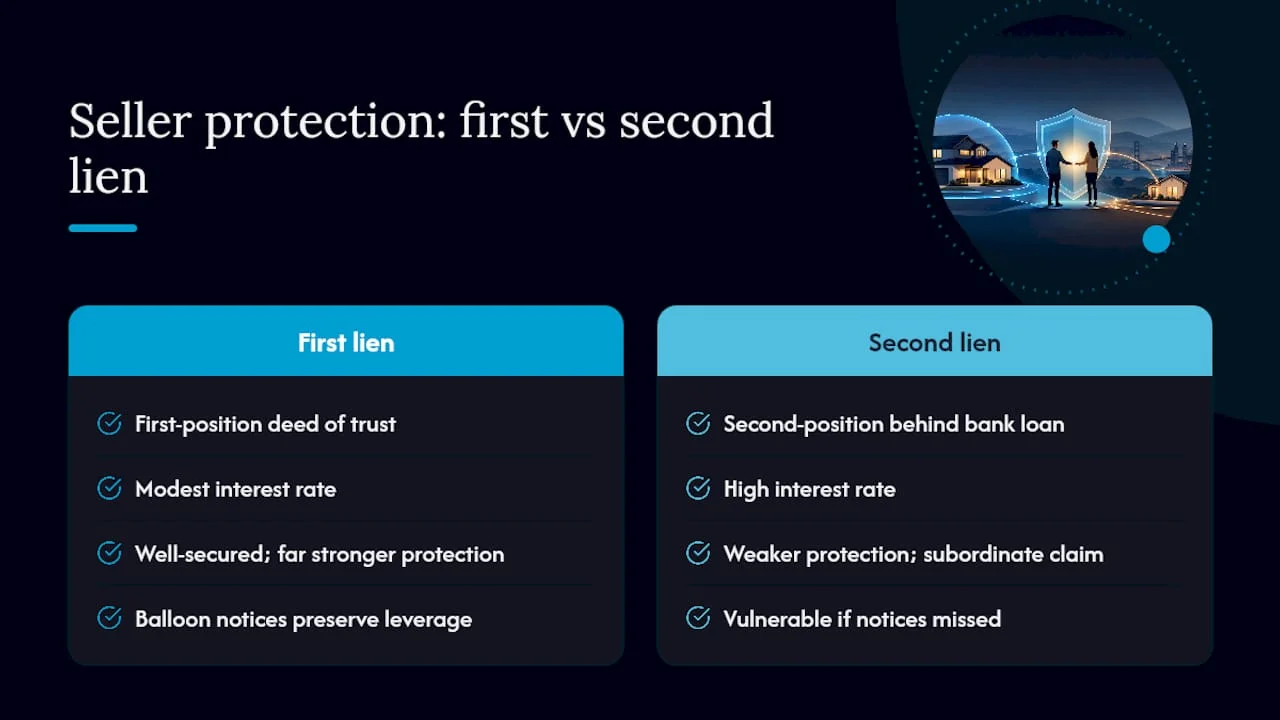
The other blind spot is timing. Balloon-payment notice rules under Civil Code §§2924i and 2966 aren’t a formality, they’re the difference between collecting what you’re owed and losing your leverage entirely. Calendar that notice window the day you sign, not the month before it’s due.
If you take one thing from this guide, let it be this: seller financing rewards preparation more than optimism. The buyers and sellers who do well with carryback deals are the ones who treat it like the regulated transaction it is, title search, recorded deed of trust, statutory notices, and qualified counsel, rather than a handshake with extra paperwork.
Ready to Structure a Seller-Financed Sale the Right Way?
Templates and generic checklists can’t tell you where your equity cushion actually needs to sit, or whether a buyer’s offer justifies the risk of a second-position lien. Laxmitoprealtor gives Santa Clara County sellers and buyers something a downloaded form can’t: local pricing judgment, negotiation experience across 570-plus closed transactions, and a network of escrow, title, and legal contacts who already understand how California carryback deals work.

If you’re considering seller financing on a listing, Laxmi can help you price the home to protect your position and structure terms that hold up. If you’re a buyer evaluating a seller-financed offer, buyer representation means someone reviewing the note and lien position before you sign anything. Start by requesting a free consultation through Laxmitoprealtor’s seller page to talk through your specific property and terms.
Frequently Asked Questions
Is seller financing legal in California?
Yes. Owner financing is legal statewide, but it requires a recorded deed of trust, proper disclosures, and compliance with balloon-payment notice rules to be fully enforceable.
What is the maximum interest rate a seller can charge in California?
California usury law generally caps non-exempt seller financing interest, though many carryback deals qualify for exemptions when a licensed broker arranges the loan. A real estate attorney should confirm which exemption applies before finalizing terms.
Does Truth in Lending Act (TILA) apply to seller financing?
It can, depending on how many properties the seller finances and whether the home is owner-occupied. High-volume sellers face more TILA scrutiny than someone financing the sale of their own primary residence.
What happens if a buyer defaults on a seller-financed loan?
The seller typically proceeds through nonjudicial foreclosure under the deed of trust, though Civil Code §580b usually limits the ability to pursue the buyer for any shortfall beyond the property itself.
Do I need title insurance for a seller-financed purchase?
Yes. Title insurance and a full title search protect both parties from undisclosed liens or ownership disputes that could surface after closing.
This article is general information, not a substitute for advice from a qualified financial advisor. Consult a qualified financial professional about your own circumstances before acting on anything here.
Sources
- The homebuying workaround more Californians are considering
- Seller Carryback Financing in California: What Buyers and Sellers Need to Know
- Seller Financing in a Real Estate Transaction – Real Estate Law Corporation™
- California Department of Real Estate reference materials (ref20.pdf)
- Seller Financing 101: How to Buy or Sell a Home Without a Bank
Recommended
- Buyer Closing Costs in California: Smart 2026 Guide
- Out-of-State Investor’s Guide to Buying Bay Area Property
- Making a Competitive Offer in the Bay Area (Smart 2026)
- Financing Investment Property: A 2026 Bay Area Guide

Laxmi Penupothula
Top 1% Realtor SCCAOR, RealTrends Verified (2021–2025) • CA DRE #02047105
SCCAOR Top 1% Santa Clara County • Intero Chairman Circle 2023–2025 • \$650M+ Closed • 570+ Transactions
Silicon Valley & Bay Area Specialist — Cupertino, San Jose, Fremont, Milpitas, Sunnyvale & surrounding cities.
Get a Free Home Valuation →