


Keep the appraisal contingency unless you fall into one of three narrow categories. Most buyers do best protecting themselves with this clause, and the exceptions are specific enough that you’ll know quickly whether you qualify.
Waiving makes sense if you’re paying all cash, if you can verify liquid reserves large enough to cover a realistic appraisal shortfall, or if you’re comfortable offering a capped partial waiver rather than an open-ended one. Outside those three scenarios, removing the contingency to win a bidding war usually trades a competitive edge for real financial exposure.
Here’s the detail that gets lost in the excitement of a multiple-offer situation: waiving the contingency doesn’t stop your lender from ordering an appraisal. The appraisal still happens. Your lender still underwrites to whichever number is lower, the appraised value or your contract price. All you’ve done is remove your right to walk away or renegotiate if that number comes in light, and that shift in risk is the entire decision.
- All-cash buyers with no financing contingency to protect
- Buyers with documented reserves covering a 5% to 8% appraisal gap
- Buyers offering a capped partial waiver with a defined dollar ceiling
Key Takeaways
Waiving the appraisal contingency shifts appraisal-gap risk entirely onto the buyer without eliminating the lender’s appraisal requirement or its underwriting rule.
| Point | Details |
|---|---|
| Default to keeping it | Most buyers should retain the appraisal contingency unless they fit a specific exception. |
| Know your exceptions | Cash buyers, buyers with verified reserves, and capped partial waivers are the defensible cases. |
| Waiver doesn’t stop the appraisal | Lenders still order it and still fund to the lower of appraised value or price. |
| Consider a capped alternative | A partial waiver with a dollar ceiling often wins offers without unlimited exposure. |
| Act before the deadline | Missing the contingency window can forfeit your right to cancel and recover earnest money. |
Table of Contents
- What Is an Appraisal Contingency and How Does It Protect You?
- Why Keeping the Appraisal Contingency Protects Most Buyers
- What Are the Real Risks of Waiving the Appraisal Contingency?
- When Does Waiving the Appraisal Contingency Actually Make Sense?
- Can You Limit Risk Without Fully Waiving Appraisal Protection?
- How Do You Formally Waive or Remove the Appraisal Contingency?
- What Happens to Your Earnest Money If the Appraisal Comes in Low?
- How an Experienced Agent Evaluates a Waiver Decision
- Where to Verify Forms, Lender Rules, and Escrow Law
- An Editorial Take on Waiving Appraisal Contingencies
- Frequently Asked Questions
- Sources
What Is an Appraisal Contingency and How Does It Protect You?
An appraisal contingency gives you the right to renegotiate the price or cancel the purchase agreement, with your earnest money returned, if a licensed appraiser values the home below your offer price. Your lender orders this appraisal independently of anything you or the seller wants, because the bank has its own exposure to manage.
The underwriting rule is simple and non-negotiable: lenders fund loans based on the lower of the appraised value or the purchase price, never the higher one. Offer $1.2 million on a house that appraises for $1.15 million, and your lender will only finance against $1.15 million. That $50,000 difference doesn’t disappear. Someone has to cover it, and without a contingency, that someone is you.
Most standard purchase contracts build in a defined window for this process:
- The appraisal contingency period typically runs 10 to 21 days after acceptance, depending on the form your state uses.
- The lender orders and schedules the appraisal, often within the first week of that window.
- If the value comes back low, you can renegotiate the price, ask the seller to cover the gap, cover it yourself, or cancel and recover your deposit.
- If you take no action before the deadline, the contingency typically expires and your leverage with it.
That deadline is the hinge point for everything else in this guide.
Why Keeping the Appraisal Contingency Protects Most Buyers
The contingency exists because a low appraisal is a cash problem disguised as a paperwork problem. Without it, a $75,000 gap between your offer and the appraised value becomes $75,000 you need in liquid cash within days, on top of your down payment and closing costs.
Here’s what the clause actually buys you:
- Protection from overpaying blind. An appraisal is an independent check on the price, not just a lender formality, and it catches situations where competitive bidding pushed a price past what the market will bear.
- A clean exit with your deposit intact. If you act inside the contingency window and the appraisal supports it, you’re generally entitled to a full refund of your earnest money rather than forfeiting it or fighting for it later.
- Real negotiating leverage. A low appraisal gives you standing to ask the seller to drop the price, split the gap, or make repairs, leverage you lose the moment you waive the clause.
This matters most for buyers putting down 10% or 20% and financing the rest. If you’re already stretching your reserves to close, a surprise five or six figure gap isn’t an inconvenience. It can be the difference between closing on time and losing the house entirely, which is precisely the situation the contingency was built to prevent.
What Are the Real Risks of Waiving the Appraisal Contingency?
Waiving the contingency doesn’t reduce your obligations to the lender. It just removes your escape hatch if the appraisal disagrees with your offer.
Once you sign a waiver, you’re on the hook for any gap between the appraised value and your purchase price, and your lender still won’t budge from underwriting to the lower figure. If you can’t produce that cash, you face two bad options: ask the seller to renegotiate from a position of zero leverage, or default and risk your earnest money entirely.
The math gets uncomfortable fast. A 5% to 8% appraisal gap on a $1.4 million offer is $70,000 to $112,000 in cash you need almost immediately, money that sits on top of your down payment, closing costs, and moving expenses. On a high-value home, a similar appraisal gap can mean tens of thousands in extra cash required.
Buyers who waived contingencies outright became common practice in the 2021 to 2022 seller’s market, when bidding wars pushed offers well past comparable sales. Plenty of those buyers never faced a gap. Plenty of others discovered, mid escrow, that “waived” meant “personally responsible” the hard way.
Pro Tip: *Before you waive anything, run the worst-case number yourself.
When Does Waiving the Appraisal Contingency Actually Make Sense?
Three buyer profiles can waive with genuine confidence rather than hope. Everyone else should think twice.
- All-cash buyers. If there’s no loan in the transaction, there’s no lender underwriting to a low appraisal, so the entire mechanism that makes waiving risky simply doesn’t apply.
- Buyers with verified, liquid reserves. If you can document funds beyond your down payment and closing costs sufficient to cover a realistic gap (again, plan on 5% to 8% of the price), you’re not gambling, you’re self-insuring a known risk.
- Buyers in genuinely competitive, low-inventory markets. In neighborhoods across Santa Clara County where multiple qualified offers are the norm rather than the exception, removing contingencies can materially change which offer gets accepted. But that only makes strategic sense paired with the reserves to back it up.
Investors buying with shorter timelines and flexible exit strategies sometimes waive more freely, since a below-appraisal purchase that still cash flows or fits a renovation plan isn’t the same risk as a primary residence stretch buy. If you’re weighing this decision as part of a broader offer strategy, our guide to making a competitive offer in the Bay Area walks through how contingencies fit into the bigger picture of what actually wins a multiple-offer situation.
Can You Limit Risk Without Fully Waiving Appraisal Protection?
Yes, and this is where most experienced agents actually spend their negotiating energy. A full waiver and a full contingency aren’t the only two options on the table.
- Write a partial appraisal-gap cap. Language along these lines is common: the buyer agrees to contribute up to a fixed dollar amount toward any appraisal shortfall, and may terminate the agreement if the gap exceeds that cap. This kind of partial waiver is frequently accepted by sellers because it signals seriousness without exposing the buyer to unlimited downside.
- Set the cap using real math, not a round number. Base it on 5% to 8% of the offer price rather than picking $10,000 because it sounds reasonable, then confirm you actually have that amount liquid and available before you offer it.
- Document proof of funds up front. A lender pre-underwrite letter or a bank statement packet handed to the listing agent alongside your offer often does more to reassure a seller than an unconditional waiver does, since it demonstrates real capacity rather than a promise.
- Pair a capped waiver with an escalation clause. If you’re escalating price to beat competing offers, tie your appraisal-gap cap to the same ceiling so you never end up contractually obligated to cover more than you priced for.
Our breakdown of appraisal gap coverage strategies covers sample contract wording in more depth if you’re drafting an offer this week.
Pro Tip: Ask your lender for a pre-underwrite, not just a pre-approval, before you cap a gap. A pre-underwrite reviews your actual financials against the specific loan amount, so the number you commit to covering is grounded in what you can truly close with.
How Do You Formally Waive or Remove the Appraisal Contingency?
Removing the contingency requires a specific document, not a verbal agreement or a casual line in an email to your agent.
- Sign the contingency removal form or addendum your state’s standard contract requires. In California, this is typically a Contingency Removal form attached to the residential purchase agreement, and it must be signed by the buyer (not the agent) to take effect.
- Deliver it in writing to escrow and the seller’s agent before the contingency deadline. Verbal waivers or informal texts don’t hold up if a dispute arises later, so get it in the file.
- Confirm what removal does not change. The appraisal still occurs. Your lender still underwrites to the appraised value. You’ve only given up your right to cancel or renegotiate based on that outcome.
Missing the written deadline can leave your status ambiguous, exactly the situation that produces earnest money disputes later. If you’re unsure which form your transaction requires, ask your agent or escrow officer before the window closes.
What Happens to Your Earnest Money If the Appraisal Comes in Low?
Timing decides almost everything here. Miss your contingency deadline and your leverage to cancel cleanly often evaporates with it.
- If you cancel inside an active appraisal contingency period, you’re typically entitled to your full deposit back.
- If you’ve already waived the contingency and then try to back out over a low appraisal, the seller may have grounds to contest your deposit.
- Escrow holders are neutral parties. When both sides disagree about who’s entitled to the funds, California law allows the escrow holder to interplead the disputed deposit to the court rather than release it to either party unilaterally.
If an appraisal comes back low, notify your agent and escrow officer immediately, in writing, before your deadline passes. Documented, timely communication is often what separates a clean refund from a drawn-out dispute.
For a fuller walkthrough of how these deadlines interact with the broader closing process, see our guide to the California escrow timeline.
How an Experienced Agent Evaluates a Waiver Decision
Before recommending any waiver, a seasoned buyer’s agent checks five things: how recent the comparable sales actually are, how many days the property sat on market, whether the buyer’s reserves genuinely cover a realistic gap, whether the lender has pre-underwritten the file, and exactly when the contingency deadline falls.
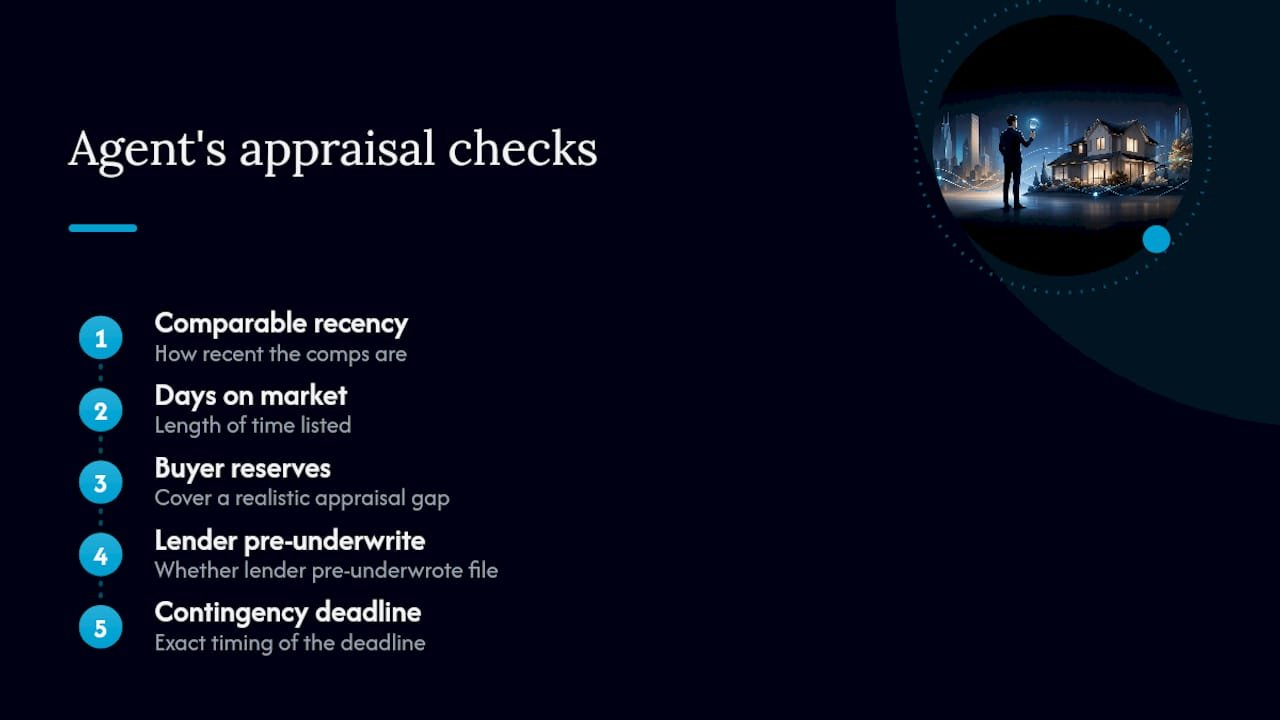
One recent South Bay buyer wanted to compete on a home with several offers already in. Rather than waiving outright, we structured a $40,000 capped appraisal-gap contribution backed by verified reserves. The appraisal came in $28,000 under contract. The buyer covered it comfortably, closed on schedule, and never touched the escalation ceiling.

Pro Tip: A capped partial waiver, backed by real numbers, wins more competitive situations than buyers expect, without the blind exposure of an unconditional one.
If you’re weighing this decision on an active offer, Laxmi Penupothula’s buyer services can help you structure contract language that protects your cash while keeping your offer genuinely competitive across Santa Clara County.
Where to Verify Forms, Lender Rules, and Escrow Law
- Standard contingency removal forms and lender mechanics: Rocket Mortgage’s appraisal contingency guide
- Partial waiver and gap-cap contract language: REI Prime’s appraisal contingency removal glossary
- California escrow return rules and disputed deposits: CIV §1057.3
Always confirm the specific form your lender and local escrow office require, since practices vary by transaction and jurisdiction.
An Editorial Take on Waiving Appraisal Contingencies
The conventional advice treats waiving as a binary switch: safe or reckless. That framing misses where the real skill in this decision actually lives. The buyers who come out ahead aren’t the ones who waive boldly or refuse to waive at all. They’re the ones who negotiate the cap.
A $40,000 capped gap contribution, backed by a lender pre-underwrite and a real reserves number, does more competitive work than most buyers realize, and it costs a fraction of the exposure an open waiver carries. Agents who push clients toward unconditional waivers because “that’s what it takes to win right now” are often solving for the offer, not the buyer’s actual financial position after closing.
Prioritize the math before the strategy. Know your realistic worst-case gap in dollars, confirm you can fund it without touching your down payment, and only then decide whether a cap, a partial waiver, or the full contingency fits your offer.
Frequently Asked Questions
Is it ever smart to waive the appraisal contingency without a cap?
Only if you’re an all-cash buyer with no lender in the transaction. If you’re financing, an uncapped waiver exposes you to the full gap between the appraised value and your offer price, with no ceiling.
How much earnest money should I expect to put down in California?
Earnest money in California typically runs 1% to 3% of the purchase price, though competitive markets sometimes push that higher. The exact figure is negotiable and stated in your purchase agreement.
Is earnest money refundable in California if I waive the appraisal contingency?
It depends entirely on timing and which contingencies remain active. If you’ve waived the appraisal contingency but still have other active contingencies, you may still have a path to a refund. Once all contingencies are removed, your deposit is generally at greater risk if you cancel.
What’s the difference between waiving and removing an appraisal contingency?
They’re often used interchangeably, but “removing” typically refers to the formal act of signing a contingency removal document during an active transaction, while “waiving” can mean agreeing upfront, before the seller even accepts your offer, not to include the contingency at all.
Do I still need an appraisal if I waive the contingency?
Yes. Your lender will still order and require an appraisal to fund your loan. Waiving the contingency only removes your contractual right to renegotiate or cancel based on that appraisal’s outcome.
Sources
- What is an appraisal contingency? | Rocket Mortgage
- Appraisal Contingency Removal Explained | REI Prime
- California Code of Civil Procedure — Escrow return rules (CIV §1057.3)
- Earnest Money Disputes in California: When Can a Seller Legally Keep Your Deposit? – Bay Legal PC
Recommended
- Appraisal Gap Coverage: What Every Home Buyer Must Know
- Home Inspection Contingency Explained (Smart 2026)
- Making a Competitive Offer in the Bay Area (Smart 2026)
- Non-Contingent Offer Meaning: 2026 Real Estate Guide

Laxmi Penupothula
RealTrends Verified Top 1% REALTOR® Nationwide (2021–2025) • CA DRE #02047105
SCCAOR Top 1% Santa Clara County • Intero Chairman Circle 2023–2025 • \$650M+ Closed • 570+ Transactions
Silicon Valley & Bay Area Specialist — Cupertino, San Jose, Fremont, Milpitas, Sunnyvale & surrounding cities.
Get a Free Home Valuation →