


If you owned and lived in your California home for at least 24 of the last 60 months, you can likely exclude up to $250,000 of gain ($500,000 if you’re married filing jointly) from federal and state tax under IRC §121, and California generally conforms to that same rule. The two facts that matter most before you run any numbers: you need 24 months of ownership and 24 months of use as your primary residence within the five years before closing, and you can typically only claim this exclusion once every two years. IRS Publication 523 lays out the full test, and the California Franchise Tax Board confirms the state follows the federal framework.
Before you dig into the math, run through this quick eligibility check:
- Did you own the home for at least 730 days in the last 5 years?
- Did you live in it as your primary residence for at least 24 of those same 60 months?
- Has it been at least 2 years since you last used this exclusion on a different home?
- Was any part of the home rented out or used for business, which could trigger depreciation recapture?
Key Takeaways
Most California homeowners who meet the 2-of-5 ownership and use test can exclude up to $250,000 or $500,000 of gain. California generally follows the same federal rules.
| Point | Details |
|---|---|
| Confirm your 24-month windows | Verify ownership and use dates against the 5-year lookback before assuming you qualify. |
| Know your exclusion cap | Single filers exclude up to $250,000; married filing jointly can exclude up to $500,000. |
| Watch for rental history | Depreciation recapture and nonqualified use can make part of your gain taxable even with full exclusion eligibility. |
| Plan escrow timing carefully | Closing date determines your 5-year window, and it affects real estate withholding calculations too. |
| Coordinate tax planning with your listing | Laxmi Penupothula builds pre-sale tax coordination into the concierge seller process for Bay Area sellers. |
Table of Contents
- What to Confirm Before You Calculate the Home Sale Exclusion in California
- How Does the Ownership and Use Test Work in California?
- How Do You Calculate Your Excludable and Taxable Gain?
- Does California Follow the Federal Home Sale Exclusion Rules?
- When Do You Only Get a Partial Home Sale Exclusion?
- How Does Renting Out Your Home Affect the Exclusion?
- What Does a Sample Home Sale Exclusion Calculation Look Like?
- What Should Bay Area Sellers Do Before Listing?
- Frequently Asked Questions
- Sources
What to Confirm Before You Calculate the Home Sale Exclusion in California
Before running any numbers, verify five things. Pull your closing statement from the purchase and note the exact move-in date, since the 2-of-5 clock starts there. Confirm your filing status as of the sale date, since single filers and joint filers hit very different exclusion caps. Check whether you or your spouse claimed this exclusion on another property within the past two years. Locate receipts for capital improvements and any depreciation schedules if part of the home was ever rented. Finally, ask your escrow officer whether real estate withholding might apply to your closing.
Pro Tip: Escrow companies calculate withholding based on paperwork you file at closing, not on your actual gain. File the exemption certificate correctly and you avoid having cash tied up until your tax return catches up.
How Does the Ownership and Use Test Work in California?
The ownership test and the use test are separate, and both matter. You must have owned the home for at least 24 months (730 days) within the five years ending on the sale date, and you must have used it as your primary residence for at least 24 months in that same window. Those 24 months of residence don’t need to be consecutive. You could live in the home for 14 months, rent it out for a stretch, move back in for 10 months, and still pass the test as long as the total residence time within the five-year window hits 24 months.
Married couples and registered domestic partners get a break on the ownership side: only one spouse needs to meet the ownership test to qualify the couple for the full $500,000 exclusion, but both spouses must independently meet the use test. This matters in California more than most states because of community property law. When one spouse dies, the surviving spouse often receives a stepped-up basis on the entire property, not just the deceased spouse’s half, according to Publication 523. That step-up can erase most or all of the taxable gain on a later sale.
Timing around escrow trips people up constantly. The sale date for purposes of the five-year lookback is the closing date, not the date you moved out or listed the property. If you’re a few weeks short of the 24-month use threshold, pushing your closing date later, when it’s feasible, can be the difference between a full exclusion and a partial one.
Common edge cases worth flagging:
- Owning a second home you visit occasionally doesn’t count toward the use test, even if you own it outright.
- Briefly renting your home while you searched for a new place doesn’t disqualify you, as long as total residence time still clears 24 months.
- A sale following a spouse’s death often qualifies for special basis treatment even if the surviving spouse hasn’t remarried or repurchased.
How Do You Calculate Your Excludable and Taxable Gain?
The math has two layers: figuring your gain, then applying your exclusion.
- Calculate adjusted basis. Start with your original purchase price, add documented capital improvements (a new roof, room addition, kitchen remodel), and subtract any depreciation you claimed if part of the home was ever used for rental or business purposes.
- Calculate gain. Take your sale price, subtract selling costs (agent commissions, transfer taxes, escrow fees), then subtract your adjusted basis. What’s left is your total gain.
- Apply the exclusion. Subtract $250,000 (single) or $500,000 (married filing jointly) from that gain. Anything above the exclusion is taxable; anything below it, isn’t.
Before you can run this calculation accurately, gather:
- Your original closing statement (HUD-1 or ALTA settlement statement) showing purchase price and closing costs
- Receipts or invoices for capital improvements, not routine repairs
- Depreciation schedules if the home was ever a rental
- Your final closing statement from the sale, showing commissions, transfer tax, and other selling costs
- Mortgage payoff statements, which don’t affect gain but confirm your net proceeds
If your adjusted basis was $600,000 and you sell for $1,100,000 with $70,000 in selling costs, your gain is $430,000. A single filer would exclude up to $250,000 of gain. A couple would exclude up to $500,000 jointly, potentially owing nothing federally, assuming no depreciation recapture applies. For a deeper look at how net proceeds and selling costs interact, see this breakdown of seller net proceeds.
Does California Follow the Federal Home Sale Exclusion Rules?
Yes. California generally conforms to IRC §121 and applies the same $250,000/$500,000 thresholds using the same ownership and use tests. Where California diverges is in how it taxes what’s left over: the state has no separate long-term capital gains rate. Any taxable gain gets added to your ordinary income and taxed at California’s regular income tax brackets, which run considerably higher than the federal long-term capital gains rate for most sellers.
If your gain exceeds your exclusion, you’ll need to report the transaction on federal Form 8949 and Schedule D, plus California Schedule D (Form 540) for the state return. Even when your full gain is excludable, you may still need to report the sale if you received a Form 1099-S or if depreciation recapture applies from prior rental use.
One California-specific wrinkle worth flagging early: real estate withholding. Escrow may withhold a percentage of your sale price and send it to the FTB unless you file the correct exemption paperwork showing the sale qualifies for the exclusion. That withholding gets reconciled on your California return, so keep the paperwork.
When Do You Only Get a Partial Home Sale Exclusion?
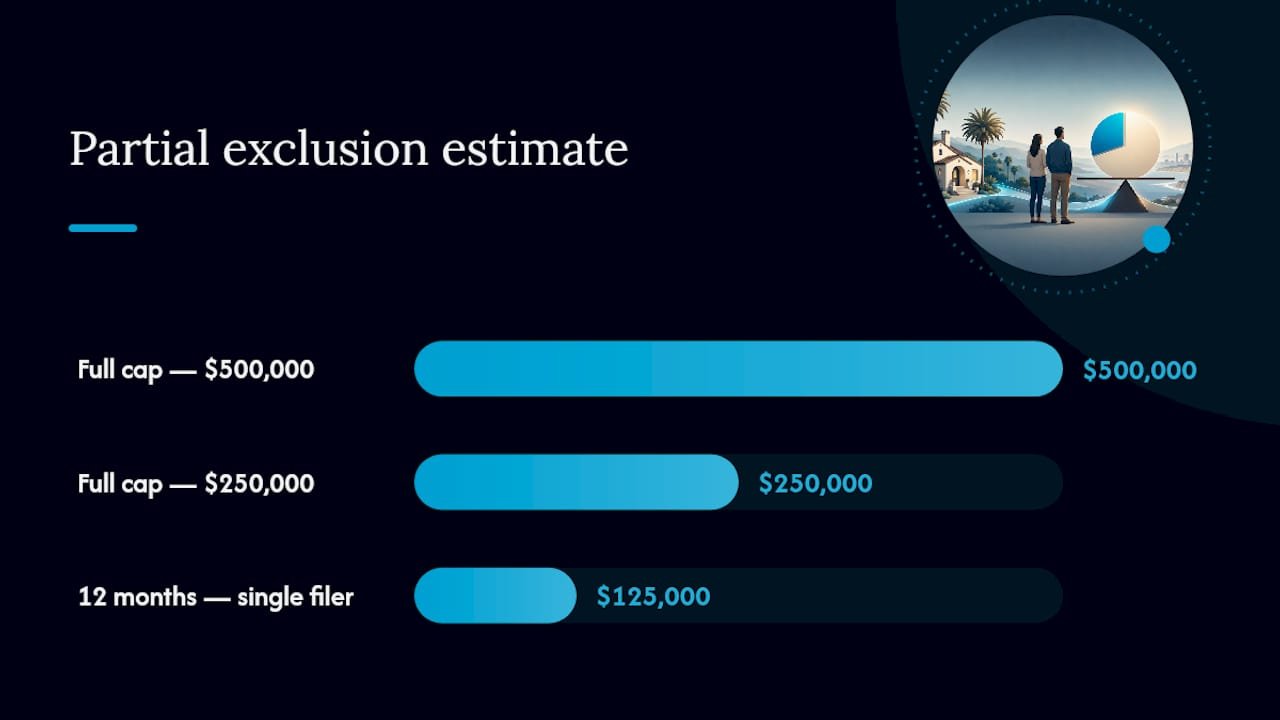
Not every seller gets the full amount. If you sell before hitting the 24-month ownership or use threshold, you may still qualify for a partial exclusion if the sale was due to a change in workplace location, a documented health issue, or an unforeseeable event like divorce, job loss, or multiple births from a single pregnancy. The partial exclusion is prorated based on how much of the 24-month period you actually satisfied. If you lived in the home 12 months instead of 24 due to a qualifying job relocation, you’d generally be eligible for half of your normal exclusion, roughly $125,000 for a single filer.
Other situations that limit or complicate your exclusion:
- You already used the exclusion on a different home within the past two years.
- You’re selling only a portion of the property, such as a subdivided lot.
- Ownership shifted due to divorce, and one ex-spouse no longer meets the use test independently.
- The property sits in a trust, which can change how ownership is attributed for tax purposes.
Pro Tip: If your circumstances involve missing improvement records, a rental conversion, a trust, or a post-divorce ownership split, don’t try to self-calculate the exclusion. Bring your documents to a CPA before you list, not after you’re in escrow.
To rough out a partial exclusion yourself: divide the number of qualifying months by 24, then multiply that fraction by $250,000 or $500,000. It’s a starting estimate, not a filing-ready number, but it tells you whether you’re looking at a small taxable gain or none at all.
How Does Renting Out Your Home Affect the Exclusion?
If your primary residence was ever a rental property, part of your gain likely won’t qualify for exclusion. Gain attributable to depreciation you claimed for business or rental use generally isn’t excludable and can trigger depreciation recapture, taxed separately from your capital gain.
Beyond depreciation, the IRS applies nonqualified use rules for periods after 2009 when the home wasn’t your primary residence, such as an extended rental stretch before you moved back in. Those periods reduce the percentage of your total gain that qualifies for exclusion, even if you eventually meet the 24-month use test.
To sort out taxable versus excludable gain on a converted rental, gather:
- Full depreciation schedules from every tax year the property was rented
- Exact dates the home was rented versus owner-occupied
- Records of any capital improvements made during the rental period
Pro Tip: Rental-to-primary conversions are the single biggest source of last-minute tax surprises for California sellers. Run this calculation with a CPA well before you list, not during escrow.
What Does a Sample Home Sale Exclusion Calculation Look Like?
Here’s a simplified example for a married couple filing jointly in Santa Clara County:
- Purchase price: $700,000, plus $50,000 in documented capital improvements. Adjusted basis: $750,000.
- Sale price: $1,450,000, minus $85,000 in selling costs. Net sale amount: $1,365,000.
- Gain: $1,365,000 minus $750,000 adjusted basis equals $615,000.
- Exclusion applied: $500,000 (married filing jointly).
- Taxable gain remaining: $115,000.
This example assumes no rental history and no depreciation recapture. If either applied, the taxable portion would likely be higher, and the Net Investment Income Tax could also enter the picture at higher income levels.
What Should Bay Area Sellers Do Before Listing?
Start gathering documents months before you list, not during escrow. Pull your original closing statement, every improvement receipt you can find, depreciation records if applicable, and your last two years of tax returns. If your expected gain is anywhere near the exclusion cap, request a pre-sale tax review rather than finding out mid-transaction.
When you sit down with your CPA, ask directly: how should gain be allocated if part of the home was rented, does the Net Investment Income Tax apply at your income level, and how will escrow withholding reconcile against your final return?
Timing matters more in Silicon Valley than almost anywhere else, since fast-moving inventory and competitive offers can pressure sellers into closing before they’ve hit the full 24-month use threshold. A local market read helps you plan a listing date that satisfies both your tax position and the market window.
A Silicon Valley REALTOR’s Take on Timing
The sellers who run into trouble almost always waited until they were already in escrow to ask tax questions. The fix is simple: coordinate your closing date with your CPA before you sign a listing agreement, especially if you’re within a few months of the 24-month mark. Keep every receipt from day one of ownership. If you don’t have a CPA, ask your agent for a referral before you need one.
How Laxmi Penupothula Helps Sellers Navigate the Numbers
Getting the tax timing right starts long before your first showing. Laxmi Penupothula’s concierge seller process builds pre-sale planning directly into the listing timeline, coordinating closing dates with your CPA when your gain is close to the exclusion threshold, and pairing that with professional staging, pre-sale inspections, and 3D Matterport tours designed to maximize your final sale price.

That level of coordination comes from experience: Laxmi has closed more than $650 million across 570+ transactions, holds RealTrends Verified Top 1% Realtor recognition for five consecutive years (2021 through 2025), and earned the SCCAOR REAL Award for the same period. If your expected gain is close to the $250,000 or $500,000 mark and you want your listing timeline to work with your tax position instead of against it, start with a free CMA and consultation to map out your sale timeline before you list.
Frequently Asked Questions
Does California have its own home sale exclusion, or does it just use the federal one?
California doesn’t have a separate exclusion program. It conforms to the federal IRC §121 exclusion and applies the same $250,000/$500,000 limits, though any taxable gain above that is taxed as ordinary income at California rates.
Can I use the home sale exclusion more than once?
Generally, no, not within a two-year period. You can use the exclusion again on a future home sale as long as at least two years have passed since your last claim and you meet the ownership and use tests again.
What happens if I sell before living in the home for two years?
You may still qualify for a partial exclusion if the sale was due to a job relocation, documented health issue, or another qualifying unforeseeable circumstance. The exclusion gets prorated based on how much of the 24-month period you satisfied.
Do I need to reinvest my sale proceeds in another home to avoid tax?
No. Unlike older federal rules that required a rollover into a new home, the current Section 121 exclusion applies regardless of what you do with the proceeds, as long as you meet the ownership and use tests.
Will escrow withhold money from my sale even if I qualify for the full exclusion?
It’s possible if you don’t file the correct exemption paperwork at closing. Filing the certificate confirming your exclusion eligibility typically prevents unnecessary withholding under FTB rules.
This article is general information, not a substitute for advice from a qualified financial advisor. Consult a qualified financial professional about your own circumstances before acting on anything here.
Sources
These are the primary references behind the rules covered above:
- Sale of residence — real estate tax tips | Internal Revenue Service
- Income from the sale of your home | Franchise Tax Board
Recommended
- Capital Gains on a Home Sale in California: What Sellers Need to Know – Laxmi Penupothula
- Seller Closing Costs in California: What They Are and What They Run – Laxmi Penupothula
- Seller Net Proceeds Explained: What You Actually Pocket on a California Home Sale – Laxmi Penupothula
- Filing for the Homeowners Property Tax Exemption

Laxmi Penupothula
RealTrends Verified Top 1% REALTOR® Nationwide (2021–2025) • CA DRE #02047105
SCCAOR Top 1% Santa Clara County • Intero Chairman Circle 2023–2025 • \$650M+ Closed • 570+ Transactions
Silicon Valley & Bay Area Specialist — Cupertino, San Jose, Fremont, Milpitas, Sunnyvale & surrounding cities.
Get a Free Home Valuation →