


In California, selling a home “as‑is” means you offer the property in its current physical condition, defects included, but it does not let you skip required disclosures or hide known problems. Sellers keep the right to decline repairs; buyers keep their inspection and contingency protections. Concealing a known defect, whether the roof leaks or the foundation is cracked, remains fraud regardless of what the listing says.
TL;DR:
- An “as‑is” sale in California means the seller will not perform repairs but still must disclose known defects and cannot hide material issues.
- Buyers retain full inspection and contingency rights, including canceling within three to five days if disclosures are late or incomplete.
- An “as‑is” clause signals repair limits, not a waiver of disclosure obligations or buyer protections against fraud.
- Proper disclosures, including the transfer statement and natural hazard report, are mandatory regardless of sale terms, with late disclosures resetting cancellation rights.
- Price negotiations often involve repair credits or escrow holdbacks, with fully disclosing properties attracting more qualified offers and reducing disputes.
Table of Contents
- What Does an As‑Is Sale in California Involve? Fast Facts to Know
- What Does “As‑Is” Really Mean in a Contract?
- Which Disclosures Are Still Required in an As‑Is Sale?
- How Should Buyers Protect Themselves in an As‑Is Purchase?
- What Are a Seller’s Options for an As‑Is Property?
- How Do You Price and Negotiate an As‑Is Sale?
- What’s the Step‑By‑Step Timeline for Selling As‑Is in California?
- Author Expertise: A Bay Area Realtor’s View on As‑Is Listings
- Editorial Take: Where As‑Is Sales Go Wrong in California
- How Laxmi Penupothula Helps You Navigate an As‑Is Sale
- Sources
What Does an As‑Is Sale in California Involve? Fast Facts to Know
An as‑is sale in California runs on the same disclosure statutes as any other residential transaction. The “as‑is” label changes what a seller will fix, not what a seller must reveal. Here are the anchors that matter most, whether you’re drafting an offer or signing a listing agreement.
The C.A.R. Residential Purchase Agreement typically sells a property in its “present physical condition” as of the date of acceptance. That single phrase carries the legal weight in an as‑is deal, not the word “as‑is” itself, which often shows up only in MLS marketing copy.
- Transfer Disclosure Statement (TDS): required for most residential resales and cannot be waived just because the listing says “as‑is.”
- Natural Hazard Disclosure (NHD): flags flood zones, fire hazard severity zones, and earthquake fault zones regardless of sale type.
- Investigation period: buyers typically get a contingency period under the standard RPA to complete inspections and decide whether to proceed, request changes, or cancel.
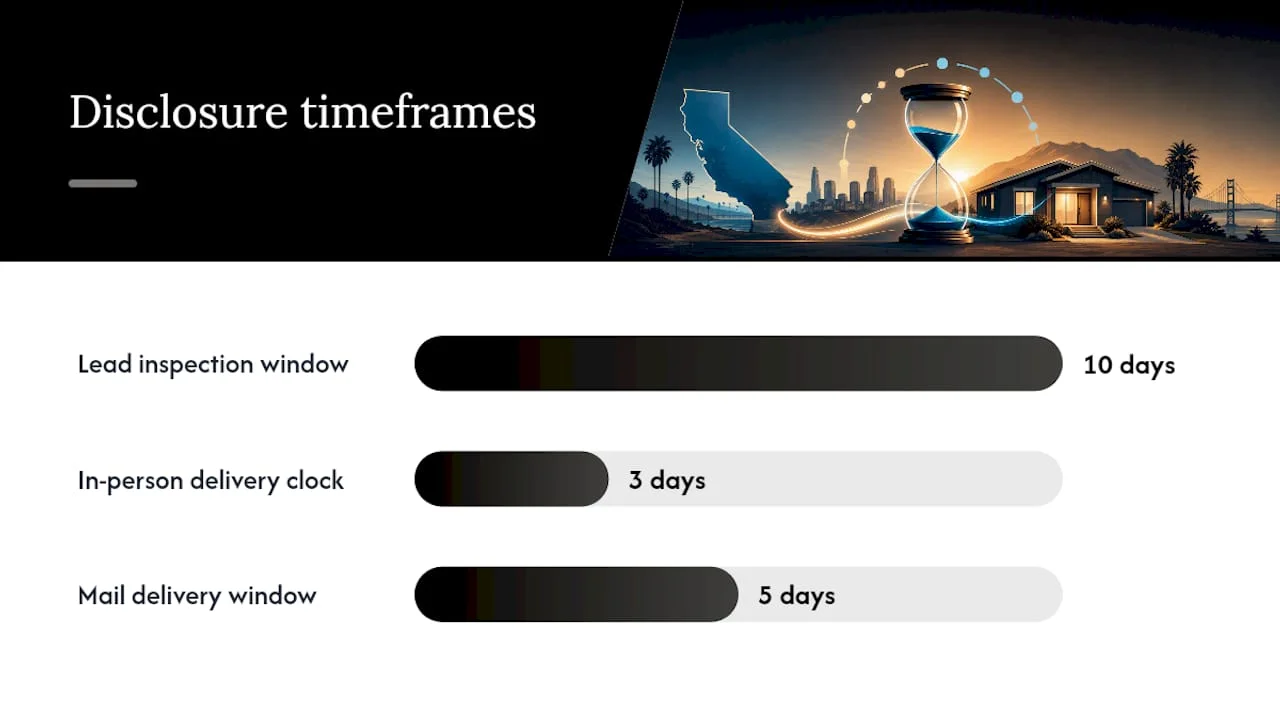
- Termination window for late disclosures: buyers generally have 3 days after receiving disclosures in person, or 5 days if mailed, to cancel the contract.
- Broker inspection duty: agents must perform a reasonably competent visual inspection and disclose material facts under Civil Code 2079, independent of what the seller discloses.
- Tax withholding: escrow may withhold 3 1/3% of the sale price under state tax rules unless an exemption, like a sale under $100,000 or a principal‑residence certification, applies.
Quick fact: the timelines above are not suggestions. Miss the 3 or 5 day disclosure window and a buyer can walk away and recover their deposit, even after opening escrow on an as‑is deal.
These numbers repeat throughout the transaction. The 17 day investigation period governs how buyers respond to inspection findings, and the 3/5 day rule governs how long a buyer has to react if disclosures arrive late or get amended. Both timelines exist independent of whether the property is marketed as as‑is, a distinction that trips up sellers who assume the label buys them out of the standard process entirely.

What Does “As‑Is” Really Mean in a Contract?
Marketing language and contract language are not the same thing, and confusing the two is where sellers get into trouble. An MLS listing that says “sold as‑is” is advertising copy. The actual legal terms live in the Residential Purchase Agreement, and courts look at the contract, not the listing description, when a dispute arises.
The clearest way to think about “as‑is” is as a repair limitation, not a waiver. It tells the buyer the seller won’t fix anything before closing. It does not tell the buyer they’re giving up their right to inspect, negotiate, or walk away. This distinction matters because so many sellers treat “as‑is” as legal armor, when it functions more as a negotiating position than a shield.
Here’s what an as‑is designation actually does and doesn’t do:
- Does: signal the seller won’t perform repairs or make credits automatically part of the deal.
- Does: let the seller decline a buyer’s repair request without breaching the contract.
- Does not: waive the TDS, NHD, or other statutory disclosures.
- Does not: protect a seller who knew about a defect and didn’t disclose it.
- Does not: eliminate the buyer’s contingency period or inspection rights.
Buyers retain full use of their contingency period in an as‑is transaction. If a home inspection turns up a cracked slab or knob‑and‑tube wiring, the buyer can still request repairs, ask for a credit, or cancel and get their deposit back, all standard mechanics under the RPA. The seller’s only real leverage is refusing those requests, which is a negotiating stance, not a legal exemption.
Where sellers face the sharpest exposure is fraudulent concealment. California Civil Code provisions prohibit contracting away liability for fraud, meaning an as‑is clause offers zero protection if a seller knowingly hid a material defect. A leaking roof patched and painted over the week before listing, then omitted from the TDS, is the textbook example that ends up in small claims court or worse. The “as‑is” language in the purchase contract does nothing to insulate a seller who lied on the disclosure form.
For sellers, the practical takeaway is this: attach an as‑is addendum to the RPA only after confirming the buyer understands what it does and doesn’t cover, and never let it substitute for a complete, honest TDS.
Which Disclosures Are Still Required in an As‑Is Sale?
California’s disclosure statutes apply the same way in an as‑is sale as they do in any traditional listing. The property’s condition may be up for negotiation. The paperwork is not.
- Transfer Disclosure Statement. The TDS covers known conditions of the structure, roof, plumbing, electrical systems, appliances, and more. It must be provided for most residential resales, and failure to disclose accurately can expose the seller to damages under Civil Code §1102.13. The seller fills it out personally, not the agent, because it asks about what the seller actually knows.
- Natural Hazard Disclosure. Third‑party vendors typically research flood zones, wildfire severity zones, and earthquake fault lines, then compile the results into a report that gets delivered alongside the TDS. This applies regardless of listing terms.
- Lead‑based paint disclosure. Homes built before 1978 fall under federal rules requiring a lead disclosure, and buyers get a 10 day window to conduct a lead inspection if they choose to.
- Mello‑Roos, HOA, and permit history disclosures. Special assessment districts, homeowners association documents, and unpermitted work all need to surface before close, particularly relevant in as‑is sales where unpermitted additions are common defect categories.
- Environmental hazard booklets and local ordinances. Some cities layer on additional requirements, like point‑of‑sale retrofit certifications, that a listing agent should flag early.
Pro Tip: If disclosures arrive late, get them delivered in person rather than by mail whenever possible. The 3 day termination clock is easier for everyone to track than the 5 day mail window, and it closes the door on ambiguity about when the buyer’s response period actually started.
Late or incomplete disclosures don’t just create paperwork headaches. They reset the buyer’s termination rights, giving them a fresh window to cancel even after they’ve been in contract for weeks. Sellers who rush the disclosure process to save a few days on the timeline often lose far more time when a buyer exercises that right at the eleventh hour.
How Should Buyers Protect Themselves in an As‑Is Purchase?
Buying a home marketed as as‑is doesn’t mean buying blind. The contingency structure built into the standard RPA exists precisely for situations like this, and skipping it to compete on a hot listing is one of the costliest mistakes a buyer can make.
A thorough inspection strategy for an as‑is property typically includes:
- General home inspection covering structure, roof, electrical, plumbing, and HVAC systems.
- Sewer lateral inspection, especially in older Bay Area homes with clay pipe.
- Pest and dry rot inspection, standard practice in California and often a lender requirement.
- Foundation or structural engineer review if the general inspector flags settling or cracking.
- Chimney, pool, or septic inspections when applicable to the specific property.
Waiving the inspection contingency to strengthen an offer is common in competitive Silicon Valley markets, but it converts every one of those unknowns into the buyer’s financial responsibility the moment escrow closes. A home inspection contingency is not a formality. It’s the mechanism that lets a buyer walk away with their deposit intact if the inspection reveals something the listing didn’t capture.
Once the inspection report comes back, buyers generally have options such as requesting repairs, requesting a credit toward closing costs, negotiating a price reduction, or canceling the contract during the investigation period. In practice, most negotiations settle on a credit rather than actual repair work, since sellers of as‑is properties are rarely eager to manage contractors before close.
Pro Tip: If an inspection uncovers something serious, like unpermitted structural work or evidence of a prior insurance claim, involve a real estate attorney before signing a repair credit agreement. A few hundred dollars in legal review can prevent a dispute worth tens of thousands later.
What Are a Seller’s Options for an As‑Is Property?
Not every as‑is property moves through the same channel, and the path you choose changes both your timeline and your final number.
Listing with an agent on the open market typically produces the highest sale price because it exposes the property to the widest buyer pool, including buyers willing to take on renovation work in exchange for a below‑market entry point. The tradeoff is time: marketing, showings, and the standard escrow period stretch the timeline compared to a direct sale.
Cash investors move fast, often closing in one to two weeks with no financing contingency, but they price in their own renovation risk and margin, which usually means an offer well below what a retail buyer would pay after repairs.
Probate and trust sales carry their own disclosure nuances. A personal representative selling under probate authority is sometimes exempt from certain TDS requirements if they never occupied the property and have no personal knowledge of its condition, though NHD and other statutory disclosures still generally apply.
REO and foreclosure sales follow different rules entirely, since a bank selling a foreclosed property typically has no firsthand knowledge to disclose and may market the home strictly as‑is with minimal representations.
- Agent listing: broadest exposure, higher potential price, longer timeline.
- Cash investor sale: fastest close, lowest price, minimal contingencies.
- Probate/trust sale: possible disclosure exemptions, court oversight in some cases.
- REO/foreclosure: bank‑driven terms, little to no seller disclosure history.
Each path solves for a different priority. Choosing between them comes down to whether speed, price, or reduced disclosure exposure matters most to your situation.
How Do You Price and Negotiate an As‑Is Sale?
Pricing an as‑is home starts with an honest scope of what’s wrong, then works backward from what a buyer would actually pay after accounting for that work. Sellers who skip the estimate step and just guess at a discount tend to either scare off buyers with too steep a price cut or get stuck on the market because they underestimated repair costs.
A reasonable pricing framework looks like this:
- Get a contractor walkthrough or pre‑listing inspection to quantify the scope of needed work in real dollars, not guesses.
- Pull comparables that sold in similar as‑is condition, not polished, staged listings, since buyer expectations differ sharply between the two.
- Factor in market strength. In a tight Santa Clara County market, as‑is homes still draw multiple offers; in a slower market, the discount required to move a fixer widens.
- Anticipate financing friction. Cash buyers can close regardless of condition, but lenders often require certain repairs, like exposed wiring or missing handrails, before funding a loan, which narrows your buyer pool if the home needs work a bank won’t finance around.
- Structure concessions instead of repairs where possible: closing cost credits, escrow holdbacks for agreed‑upon work, or extended timelines that let a cash buyer without financing pressure move at their own pace.
Appraisal risk deserves particular attention. A financed buyer’s lender will still order an appraisal, and if the appraiser flags safety or habitability issues, the loan can get held up regardless of what the purchase contract says about “as‑is” terms. That’s one reason cash offers on distressed as‑is properties often win even when the price is lower: financing friction disappears entirely.
Negotiation on an as‑is deal is rarely a straight take it or leave it. As inspection findings come in, most sellers end up granting some form of credit or price adjustment rather than performing repairs directly, which keeps the seller out of the contractor business while still closing the gap that got the buyer to the table.
What’s the Step‑By‑Step Timeline for Selling As‑Is in California?
A well‑run as‑is sale follows a predictable sequence. Sellers who front‑load the paperwork almost always close faster and with fewer surprises than those who try to shortcut disclosures to save time early.
- Pre‑listing: gather permit history, HOA documents, and past inspection reports. Order the Natural Hazard Disclosure report early, since it takes a few days to process. Consider a pre‑listing inspection so you can disclose known issues with confidence rather than guessing.
- Listing preparation: confirm the listing agreement language matches your intent to sell as‑is, set MLS remarks that attract buyers expecting a fixer rather than a move‑in‑ready home, and price using your contractor estimate and comparables.
- Going live and accepting an offer: review offers not just on price but on contingency structure, since a clean cash offer can beat a higher financed offer once appraisal and lending risk are factored in.
- Escrow: deliver the TDS, NHD, and all required disclosures immediately after acceptance to start the buyer’s response clock. Track the 17 day investigation period closely and respond to repair requests or credit negotiations promptly.
- Closing: confirm whether tax withholding applies, coordinate the final walkthrough, and review escrow’s closing statement before signing.
Every one of these steps ties back to the same statutory clock that governs any California resale. As‑is only changes what happens with repair requests, not when disclosures are due or how long a buyer has to respond to them.
Author Expertise: A Bay Area Realtor’s View on As‑Is Listings
Laxmi Penupothula has closed more than $650 million in sales across 570+ transactions throughout Santa Clara County, including Cupertino, Sunnyvale, San Jose, Saratoga, Fremont, and Milpitas. She has ranked in RealTrends Verified’s top 1% of agents nationally for five consecutive years, 2021 through 2025, and earned the SCCAOR REAL Award for top 1% sales volume in Santa Clara County every one of those same years.
That volume matters specifically for as‑is sellers, because pricing and disclosure strategy on a distressed or dated property benefit from seeing dozens of comparable outcomes rather than guessing from a single data point.
Pre‑listing inspections and complete, transparent disclosures tend to reduce disputes after closing and often produce stronger offers by widening the pool of buyers willing to compete, rather than scaring off everyone but the deepest discount hunters.
For sellers weighing whether to invest in pre‑listing prep on a home they plan to sell as‑is, that’s the calculation worth running. A pre‑sale inspection, professional staging where it makes sense, and high‑quality marketing can shift a listing from “buyers assume the worst” to “buyers know exactly what they’re bidding on,” which tends to translate directly into stronger net proceeds even when the home needs real work.
Editorial Take: Where As‑Is Sales Go Wrong in California
The biggest misconception in as‑is sales isn’t legal, it’s psychological. Sellers treat the phrase as permission to disclose less, when the statute treats it as no exemption at all. That gap between what people assume and what the Civil Code actually says is where most disputes start.
Conventional advice tells sellers to “just say as‑is and move on.” That’s backwards. The sellers who do best skip the shortcut and lean into disclosure, because a complete TDS paired with an honest inspection report builds buyer confidence that a vague “as‑is, no warranties” listing never will. Buyers pay more for certainty, even certainty about bad news, than they pay for ambiguity.
If you’re selling a property with real issues, prioritize documentation over discount. Get the inspection done, put it in writing, and let the price reflect the true scope of work rather than a guess. That single decision does more to protect you from a post‑closing claim than any clause your agent can draft into the purchase agreement.
— Mr
How Laxmi Penupothula Helps You Navigate an As‑Is Sale
Selling as‑is in Santa Clara County still rewards preparation, and a concierge‑level seller strategy can be very helpful. Experienced real estate agents often work with sellers to run comparative market analyses, coordinate pre‑listing inspections so disclosures are accurate from day one, and reach both traditional buyers and cash investors through a targeted marketing plan built around each property’s actual condition.

A consult starts with a straightforward conversation about your property’s condition, your timeline, and whether an open‑market listing, an investor sale, or a hybrid approach fits your goals best. From there, the agent’s team handles document collection, NHD ordering, and disclosure timing to keep the process organized once a buyer’s contingency clock starts running. When repair credits or escrow holdbacks come up during negotiation, experience with many closed transactions helps when negotiating from data, not guesswork.
If you’re weighing whether to sell your Bay Area home as‑is or invest in light prep first, start with a free CMA and seller consultation to see which path nets you more.
This article is general information, not a substitute for advice from a qualified lawyer. Consult a qualified legal professional about your own circumstances before acting on anything here.
Sources
- California Civil Code §1102.3
- California Real Estate Reference Book — Disclosures (DRE)
- California Residential Purchase Agreement: Buyer mistakes (2026)
- Failure to disclose in California real estate transactions — buyer rights and seller liability
Recommended
- California TDS Form: What Sellers and Buyers Must Know
- California Listing Agreement for Sellers: What to Check First
- Milpitas Home Sellers: How to Avoid the Most Common Listing Mistakes

Laxmi Penupothula
Top 1% Realtor SCCAOR, RealTrends Verified (2021–2025) • CA DRE #02047105
SCCAOR Top 1% Santa Clara County • Intero Chairman Circle 2023–2025 • \$650M+ Closed • 570+ Transactions
Silicon Valley & Bay Area Specialist — Cupertino, San Jose, Fremont, Milpitas, Sunnyvale & surrounding cities.
Get a Free Home Valuation →