


Yes, well-executed landscaping typically increases sale price by a moderate percentage over an unimproved yard, with the highest returns coming from maintenance and curb-appeal work rather than big structural builds. Budget 1% to 2% of your home’s value for pre-sale landscaping, and put most of that toward the fixes buyers actually notice.
TL;DR:
- Small landscaping improvements such as mulching, edging, and pruning can provide above 100% ROI when improving buyer perception of the home.
- Mature trees and high-quality plantings, especially evergreen and established specimen plants, are the elements most likely to add real appraised value.
- Major structural projects like decks or patios typically recover less of their cost at resale, making them less cost-effective as pre-listing updates.
- Timing of landscaping work is crucial; installations should be completed at least two weeks before listing photos to avoid looking staged or unestablished.
- Regional market preferences and the home’s price point greatly influence how much landscaping investment will boost perceived and appraised value.
Table of Contents
- Does Landscaping Increase Home Value? What the Research Shows
- High-ROI Landscaping Projects to Prioritize Before Listing
- Landscaping Upgrades That Rarely Pay Off at Resale
- A Practical Pre-Listing Timeline for Limited Budgets
- Curb-Appeal Checklist for Listing Photos and Showings
- Realtor Perspective: Applying These Choices to Your Sale
- How Landscaping ROI Varies by Regional Market
- Landscaping Impact Across Property Types
- Seasonal Timing and Landscaping ROI
- Maintenance Costs and Net ROI During the Sale Process
- DIY Versus Professional Landscaping: Which Delivers Better ROI?
- Time on Market: What the Data Suggests
- Where the Conventional Advice Falls Short
- Sources
Does Landscaping Increase Home Value? What the Research Shows
The moderate range of value increase is supported by research. A Virginia Tech study measured how buyers perceived home value based on landscaping quality alone, holding the house itself constant. The result: perceived value shifted within a range. This finding is supported by the Virginia Tech study. The pattern that mattered most wasn’t the price tag of the plants. It was design sophistication, meaning balanced layouts, proper scale, and a front entrance that reads as intentional rather than assembled.
That distinction matters for anyone comparing perceived value to appraised value. Perceived value is what a buyer feels walking up the driveway, the number that drives offer competition and emotional attachment. Appraised value is what a licensed appraiser puts on paper, and it tends to move more conservatively. The Appraisal Institute reports that mature trees and established, high-quality plantings are among the few landscaping elements appraisers consistently credit, sometimes adding thousands of dollars depending on the market. A large, healthy shade tree is a documented asset in a way that a bed of annuals planted last week simply isn’t yet.
A few caveats keep this honest:
- ROI figures vary by market, price bracket, and neighborhood norms, so the percent increase differs across locales.
- Some landscaping benefits, such as energy savings from mature tree canopy, manifest over time and may not factor into resale calculations at all, per Mass.
- Frontiers research on ROI methodology warns that ROI calculations depend heavily on timescale and what benefits you choose to count, which is why quoting a single flat percentage for every project is misleading.
Treat the estimated value increase as a qualitative range influenced by execution quality, not a guaranteed figure.
High-ROI Landscaping Projects to Prioritize Before Listing
Not every dollar spent on your yard returns equally. The data consistently shows an inverse relationship between project size and percent return: the smaller, more routine the task, the higher the ROI per dollar.
- Weekend quick wins. Mowing, edging, weeding, fresh mulch, pruning overgrown shrubs, and a power wash of the walkway and siding. These tasks often cost under $300 total if you do them yourself, and industry ROI data puts returns on lawn care and mulch refreshes well above 100% of cost when they shift a listing from “neglected” to “cared for” in buyer perception.
- Mid-tier upgrades. A defined walkway edge, layered entrance plantings, and low-voltage path lighting typically run $500 to $2,500 depending on your lot. These pay off when the current entry looks unfinished or when neighboring comps have them and yours doesn’t.
- Structural additions. Decks, patios, and retaining walls belong last on the list. Consider them only if a comparable home just sold with one and buyers are visibly comparing outdoor living space, or if you have six-plus months of lead time before listing.
Statistic Callout: Basic curb-appeal maintenance and lawn care generally return more per dollar spent than large structural landscaping installs, according to aggregated remodeling and appraisal data cited across the residential landscaping industry. Structural projects like patios typically recover a smaller share of their installation cost at resale.
Plant selection deserves its own thought. Evergreen anchors, boxwood, holly, dwarf conifers, hold their shape and color through your entire listing window, no matter when you go live. Layer in one or two seasonal color plants near the entry for a finished look without betting the whole yard on a bloom cycle that might be over by your first open house.
Pro Tip: Buy your anchor evergreens in the largest size your budget allows. A gallon-pot shrub looks like a recent purchase in photos; a 15-gallon or 24-inch box version looks like it’s always been there, and that “established” read is exactly what drives the perceived-value gains Virginia Tech documented.

For a fuller walkthrough of specific fixes ranked by visual impact, see this breakdown of curb appeal ideas that boost value fast.
Landscaping Upgrades That Rarely Pay Off at Resale
Some projects feel like value adds but tend to shrink your buyer pool or drag down net proceeds once you account for what they cost to build and maintain.
- Pools. In most Bay Area markets, a pool is a preference item, not a value driver. It appeals strongly to some buyers and eliminates others outright, particularly households worried about safety or maintenance, and regional landscaping guidance makes clear that pool value is highly climate and market dependent.
- Elaborate water features and oversized outdoor kitchens. These read as personal indulgences rather than universal upgrades. A built-in pizza oven might delight you; it rarely moves a buyer’s offer.
- Rushed new plantings. Beds installed the week before photos often look thin, patchy, or freshly disturbed with visible mulch lines and bare soil. That undercuts the polished look you’re paying for.
- High-upkeep choices. Intricate topiary, water-hungry lawns in drought-prone regions, or delicate specimen plants signal ongoing cost to a buyer doing mental math on maintenance.
The test for any big-ticket item is simple: pull three recent comps in your price range and radius. If none of them have a pool or an outdoor kitchen, adding one won’t close a gap, because there isn’t one to close.
A Practical Pre-Listing Timeline for Limited Budgets
Landscaping ROI depends as much on sequencing as on spend. Installing plants the week of your first showing almost always backfires, since new plantings need time to settle before they photograph well.
- Eight to six weeks out. Walk the property, make your priority list, and order any materials for mid-tier or structural upgrades now, since lead times on lighting fixtures, pavers, or larger plants can stretch several weeks.
- Six to three weeks out. Complete walkway repairs, install lighting, and finish entrance plantings. This window gives new landscaping time to settle and lose that just-installed look before your photographer shows up.
- Two weeks to listing day. Final detailing only: mow, edge, refresh mulch, coordinate with your stager, and time your last full yard cleanup two to three days before photography, not the morning of.
Aim for total landscaping spend around 1% to 2% of your home’s expected sale price, and resist the urge to load that budget into one dramatic project. For a market-specific version of this sequence, this Milpitas pre-sale prep guide walks through the same phasing with local contractor timing.
Curb-Appeal Checklist for Listing Photos and Showings
Buyers scroll photos before they ever drive by, so your checklist should be sorted by what a camera actually catches.
- Lawn care (must do, DIY or $40 to $75 per visit): patchy or brown grass photographs as neglect from any angle.
- Bed cleanup and edging (must do, DIY $0 to $50): crisp edges signal maintenance even when the rest of the yard is modest.
- Fresh mulch (must do, $3 to $5 per bag or $75 to $150 hired): dark, even mulch reads as “recently cared for” in every listing photo.
- Walkway repair (must do if cracked, $200 to $800): cracked concrete draws the eye in wide-angle shots more than almost anything else.
- Lighting check (nice to have, under $100 for solar path lights): matters most for evening showings and twilight photography.
- Power wash siding and walkways (must do, $150 to $300 hired): dirt streaks and algae are highly visible in bright listing photos and cost little to remove.
- Front door touch-up (nice to have, $30 to $60 for paint): a scuffed door is one of the most commented-on flaws in buyer feedback forms.
Pro Tip: Shoot a test photo on your phone from your front walkway before the professional photographer arrives. Whatever draws your eye first in that test shot, a dead patch of lawn, a leaning mailbox, is exactly what a buyer will notice first too.
Pair this list with a full home staging checklist so your exterior and interior prep stay coordinated on the same timeline.
Realtor Perspective: Applying These Choices to Your Sale
Case studies bear this out. In one recent San Jose listing, targeted exterior fixes, not a full landscape overhaul, helped push the Almaden sale $100,000 over asking. A similarly modest approach turned around a Milpitas home that had previously been delisted, where refreshed curb appeal was part of relaunching the listing successfully.
Agents lean on curb appeal for a practical reason: it drives the online click that leads to a scheduled showing, and it sets the tone for negotiation before a buyer ever crosses the threshold. A yard that looks tended signals a well-maintained house overall, which affects how buyers read your inspection report later.
Before hiring a landscaper, ask these six questions: What is your timeline to completion? Will the work be photo-ready or does it need settling time? What is the maintenance handoff for new plantings? Can you provide a written cost breakdown by task? Have you worked on pre-listing timelines before? What happens if a delay pushes past our photography date? For sellers weighing these decisions alongside a full sale strategy, Laxmitoprealtor’s seller services coordinate this kind of vendor scheduling directly.
How Landscaping ROI Varies by Regional Market
ROI percentages move with local buyer expectations and climate. In warm, landscape-forward regions of California, mature drought-tolerant plantings and hardscape are often expected baseline features, so their absence can hurt more than their presence helps. In markets with shorter growing seasons, a well-timed spring listing with visible green lawn and blooming perennials can create a sharper contrast against neighboring properties still shaking off winter, amplifying perceived value.
Price bracket matters too. In entry-level markets, buyers weigh landscaping against move-in readiness overall, so a clean, simple yard often performs as well as an elaborate one. In luxury markets, buyers increasingly expect landscape design to match architectural quality, and a mismatched or dated yard can actively suppress offers on an otherwise strong property.
Local comps remain the most reliable gauge. Two identical landscaping investments can produce different returns forty miles apart, simply because buyer pools and price expectations differ. Before committing a landscaping budget, look at what’s already installed on recently sold homes in your immediate radius rather than relying on a national average.
Landscaping Impact Across Property Types
A single-family home with a visible front yard and driveway gets the most direct landscaping ROI, since the exterior is the first and largest visual impression a buyer forms. Every dollar spent on lawn care, plantings, and walkway condition shows up in listing photos and drive-by appeal.
Condos and townhomes work differently. Individual owners rarely control the broader grounds, so landscaping ROI shifts toward the small, controllable zone: a patio, a balcony planter arrangement, or the entry mat and door area. HOA-maintained common areas matter more here than anything the seller personally installs, which means condo sellers often get more value from staging and interior updates than from yard work.
Luxury homes raise the bar considerably. Buyers in this bracket expect landscape architecture, not just landscaping, meaning intentional hardscape, mature specimen trees, and a design that complements the home’s architecture. A luxury buyer comparing $3 million properties will notice generic builder-grade plantings as a mismatch, even if the interior finishes are flawless. At this level, professional landscape design input tends to be worth its cost far more than at entry-level price points.
Seasonal Timing and Landscaping ROI
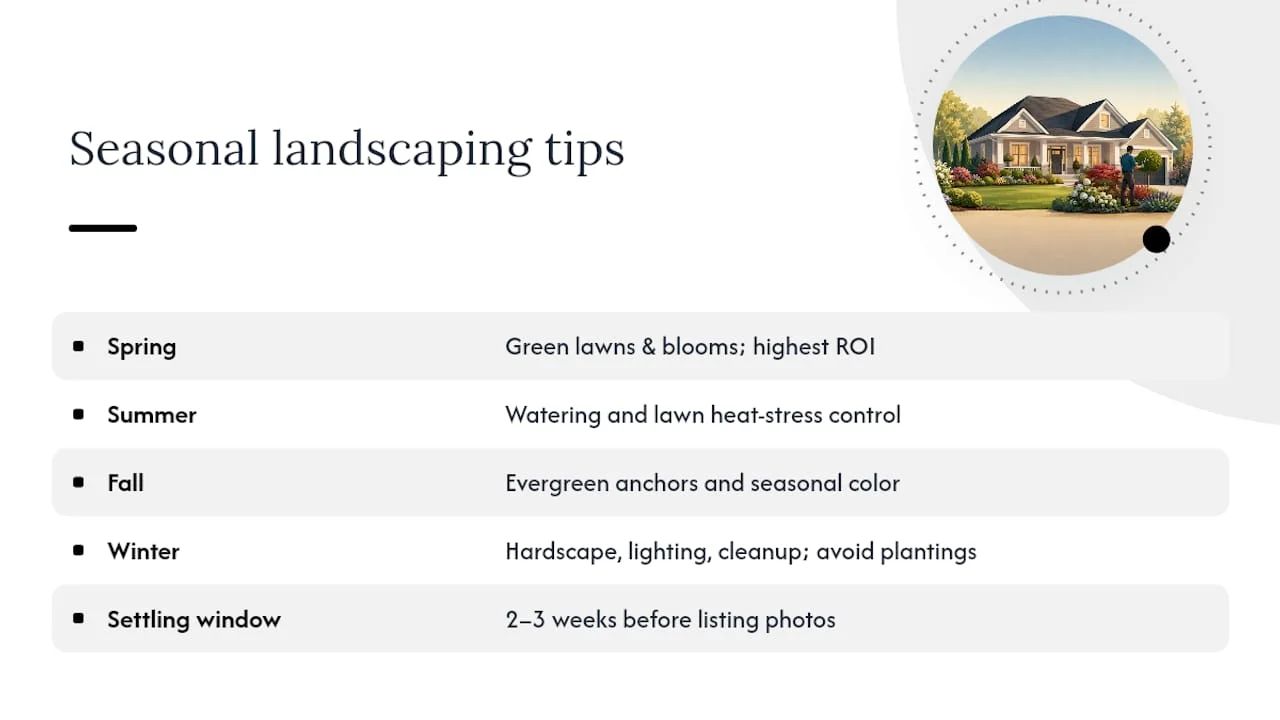
Spring listings benefit the most from landscaping investment, since lawns are naturally green, perennials are blooming, and buyer activity peaks alongside the best possible plant condition. This is the season where curb-appeal spending returns the most visible impact for the least effort.
Fall listings require more deliberate planning. Deciduous plants losing leaves can make a yard look sparse right when you need it to look its best, so evergreen anchors and seasonal color plantings carry more weight in this window.
Winter listings in most markets benefit from restraint: focus spending on hardscape, lighting, and cleanup rather than plantings that won’t show well until spring anyway. Summer listings need attention to watering and lawn stress, since a brown, heat-damaged lawn photographs just as poorly as an unmowed one. Whatever the season, the settling window discussed earlier still applies. New installs need two to three weeks minimum before they photograph as established rather than freshly planted.
Maintenance Costs and Net ROI During the Sale Process
Landscaping ROI calculations often ignore the ongoing cost of keeping improvements looking sharp for however long your home sits on the market. A newly installed lawn or fresh planting bed needs continued watering, mowing, and weeding every single week your listing is active, and that cost adds up fast during a slow-moving sale.
Net ROI, the number that actually matters to your bottom line, is your sale price premium minus both installation cost and the maintenance spend across your entire listing period. A home that sits for ten weeks with a high-maintenance yard can quietly erode the gain from the initial landscaping investment through lawn service bills, irrigation costs, and touch-up visits.
This is one more argument for prioritizing low-maintenance, high-impact choices like mulch, evergreen structure, and simple hardscape repair over water-hungry lawns or delicate seasonal beds. The lower your weekly upkeep cost during the sale window, the more of your original ROI actually reaches closing.
DIY Versus Professional Landscaping: Which Delivers Better ROI?
DIY makes sense for the weekend quick-win category: mowing, mulching, weeding, and basic pruning cost little beyond your own time and consistently return well above their cost in buyer perception. Most sellers can handle this tier without hiring anyone.

Professional help earns its cost in the mid-tier and design-sensitive categories. The Virginia Tech findings on design sophistication are the key reason: a professionally scaled entrance planting with proper plant sizing and layout consistently outperforms a DIY arrangement, even when the DIY version uses similar plants at a similar total cost. ASLA’s residential landscaping guidance reinforces that professional design input tends to correlate with stronger buyer appeal, particularly for layout and plant selection choices that require an eye for scale.
The practical split for most sellers: handle maintenance yourself, hire a professional for anything involving hardscape, lighting design, or an entrance that needs to look intentional rather than assembled. If your budget is genuinely tight, spend the professional dollars on the front twenty feet of your property. That’s the zone every buyer sees first, in person and in photos.
Time on Market: What the Data Suggests
Homes with strong curb appeal tend to generate more initial showings, and more showings within the first two weeks of listing correlate with stronger offers and faster contracts. The mechanism is straightforward: a yard that photographs well earns more clicks on a listing photo, and more clicks translate into more scheduled showings, which creates the competitive pressure that shortens time on market.
The Almaden case referenced earlier closed well above asking in a tight window, a pattern consistent with listings that generate strong early interest rather than sitting through multiple price adjustments. The Milpitas relisting told a similar story from the other direction: the same home that had previously failed to sell found buyers once its presentation, including its exterior, was refreshed and relaunched.
None of this means landscaping alone guarantees a fast sale. Price, condition, and market timing still carry the most weight. But a yard that photographs poorly gives buyers a reason to scroll past your listing before they ever consider the price, and that lost first impression is difficult to recover once a listing starts to feel stale on the market.
Where the Conventional Advice Falls Short
Most landscaping advice for sellers defaults to a project list ranked by cost, cheap fixes first, expensive ones later, without asking whether the expensive ones ever made sense for that property. That framing misses the real lesson in the research: design sophistication, not spend, drives perceived value. A $400 mulch and pruning job executed with attention to scale and symmetry will outperform a $4,000 planting scheme that looks assembled rather than designed.
The bigger blind spot is timing. Sellers obsess over what to plant and skip when to plant it, then wonder why their listing photos show visibly fresh mulch lines and leggy new shrubs. Settling time isn’t optional. It’s the difference between a yard that looks established and one that looks staged for a camera.
If you take one thing from this, prioritize the front twenty feet of your property, sequence the work so nothing looks rushed in photos, and resist any big-ticket project that doesn’t match what’s already selling in your immediate comps.
— Mr
Ready to put this into a real pricing strategy for your property? Laxmitoprealtor’s seller services start with a free comparative market analysis that factors in exactly where your landscaping stands against active comps in Santa Clara County, so every dollar you spend before listing has a clear return behind it.
Sources
- The Effect of Landscape Plants on Perceived Home Value | VCE Publications | Virginia Tech
- Appraisal Institute insights on landscaping and home value
Recommended
- Best Curb Appeal Ideas to Boost Your Home’s Value Fast
- Which Renovations Add Value Before Selling? (And Which to Skip)
- Home Staging & Prep Guide: Getting Your Bay Area Home Ready to Sell
- Home Staging Checklist: Get Show-Ready and Sell Faster

Laxmi Penupothula
Top 1% Realtor SCCAOR, RealTrends Verified (2021–2025) • CA DRE #02047105
SCCAOR Top 1% Santa Clara County • Intero Chairman Circle 2023–2025 • \$650M+ Closed • 570+ Transactions
Silicon Valley & Bay Area Specialist — Cupertino, San Jose, Fremont, Milpitas, Sunnyvale & surrounding cities.
Get a Free Home Valuation →