


The fastest, highest-return curb appeal moves are straightforward: pressure-wash every hard surface, fix any safety or structural issues, repaint entry focal points, update lighting and hardware, refresh landscaping with fresh mulch and edging, and address the garage door if it dominates your facade. Follow that sequence — Clean, then Repair, then Improve — and you avoid the most expensive mistake sellers make: spending on cosmetic upgrades that sit on top of unresolved problems. Research cited by GenRoom indicates that homes with strong curb appeal typically sell about 7% faster and for about 7% more than comparable homes with neglected exteriors, according to a University of Texas at Arlington study. Most of the moves below cost under $500 and can be completed in a single weekend.
Quick cost reference:
- Very low: under $100 (cleaning, mulch, hardware swaps)
- Moderate: $500–$5,000 (paint, lighting, landscaping refresh)
- Major: $2,500+ (garage door replacement, full siding repaint, hardscape)
Top 6 high-impact moves at a glance:
- Pressure-wash siding, driveway, and entry
- Repair safety hazards (cracked steps, loose railings, broken panes)
- Paint or replace the front door and trim
- Update porch lighting, house numbers, and door hardware
- Edge beds, add fresh mulch, and trim overgrown shrubs
- Refresh or replace the garage door if it faces the street
Table of Contents
- What are the best curb appeal ideas under $100?
- How do you restore a front yard that looks neglected?
- Which painted surfaces give you the biggest visual return?
- Does exterior lighting actually increase a home’s sale price?
- How do you style a porch and entry for listing photos?
- What should you do about the driveway, garage, and windows?
- How should you prioritize curb appeal projects?
- Which curb appeal projects move the needle most for sellers?
- What does a 30/60/90-day curb appeal plan look like?
- Safety and accessibility enhancements as part of curb appeal
- Common mistakes to avoid in curb appeal improvements
- Key Takeaways
- The projects sellers underestimate most
- Laxmitoprealtor’s concierge pre-sale service for Silicon Valley sellers
- Useful sources and further reading
What are the best curb appeal ideas under $100?
These are the projects that cost almost nothing yet produce the most visible change per hour of effort. NAR’s weekend curb appeal plan confirms that a focused two-weekend effort, starting with cleaning and lawn conditioning, delivers results comparable to far more expensive renovations.
- Pressure-wash the entry, driveway, and siding (2–4 hours, $40–$80 rental). This single step often makes paint, resurfacing, and replacement unnecessary. Pressure washing every surface reveals what actually needs repair and what just needed cleaning.
- Replace house numbers (30 minutes, $15–$40). Brushed brass or matte black numbers on a clean surface read clearly in listing photos and from the street.
- Swap porch light bulbs for warm-white LEDs (15 minutes, $10–$20). A 2700K bulb makes the entry feel welcoming without rewiring anything.
- Add fresh mulch to planting beds (2–3 hours, $30–$60 for a standard front bed). Dark mulch creates a clean frame around the house that photographs well.
- Edge the lawn along the driveway and walkway (1–2 hours, free with a rented edger or $20–$30 to rent). Crisp edges signal maintenance even when the lawn itself is average.
- Trim overgrown shrubs away from windows and the entry (1–2 hours, free with existing tools). Shrubs that block windows make a home look smaller and darker in photos.
- Replace the doormat (10 minutes, $20–$40). A clean, proportional mat is the simplest staging move at the entry.
- Paint or spray-paint door hardware (1 hour, $8–$15 in spray paint). Matching the finish to house numbers and light fixtures creates a cohesive look for almost nothing.
Pro Tip: Renting a pressure washer ($40–$80/day) almost always beats buying one for a single project. For paint, a handheld spray painter ($30–$50 rental) speeds up door and shutter work significantly. Hire help only when the surface is above one story or when lead paint is a possibility — both situations require safety equipment and experience.
How do you restore a front yard that looks neglected?
Landscaping frames the house. When beds are overgrown and the lawn is patchy, even a freshly painted door loses its impact. The sequence matters: clean and weed first, then edge, then mulch, then plant for color.
- Clean and weed all beds before spending anything on plants or mulch. Weeds visible through new mulch undercut the entire investment.
- Edge every bed and the lawn border along hard surfaces. A sharp edge is the single most professional-looking detail in a front yard.
- Apply 2–3 inches of dark hardwood or cedar mulch. For a standard 100-square-foot bed, plan on roughly one cubic yard. Mulch suppresses weeds, retains moisture, and photographs dramatically better than bare soil.
- Choose low-maintenance plants suited to your climate. For Bay Area and broader California climates, lavender, salvia, and ornamental grasses perform well with minimal water. For broader U.S. climates, the National Garden Bureau’s plant guides and All-America Selections list regionally tested annuals and perennials that establish quickly.
- Add seasonal color in containers near the entry if bed space is limited. Two matching planters flanking the door deliver visual impact without a full landscaping project.
For a basic refresh — weeding, edging, mulching, and adding two to four plants — plan on one weekend. Larger planting projects, including sod repair or bed expansion, typically take two to three weekends or benefit from a landscape professional.
Before-and-after photos are worth taking at every stage. For listing purposes, photograph the yard from the street at a slight angle, not straight-on, to capture depth. Shoot in the morning or late afternoon when light is soft. Remove cars from the driveway and any hoses, bins, or tools from the frame.

Which painted surfaces give you the biggest visual return?
Paint delivers the biggest appearance change for a typical exterior budget. The front door is the highest-priority paintable surface because it sits at eye level, anchors the entry, and photographs as the focal point of every listing image.
Priority order for paintable surfaces:
- Front door
- Trim and shutters
- Porch floor and steps
- Garage door (if it faces the street)
- Full siding (only when paint is visibly failing)
Color guidance by home style:
- Craftsman: Deep navy, forest green, or charcoal door against warm cream or taupe trim
- Modern/contemporary: Matte black or dark charcoal door with white or light gray trim
- Farmhouse: Black or deep red door with white trim and black hardware
Cost ranges:
- DIY front door repaint: $30–$80 in materials, 3–5 hours
- Professional front door repaint: $150–$400
- DIY garage door repaint: $50–$120, one weekend
- Professional full exterior repaint: $3,000–$8,000+ depending on home size
Pro Tip: Surface prep is 60–70% of a successful paint job. Scrape loose paint, sand rough edges, clean with a degreaser, and prime bare wood before applying finish coats. Skipping prep is the most common reason a fresh paint job looks poor within a year.
For garage doors, a fresh coat of paint and updated decorative hardware (hinges, handles) can cost under $150 and produce a near-replacement visual effect. Full garage door replacement is justified when the door is structurally compromised, poorly insulated, or so dated in style that no paint color rescues it.
Does exterior lighting actually increase a home’s sale price?
Yes. Zillow’s research identifies outdoor lighting as a factor that can increase buyer interest and sale price. Beyond the financial case, lighting is one of the fastest hardware upgrades to execute and one of the most visible in listing photos taken at dusk.
Fixture types and where they matter most:
- Porch sconces (flanking the front door): highest visual impact, most prominent in photos
- Pathway stake lights (solar): low cost, no wiring, effective for guiding visitors
- Step lights (hardwired): clean, modern look; require an electrician for new circuits
- Motion-sensor flood lights (garage and side entries): safety-focused, deters intruders
- Accent uplights (trees, architectural features): adds drama for evening showings
Shopping checklist for a cohesive look:
- Match all visible metal finishes (matte black, brushed nickel, oil-rubbed bronze)
- Target 800–1,100 lumens for porch sconces; 100–200 lumens for pathway lights
- Choose 2700K–3000K color temperature for a warm, welcoming tone
- Solar pathway lights: zero wiring, $15–$40 per fixture, adequate for most walkways
- Hardwired sconces: $50–$200 per fixture plus $100–$300 for electrician labor per fixture
Safety note: Replacing an existing porch sconce is a DIY task for most homeowners. Installing new hardwired pathway lights or adding a circuit requires a licensed electrician and, in most jurisdictions, a permit. Never skip the permit for new electrical work — it affects your home’s inspection record at resale.
How do you style a porch and entry for listing photos?
The entry is the first frame a buyer sees in listing photos, and it sets the perceived price point before they read a single line of the description. Staging it takes less than a day and costs far less than any structural improvement.
Staging checklist:
- One pair of matching planters flanking the door (proportional to door width)
- A clean, appropriately sized doormat (at least as wide as the door)
- Updated porch light fixture with a warm-white bulb
- Polished or replaced door hardware in a consistent finish
- A seasonal wreath or simple door accent (optional, but effective in photos)
- One small seating element if the porch has space (a bench or two chairs, not a full set)
Scale and symmetry matter more than budget. Two identical planters in a modest material look more intentional than two mismatched expensive ones. Avoid cluttering the entry with too many decorative items — architectural detail reads better when it is not competing with objects.
Pro Tip: For planters and porch furniture, powder-coated metal and all-weather resin outperform terra cotta and untreated wood in both durability and photo quality. A $35 metal planter from a home improvement store photographs as well as a $200 ceramic one.
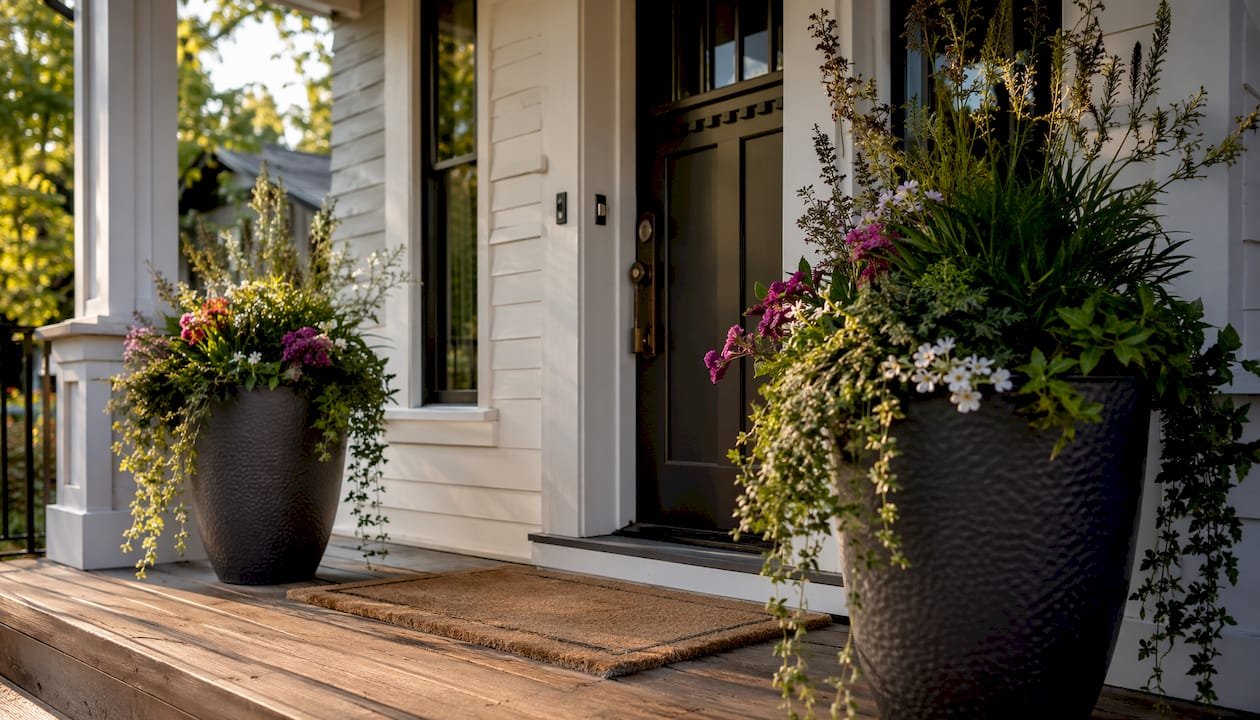
For listing photos specifically, review the preparation checklist for professional listing photography to confirm what to remove from the frame. Turn on all porch lights for dusk shots. Shoot from a slight angle at street level, not from the porch looking down. Remove cars, trash bins, garden hoses, and anything that reads as clutter.
What should you do about the driveway, garage, and windows?
These three elements dominate the facade on most American homes. Neglecting them undermines every other improvement.
- Pressure-wash the driveway. Oil stains and algae growth make a clean house look neglected. A rented pressure washer handles most residential driveways in two to three hours.
- Seal hairline cracks in concrete or asphalt. A $15–$25 tube of concrete crack filler handles most cosmetic cracks. Structural cracking (wide, heaving, or sinking sections) requires a professional assessment.
- Wash all visible windows and frames. Clean glass brightens the interior in photos and signals maintenance. Replace any cracked panes before listing — buyers notice, and inspectors flag them.
- Repair or replace rotted window trim. Rotted trim is a red flag in inspections and photographs poorly. Epoxy wood filler handles small sections; full trim replacement runs $100–$300 per window with a carpenter.
- Assess the garage door. A paint refresh and decorative hardware update ($50–$150) work when the door is structurally sound. Full replacement is warranted when the door is warped, poorly insulated, or stylistically incompatible with the home.
Garage door replacement consistently ranks among the highest-recoup exterior projects in national cost-versus-value analyses, alongside steel entry doors and manufactured stone veneer. New garage doors typically run $1,200–$4,000 installed, depending on material and style.
Difficulty markers:
- Pressure washing, crack sealing, window washing: DIY
- Window pane replacement, trim repair: DIY to trade hire
- Structural driveway resurfacing: hire a licensed contractor
- Garage door replacement: hire a licensed installer
How should you prioritize curb appeal projects?
The Clean, Repair, Improve sequence exists for a practical reason: skipping steps leads to rework and higher costs. New mulch laid over weeds is wasted money. Fresh paint on unprimed, dirty wood fails within months. A staged approach, as Precision Remodeling Solutions outlines, moves from structural and waterproofing repairs through surface prep to major installations and then cosmetic finishes.
Decision matrix:
| Project Type | Recommended Approach |
|---|---|
| Cleaning (pressure wash, window wash) | DIY |
| Mulching, edging, basic planting | DIY |
| Door and trim painting | DIY or trade hire |
| Lighting fixture swap (existing box) | DIY |
| New hardwired electrical | Licensed electrician |
| Crack sealing (cosmetic) | DIY |
| Structural driveway repair | Licensed contractor |
| Garage door replacement | Licensed installer |
| Full siding replacement | Licensed contractor |
Cost and timeline tiers:
| Tier | Budget Range | Sample Projects | Typical Timeline |
|---|---|---|---|
| Quick wins | Under $1,000 | Pressure wash, mulch, door paint, hardware, lighting | 1–2 weekends |
| Moderate | $1,000–$5,000 | Garage door refresh, professional landscaping, window repairs | 2–6 weeks |
| Major | Over $5,000 | Garage door replacement, full siding repaint, hardscape | 4 weeks |
Seasonal and HOA considerations: In most U.S. climates, spring and early fall are the best windows for planting and exterior painting. Avoid painting in temperatures below 50°F or above 90°F. Always check HOA guidelines before selecting paint colors, fence materials, or hardscape changes — violations can delay a listing.
Which curb appeal projects move the needle most for sellers?
Targeted focal-point upgrades consistently outperform large, unfocused spending. A painted door, updated hardware, and fresh mulch shift buyer perception more reliably than a full driveway replacement that buyers may not notice.
National cost-versus-value data, referenced by Precision Remodeling Solutions, places garage door replacement, steel entry door installation, and manufactured stone veneer among the highest-recoup exterior investments. For sellers on tight budgets, the priority list is simpler: clean everything, paint the door, update hardware and lighting, and add fresh mulch. That combination costs well under $1,000 and addresses every element visible in a listing’s hero photo.
Sellers who can invest moderately ($1,000–$5,000) should add a garage door refresh or replacement, professional landscaping, and any deferred window or trim repairs. Zillow’s data puts average pre-listing improvement spend at roughly $5,380, which aligns with a moderate-tier plan covering cleaning, staging, and targeted repairs.
Laxmi Penupothula, ranked in the Top 1% of REALTORS® in Santa Clara County by SCCAOR for five consecutive years, advises sellers to prioritize the projects that appear in the first listing photo. In Silicon Valley’s competitive market, first-photo click-through rate directly influences showing volume, which drives offer count and final price.
What does a 30/60/90-day curb appeal plan look like?
Turn the priority framework into a concrete schedule. Bay Area sellers preparing a home for listing benefit from a phased plan that keeps the property show-ready at each stage.
30/60/90-day checklist:
- Week 1 (Days 1–7): Pressure-wash all hard surfaces. Mow, edge, and weed all beds. Wash windows. Remove clutter from the entry, porch, and driveway. Take before photos from the street.
- Weeks 2–4 (Days 8–30): Paint the front door and trim. Replace house numbers, door hardware, and porch light fixtures. Add fresh mulch. Plant seasonal color in beds or containers. Repair hairline cracks in the driveway.
- Days 31–60: Address moderate projects: garage door refresh or replacement, professional landscaping if needed, window trim repairs, and any deferred exterior painting.
- Days 61–90: Complete major projects requiring permits or contractors (structural driveway work, full siding repaint, new hardwired lighting circuits). Conduct a final walk-around from the street and photograph results.
Sample budget template:
| Line Item | DIY Estimate | Pro Estimate |
|---|---|---|
| Pressure washing | $40–$80 (rental) | $150–$300 |
| Mulch and edging | $50–$100 | $200–$500 |
| Front door paint and hardware | $80–$150 | $300–$500 |
| Porch lighting (2 fixtures) | $100–$300 | $300–$500 |
| Garage door refresh (paint + hardware) | $100–$200 | $300–$500 |
| Garage door replacement | N/A | $1,200–$4,000 |
| Professional landscaping | N/A | $500–$3,000 |
Document every improvement with receipts and before/after photos. This documentation supports your listing marketing narrative and gives buyers confidence in the home’s condition. Sellers working with a concierge listing specialist can hand this documentation directly to their agent for inclusion in the disclosure package and marketing materials.
Safety and accessibility enhancements as part of curb appeal
Safety improvements serve double duty: they protect residents and visitors, and they eliminate the red flags that buyers and inspectors flag during the sale process.
High-priority safety items:
- Repair cracked or uneven walkway sections. A raised edge is a trip hazard and a liability. Concrete leveling compound handles minor lips; full slab replacement is needed for heaving sections.
- Secure loose railings on steps and porches. A wobbly railing fails inspection and signals deferred maintenance to buyers.
- Ensure adequate pathway lighting. Well-lit walkways reduce fall risk and are a visible signal of a well-maintained property. Solar stake lights handle most residential paths without any electrical work.
- Check step risers for consistent height. Inconsistent riser heights are a common trip hazard, particularly on older wood porches.
- Install a handrail if steps exceed two risers. Most U.S. building codes require a handrail for three or more steps. Verify local requirements before listing.
Accessibility improvements, such as a gently sloped entry path or a wider walkway, add value for a broader buyer pool and align with EPA Greenscaping principles that favor low-maintenance, functional outdoor spaces. These are not luxury upgrades; they are practical investments that reduce liability and widen buyer appeal.
Common mistakes to avoid in curb appeal improvements
Most curb appeal errors fall into one of three categories: wrong sequence, wrong scale, or wrong focus.
Sequence mistakes:
- Planting before weeding and edging. New plants surrounded by weeds look worse than no plants at all.
- Painting before cleaning and priming. Paint applied to dirty or unprepared surfaces fails quickly and costs more to redo than to do correctly the first time.
- Replacing before repairing. A new garage door installed on a damaged frame is a waste of money.
Scale mistakes:
- Oversized planters or furniture on a small porch. Proportion matters. A bench that blocks the door or planters that crowd the entry make the space feel smaller, not more welcoming.
- Landscaping that overwhelms the architecture. Tall shrubs planted directly against the foundation hide the home’s lines and can cause moisture problems.
Focus mistakes:
- Spending heavily on the backyard before the front. Buyers form their first impression at the curb, not the patio.
- Choosing trendy colors that date quickly. Neutral, classic palettes hold their appeal across buyer demographics and photography conditions.
- Ignoring the most common listing preparation errors that sellers make, including leaving personal items, worn mats, and dead plants in the entry frame.
The NARI (National Association of the Remodeling Industry) recommends getting at least two contractor bids for any project over $1,000 and verifying licenses and insurance before work begins. This applies to landscaping, painting, electrical, and structural repairs alike.
Key Takeaways
The highest-impact curb appeal improvements follow a clear sequence: clean first, repair second, then invest in visible upgrades that appear in the listing’s first photo.
| Point | Details |
|---|---|
| Clean before you spend | Pressure washing often eliminates the need for paint, resurfacing, or replacement. |
| Sequence prevents rework | Follow Clean, Repair, Improve to avoid spending on cosmetics that hide structural issues. |
| Focal points drive perception | Door, lighting, hardware, and fresh mulch shift buyer perception for under $1,000. |
| Garage door has strong ROI | Replacement and refresh rank among the highest-recoup exterior projects in national data. |
| Laxmitoprealtor’s concierge approach | Laxmi Penupothula coordinates pre-sale inspections, staging, and targeted upgrades to maximize listing impact in Silicon Valley. |
The projects sellers underestimate most
Most sellers focus on what to add. The more experienced move is knowing what to remove and what to clean before spending a dollar on anything new. In Silicon Valley’s market, where listing photos circulate across dozens of platforms within hours of going live, the entry shot is the product photo. A cracked walkway, a mismatched light fixture, or a front door in a color that photographs poorly can suppress click-through rates before a single buyer visits.
The sellers who see the clearest results are those who treat the exterior as a staged environment, not a maintenance checklist. That means photographing the home from the street before starting, identifying the three to five elements that most undercut the overall impression, and addressing those specifically rather than spreading a budget across every surface. A $200 front door repaint and $60 in mulch, executed well, outperforms a $2,000 driveway seal that buyers never consciously notice.
For Bay Area sellers specifically, the competitive listing environment rewards precision. Buyers in Cupertino, Sunnyvale, and San Jose are sophisticated; they notice the difference between a home that has been thoughtfully prepared and one that has been hastily touched up. The sequence, the details, and the photography all matter.
Laxmitoprealtor’s concierge pre-sale service for Silicon Valley sellers
Sellers who want results like a San Jose home sold $100K over asking don’t get there by accident. Laxmitoprealtor’s concierge pre-sale service handles the full preparation process, from pre-listing inspection and contractor coordination to professional staging, photography, 3D Matterport tours, and a custom marketing strategy built around your home’s specific strengths.

What the concierge service includes:
- Pre-sale inspection to identify and prioritize repairs before buyers see them
- Professional home staging tailored to your home’s architecture and buyer profile
- High-resolution photography, videography, and 3D Matterport tours
- Contractor coordination for targeted exterior upgrades
- 2D floor plans and a custom marketing strategy for maximum exposure
This service is particularly well-suited for sellers managing a fast timeline, out-of-town owners who cannot oversee contractor work directly, and homeowners who want to maximize final sale price without guessing which improvements matter most in their specific neighborhood. Laxmi Penupothula has closed over $650 million in sales across 570+ transactions in Santa Clara County, earning the SCCAOR REAL Award for Top 1% of members every year from 2021 through 2025.
Contact Laxmitoprealtor for a free pre-listing consultation and find out which curb appeal investments will move the needle most for your specific property and neighborhood.
Useful sources and further reading
- National Association of REALTORS® — How to Boost Curb Appeal in Two Weekends or Less: Practical weekend-by-weekend action plan from NAR’s Styled, Staged & Sold resource.
- Zillow — Exterior Home Improvements to Help You Sell: Data-backed guidance on which exterior upgrades affect sale price and buyer interest, including lighting and pre-listing spend averages.
- GenRoom — Exterior Home Makeover Complete Guide: Before-and-after cost breakdowns and paint-first guidance for homeowners planning a full exterior refresh.
- Precision Remodeling Solutions — How to Upgrade Your Home Exterior: Sequencing framework and cost-versus-value data for garage doors, entry doors, and stone veneer.
- NestNoted — Real Estate Listing Tracker: Useful for buyers and sellers tracking listing engagement and understanding how curb appeal affects click-through on active listings.
Recommended
- San Jose Home Selling Tips 2026 | Increase Value Fast
- How to Maximize Your Home’s Value Before Selling in Fremont, CA
- Top 7 Home Upgrades That Increase Value in San Jose & Sunnyvale CA
- Prepare Your Milpitas Home for Sale: 6 Proven Steps (2026 Guide)

Laxmi Penupothula
RealTrends Verified Top 1% REALTOR® Nationwide (2021–2025) • CA DRE #02047105
SCCAOR Top 1% Santa Clara County • Intero Chairman Circle 2023–2025 • \$650M+ Closed • 570+ Transactions
Silicon Valley & Bay Area Specialist — Cupertino, San Jose, Fremont, Milpitas, Sunnyvale & surrounding cities.
Get a Free Home Valuation →