


Cupertino works best for families and tech professionals who will pay a premium for top-rated public schools, low crime, and proximity to major Silicon Valley employers. It does not work well for anyone who wants nightlife, walkability, or a bargain. Homes sell well into the seven figures, the Cupertino Union School District and Fremont Union High School District anchor most buying decisions, and daily life runs almost entirely on a car.
TL;DR:
- Homes in top school zones sell quickly, often within two weeks, and prices frequently exceed a million dollars for desirable neighborhoods.
- Living costs are significantly above the national average, with housing expenses being the primary driver, requiring a household income in the low-to-mid six figures for comfort.
- School boundary confirmation is vital, as boundaries can change between years, and homes can be split between districts, affecting both price and enrollment.
- The city relies heavily on cars for daily life, with limited walkability and public transit options, making weekday commutes and drive times essential to evaluate beforehand.
- The main buyer profiles thrive when prioritizing school quality and proximity to Apple, while underestimating boundary impacts or skipping commute tests can lead to challenges.
Table of Contents
- Neighborhoods and Housing: Where to Live and What It Costs in Cupertino
- What Does It Cost to Live Comfortably in Cupertino?
- How Are Cupertino Schools Organized, and What Should Parents Do First?
- What’s the Commute Really Like in Cupertino?
- Everyday Life, Amenities, and Safety in Cupertino
- Practical Moving Checklist for Relocating to Cupertino
- Where Do Cupertino Residents Go for Healthcare?
- What Does Cupertino’s Job Market Look Like?
- What Does Community Life Look Like in Cupertino?
- Where Do Cupertino Residents Shop for Groceries and Daily Essentials?
- A Local REALTOR®’s View on Who Actually Thrives Here
- How Laxmitoprealtor Helps Families Make the Move
- Sources
- FAQ
Neighborhoods and Housing: Where to Live and What It Costs in Cupertino
Cupertino’s neighborhoods split mostly along school assignment and topography rather than architectural style, since most housing stock dates from the 1960s through the 1980s. Monta Vista, on the west side near the hills, draws buyers chasing Monta Vista High School’s reputation and pays a visible premium for it. Homestead and the Lynbrook attendance area sit closer to Interstate 280 and offer slightly more inventory turnover, though the difference in price rarely exceeds a few percentage points. Oak Valley, a newer gated development near Highway 85, appeals to buyers who want a homeowners’ association, amenities like a clubhouse and pool, and more consistent home ages. Quieter pockets north of Stevens Creek Boulevard suit retirees and remote workers who want less foot traffic near the Apple campus corridor.
Inventory stays tight year round, and well-located homes in strong school zones routinely draw multiple offers within the first two weeks of listing. Rentals follow the same logic: a two-bedroom apartment near a top elementary school rents for noticeably more than an equivalent unit two miles away in a different attendance zone.
- Get full mortgage pre-approval before touring anything. Homes in desirable zones move fast, and sellers rarely wait on financing contingencies.
- Confirm the exact school boundary for any address before writing an offer. Boundaries can split a street down the middle.
- Schedule inspections within 48 hours of an accepted offer. Competitive timelines leave little room to negotiate extra days.
- Ask about planned renovations or additions. Many 1970s ranch homes have already been expanded, and permit history affects resale value.
Pro Tip: Cross-check a home’s address against the current school boundary map before you fall in love with it. Boundaries occasionally shift between school years, and the map on a real estate listing site is not always the most current version.
For buyers weighing higher-end inventory specifically, a luxury home buying guide for Cupertino walks through what separates premium listings from standard resale stock in this market.
What Does It Cost to Live Comfortably in Cupertino?
Salary shows Cupertino running well above the national average across nearly every category, with housing costs being the primary contributor. Groceries, utilities, and transportation add up too, but housing is where budgets get tested.
By the numbers: Salary.com’s cost-of-living index for Cupertino places overall expenses significantly above the U.S. average, with housing costs the single largest contributor to that gap.
A single professional renting a one-bedroom apartment and covering typical utilities, groceries, and a car payment should plan a monthly budget that comfortably clears several thousand dollars before discretionary spending. A family of four owning a home with a mortgage, two vehicles, and school-related activities will see a monthly budget run considerably higher once property taxes and insurance are factored in.
As a rule of thumb, a household earning in the low-to-mid six figures combined can live comfortably in Cupertino without major sacrifice, while households below that threshold often find themselves stretched, particularly if they are renting rather than owning.
A few ways to close the gap without leaving the school district:
- Consider a smaller unit in Homestead’s boundary rather than a larger one in Monta Vista, since the price difference can be substantial for a similar quality of life.
- Carpool or use an employer shuttle to cut transportation costs, since two-car households in Cupertino pay a real premium in insurance and parking.
- Look at shared housing arrangements near De Anza College if you’re single and new to the area.
How Are Cupertino Schools Organized, and What Should Parents Do First?
Cupertino’s school system runs on a two-district structure that every relocating parent needs to understand before house-hunting. The Cupertino Union School District operates 19 elementary schools and 4 middle schools, while high schools fall under the separate Fremont Union High School District. Both districts carry strong academic reputations, which is exactly why school boundaries move home prices so dramatically in this city.
Parents should treat boundary confirmation as step one, not step three:
- Pull the current elementary, middle, and high school assignment for any address you’re considering, directly from the district’s boundary tool.
- Visit schools during an open house or back-to-school event rather than relying only on ratings sites.
- Check enrollment deadlines early. Many families start their home search 6 to 12 months before the school year they’re targeting, specifically to line up closing dates with enrollment windows.
- Ask your agent about a backup zone in case your top-choice boundary home falls through during a competitive bidding process.
Pro Tip: If you’re relocating mid-year, call the district enrollment office before you sign a lease or close on a home. Mid-year transfers have separate paperwork timelines that can catch newcomers off guard.
What’s the Commute Really Like in Cupertino?
Cupertino runs on cars. Walk Score data puts most neighborhoods well below what’s considered walkable, and there’s no in-city Caltrain station, which means public transit rarely covers the full trip for anyone commuting outside the immediate area.
Apple Park’s presence pushes serious peak-hour congestion along Wolfe Road, De Anza Boulevard, and the I-280 interchanges near it. A commute to Apple Park itself can take ten minutes; the same trip to downtown San Jose often runs 25 to 35 minutes depending on the hour, and reaching a Caltrain station usually means driving to Sunnyvale or Mountain View first.
- Test your actual commute on a weekday morning before you commit to a neighborhood, not just on a weekend drive-by.
- Ask prospective employers about shuttle programs, since several large tech campuses run their own routes from nearby transit hubs.
- Budget extra time for the “last mile” between any transit stop and your final destination. It’s rarely a short walk.
Everyday Life, Amenities, and Safety in Cupertino
Cupertino trades nightlife for quiet. The dining scene leans heavily into Asian cuisines along Stevens Creek Boulevard and Wolfe Road, reflecting the city’s demographics, and it’s genuinely strong if you like Taiwanese, Cantonese, or Indian food. Families lean on Memorial Park for weekend sports and events, Blackberry Farm for picnics and a public pool, and De Anza College for both community classes and cultural programming.
Safety is a major draw. Violent crime stays low citywide, though residents should still expect the same property-crime patterns common across affluent Bay Area suburbs, mainly vehicle break-ins and porch package theft rather than anything more serious.
- Park in a garage or well-lit driveway rather than on the street when possible.
- Have packages held at a secure locker or delivered to a workplace if you’re not home during the day.
- Head to San Jose or Palo Alto for concerts, bars, or a livelier evening out. Cupertino itself quiets down early.
Local guides describe the city’s residential character as suburban and family-centered almost by design, which lines up with what most newcomers notice within their first month.
Practical Moving Checklist for Relocating to Cupertino
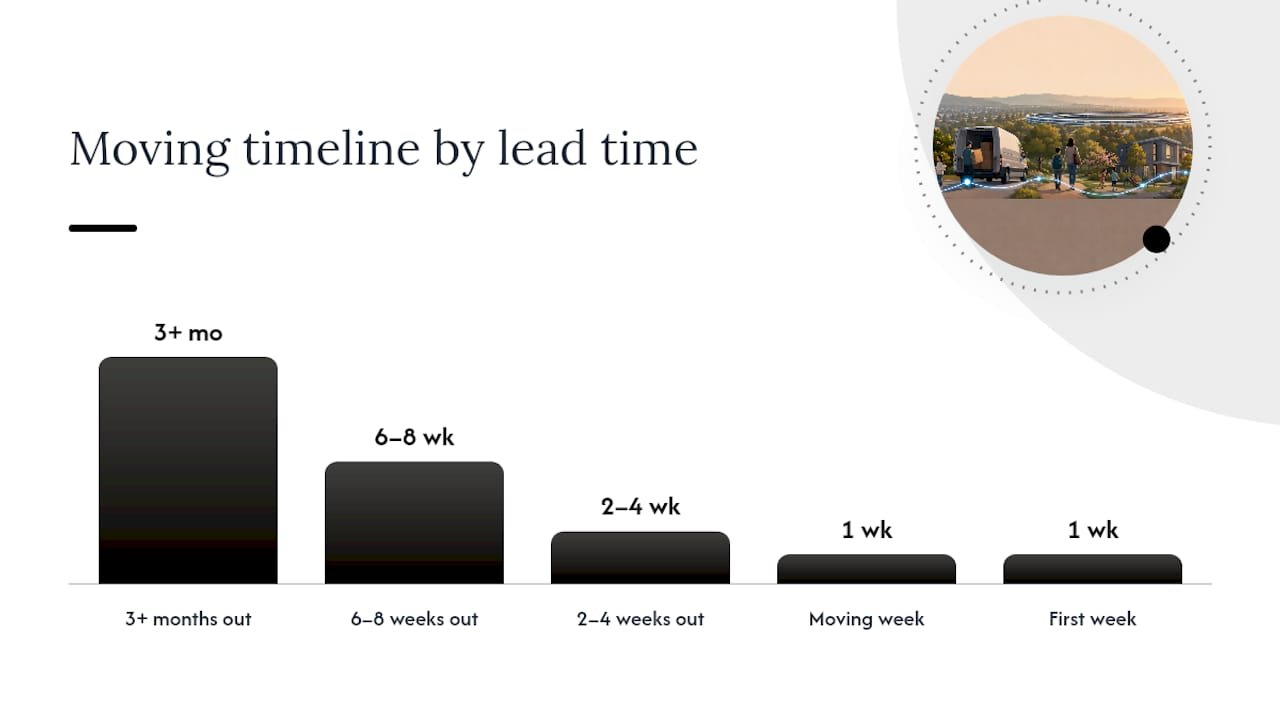
Treat a Cupertino move as a project with a real timeline, not a last-minute scramble.
- 3+ months out: Secure mortgage pre-approval, confirm school boundaries, and start comparing moving quotes.
- 6 to 8 weeks out: Book movers or a storage unit, and begin sorting what actually needs to make the trip. Public Storage operates a facility in Cupertino that’s a common option for families bridging a gap between homes.
- 2 to 4 weeks out: Set up utilities, submit change-of-address forms, and finalize school enrollment paperwork.
- Moving week: Confirm arrival windows with your moving company and do a final walkthrough of your old address.
- First week after: Register with the city, get library cards, and locate the nearest sheriff and fire station contacts through Cupertino’s New Residents page.
When comparing movers, ask directly about valuation coverage, whether furniture disassembly is included, and how they handle delays. A guide to furniture disassembly services covers the right questions to ask before you sign a contract.
Pro Tip: Get insurance valuation in writing before moving day, not after. Verbal estimates from movers rarely match what actually gets reimbursed if something breaks.
Where Do Cupertino Residents Go for Healthcare?
Cupertino itself has no full-service hospital within city limits, so residents rely on nearby facilities in adjacent cities for anything beyond routine care. El Camino Health in Mountain View and Kaiser Permanente Santa Clara are the two most commonly used hospital systems for Cupertino families, both roughly a 15 to 20 minute drive depending on traffic. Stanford Health Care facilities in Palo Alto handle more specialized cases and are a common referral point for residents carrying Stanford-affiliated insurance plans.
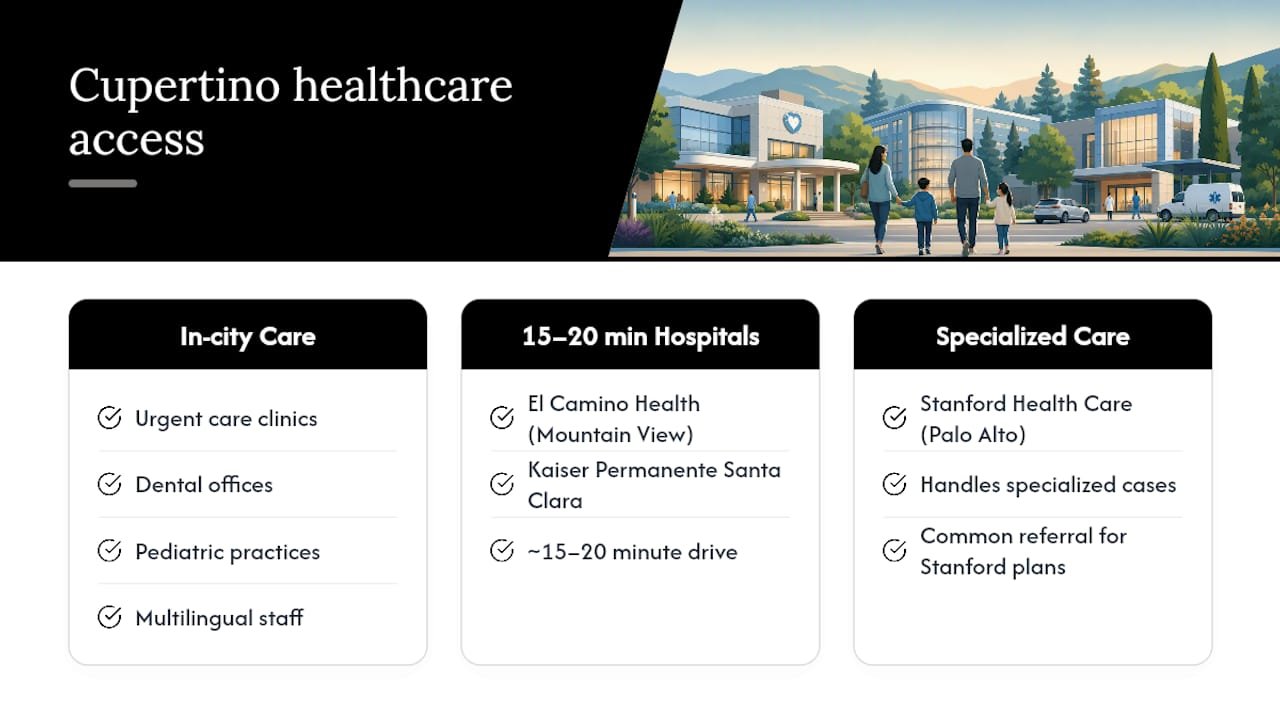
For everyday care, Cupertino has a solid network of urgent care clinics, dental offices, and pediatric practices concentrated along Stevens Creek Boulevard and De Anza Boulevard, many catering specifically to the city’s large Asian-American population with multilingual staff. Families relocating from areas with an in-city hospital should factor the drive time into decisions about which neighborhood to choose, particularly if a household includes elderly parents or young children who may need frequent pediatric visits. Most residents describe the healthcare access as strong on quality but dependent entirely on driving, consistent with the rest of the city’s car-oriented layout.
What Does Cupertino’s Job Market Look Like?
Cupertino is, in practical terms, a company town. Apple headquarters at Apple Park anchors the local economy and employs thousands directly in the city, with a footprint that shapes traffic, housing demand, and even restaurant hours around the campus. Beyond Apple, the broader employment picture includes numerous smaller tech firms, startups, and satellite offices for larger Silicon Valley companies that cluster along the same corridors.
Many residents don’t actually work in Cupertino itself. It’s common for households to have one spouse commuting to Apple or a nearby tech employer while the other travels to San Jose, Sunnyvale, or Mountain View, which reinforces the city’s two-car, two-commute reality. Retail, education, and healthcare round out the remaining local job base, though salaries in those sectors haven’t kept pace with the tech-driven cost of living, which is part of why the housing market skews so heavily toward dual-income tech households.
For anyone relocating specifically for a role at a nearby employer, it’s worth mapping the actual commute before choosing a neighborhood rather than assuming proximity to Cupertino automatically means a short drive to your office.
What Does Community Life Look Like in Cupertino?
Community life in Cupertino centers on schools, parks, and a genuinely active civic calendar rather than bars or nightlife. The city runs a full slate of recreation programs through its Parks and Recreation Department, covering everything from youth sports leagues to senior center activities and adult enrichment classes. Memorial Park hosts the city’s larger public events, including seasonal festivals and outdoor movie nights that draw families from across the city.
Cultural and civic organizations reflect Cupertino’s demographics closely, with active groups supporting the city’s large Chinese-American, Taiwanese-American, and Indian-American communities, many organized around temples, cultural centers, and language schools that meet on weekends. Parent-teacher organizations tend to be unusually active given the emphasis on school performance, and many newcomer families report that PTA involvement is one of the fastest ways to build a local social network. De Anza College also runs public lecture series and community events open beyond its student population.
For residents wanting a broader social or professional network, the surrounding cities fill in gaps Cupertino doesn’t cover on its own, particularly for young professionals without kids who find the city’s family-first culture a bit quiet on weeknights.
Where Do Cupertino Residents Shop for Groceries and Daily Essentials?
Grocery access in Cupertino skews heavily toward stores serving the city’s Asian-American population, and that’s a genuine advantage for residents who cook with ingredients harder to find in a typical American supermarket. 99 Ranch Market and similar Asian grocery chains sit within a short drive for most neighborhoods, alongside mainstream options like Safeway and Whole Foods along Stevens Creek Boulevard and De Anza Boulevard.
Because the city is car-dependent, almost no neighborhood offers true walk-to-grocery convenience, so residents plan shopping trips around their weekly driving routine rather than popping out on foot. The Marketplace shopping center and nearby retail clusters cover most everyday needs, from pharmacies to home goods, without requiring a trip outside city limits. For specialty or bulk shopping, many residents drive the short distance into Sunnyvale or San Jose, where larger retail centers offer more variety.
Farmers markets run seasonally and add a nice option for fresh produce, though they’re a supplement to regular grocery runs rather than a replacement for them in a city built around car trips rather than walkable retail corridors.
A Local REALTOR®’s View on Who Actually Thrives Here
Families chasing school quality and tech professionals shortening their commute to Apple Park are the two client profiles who consistently end up glad they moved to Cupertino. The buyers who struggle are usually the ones who underestimate how much a school boundary can swing a home’s price, or who skip a weekday commute test before falling for a floor plan.
A proper comparative market analysis, paired with concierge preparation like professional staging and photography for sellers on the other side of the transaction, tends to prevent both problems. If you’re weighing a move and want a real conversation about which neighborhood fits your priorities, Laxmi Penupothula’s Cupertino agent profile is a good place to start that conversation.
How Laxmitoprealtor Helps Families Make the Move
This local service offers experienced guidance for a Cupertino move, with detailed knowledge of school boundaries in the city. With detailed knowledge of local neighborhoods and experience in a competitive market, this service helps buyers move quickly without missing important details such as school boundaries.

An initial consultation typically covers your target school zone, a realistic budget range based on current inventory, and a plan for pre-approval timing so you’re ready to compete the moment the right listing appears. For sellers preparing to leave Cupertino, that conversation covers staging, photography, and pricing strategy to support the sales process. [author_bio]
If you’re ready to talk specifics, start with a Cupertino property search or reach out through the Bay Area real estate FAQ page for answers to common relocation questions before your first showing.
Sources
- Education — City of Cupertino
- Salary
- Cupertino, CA Walk Score
- Public Storage — Cupertino, CA facility
FAQ
Is Cupertino a Good Place to Live?
Cupertino is an excellent fit for families prioritizing top-rated public schools and low crime, and for professionals working near Apple Park, though it demands a high housing budget and heavy reliance on a car.
What Salary Do You Need to Live Comfortably in Cupertino?
A household earning in the low-to-mid six figures combined can typically live comfortably in Cupertino, according to Salary.com’s cost-of-living estimates, while households below that range often feel stretched, especially if renting.
What Percent of Cupertino’s Population Is White?
Cupertino’s demographics skew heavily Asian-American, with white residents making up a minority of the population; the city’s dining, retail, and cultural life reflect that composition strongly, particularly its large Chinese-American and Taiwanese-American communities.
Is Cupertino Better Than Sunnyvale?
Cupertino generally offers stronger school ratings and lower crime, while Sunnyvale tends to offer slightly more housing variety and marginally easier access to Caltrain, so the better choice depends on whether school assignment or transit access matters more to your household.
Recommended
- 5 Reasons to Move to Cupertino, CA
- Buy a Home in the Bay Area: The Smart 2026 Guide
- Relocating to Silicon Valley? Complete Home Buying & Moving Guide
- Selling in California? Here’s How to Use School Ratings to Your Advantage

Laxmi Penupothula
RealTrends Verified Top 1% REALTOR® Nationwide (2021–2025) • CA DRE #02047105
SCCAOR Top 1% Santa Clara County • Intero Chairman Circle 2023–2025 • \$650M+ Closed • 570+ Transactions
Silicon Valley & Bay Area Specialist — Cupertino, San Jose, Fremont, Milpitas, Sunnyvale & surrounding cities.
Get a Free Home Valuation →