


Luxury home staging reveals a property’s architecture and lifestyle potential rather than neutralizing it, and that distinction is what supports higher offers and faster sales. It works because it sells a way of living, not just square footage. This guide covers both delivery paths, physical staging and high-fidelity virtual staging, and how sellers and agents choose between them.
TL;DR:
- Luxury staging generally costs between $30,000 and $50,000 for large estates, with custom furniture and insured artwork being common expenses.
- Large-scale projects typically require two to three weeks from design approval to completion, with physical setup taking one to two days.
- Virtual staging is a faster, cheaper alternative suitable for occupied homes or quick turnarounds but requires high-quality rendering and clear disclosure.
- Staged homes tend to sell for one to ten percent more than unstaged homes and spend 73% less time on the market.
- Effective staging focuses on highlighting unique architectural features and creating clear circulation paths to enhance buyer perception and confidence.
Table of Contents
- Why Luxury Staging Moves Money for Sellers and Agents
- How Luxury Staging Differs From Standard Staging
- What Luxury Staging Costs and How Long It Takes
- The Staging Process, Step by Step
- How to Choose a Luxury Home Staging Professional
- Who Is Behind This Guide
- An Editorial Take on What Actually Drives Staging ROI
- Ready to Plan Your Staging and Listing Strategy?
- Sources
- FAQ
Why Luxury Staging Moves Money for Sellers and Agents
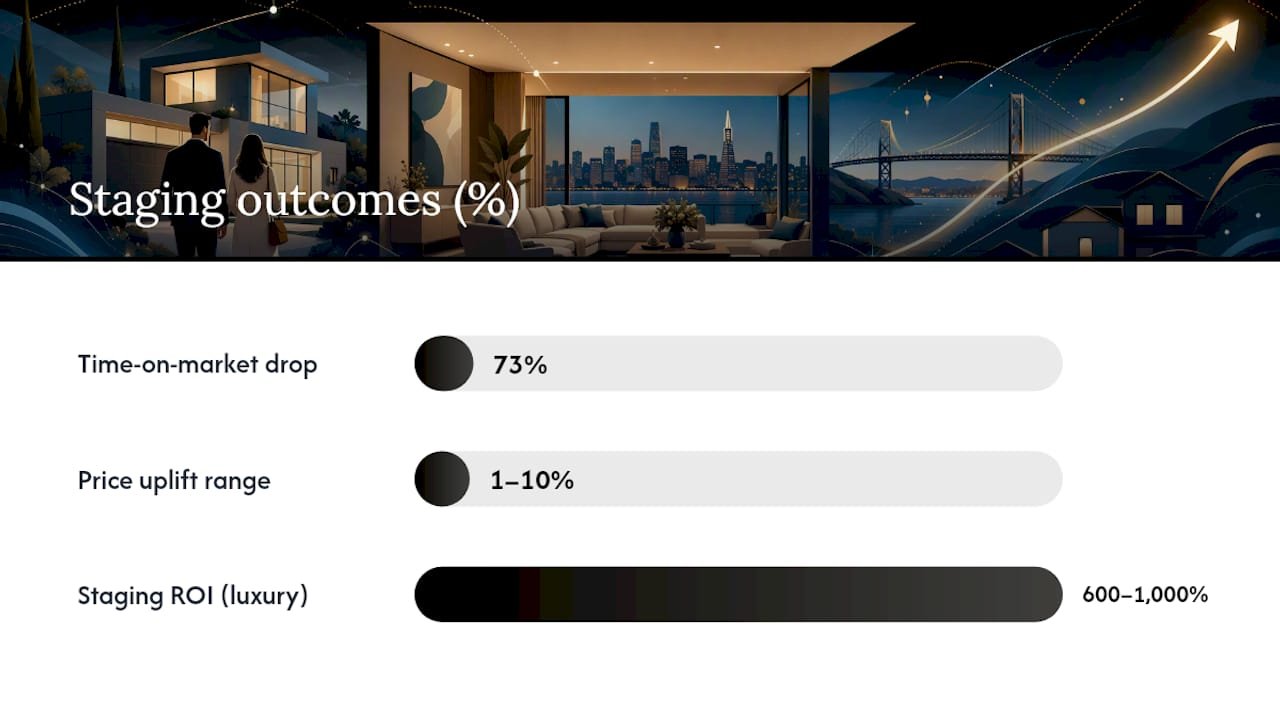
Staged homes spend 73% less time on market and often sell for 1 to 10% over the listing price, according to industry data compiled by Vesta. On a $4 million listing, a 5% uplift is $200,000. That single figure is why serious agents stop treating staging as decor and start treating it as pricing strategy.
Inman’s reporting backs this up from the cost side. Staging investments in the $30,000 to $50,000 range on luxury listings can generate 600 to 1,000% ROI when the higher sale price and faster close are weighed against the spend. A $40,000 staging budget returning even a 3% price lift on a $5 million home nets $150,000, well past the cost of the work itself.
For agents, the benefit runs beyond any single commission check. NAR research on luxury listings found that presentation investments help buyers visualize themselves in a space, and that this often becomes the tool an agent uses to break into a higher price tier for future listings.
What staging buys sellers and agents, concretely:
- Faster days on market, which protects a listing’s momentum and pricing narrative
- Price uplift that regularly outpaces the staging spend by a wide margin
- A stronger position for repricing if the home needs to sit through a slow week or two
- Credibility with buyers’ agents who show a staged home more confidently
How Luxury Staging Differs From Standard Staging
Standard staging neutralizes a home so buyers can imagine anything, while subtle architectural elements like glass interior doors enhance perceived luxury and reveal the home’s unique character. Luxury staging does the opposite: it reveals what is already exceptional. CHS Design describes this contrast directly: marble slabs, wide-plank hardwood, and glass walls get pulled forward as focal points instead of being softened into a beige backdrop. A stager working a Los Altos Hills estate with a book-matched marble entry will not cover it with a runner. They will strip the space around it so the stone does the talking.
That approach in practice follows a few consistent rules:
- Fewer, stronger pieces beat a full room set. One correctly scaled console reads as intentional; five smaller ones read as clutter.
- Circulation paths matter as much as furniture choice. Buyers need a clear, wide walking line through every room they tour.
- Large rooms get zoned into smaller functional areas, a conversation grouping here, a reading nook there, so scale does not overwhelm the sense of livability.
- Fine art and curated objects earn their place by telling a story about the home’s lifestyle, not filling wall space.
On that last point, some agencies now treat original artwork as a functional part of the sale, coordinating installation, insurance, and logistics so the piece becomes part of the walk-through experience.
Pro Tip: Walk the home before staging begins and identify its one best architectural feature, whether that is a fireplace, a window wall, or a staircase. Every design decision should point back to that feature, not compete with it.
What Luxury Staging Costs and How Long It Takes
Budgets vary by square footage, but the drivers are consistent: custom furniture pieces, white-glove delivery and installation, and insurance coverage for fine art if it is part of the plan. A modest luxury condo staging might run in the low five figures. A sprawling estate with custom fabrication, multiple zones, and insured artwork can land in the $30,000 to $50,000 range that Inman cites as typical for luxury listings.
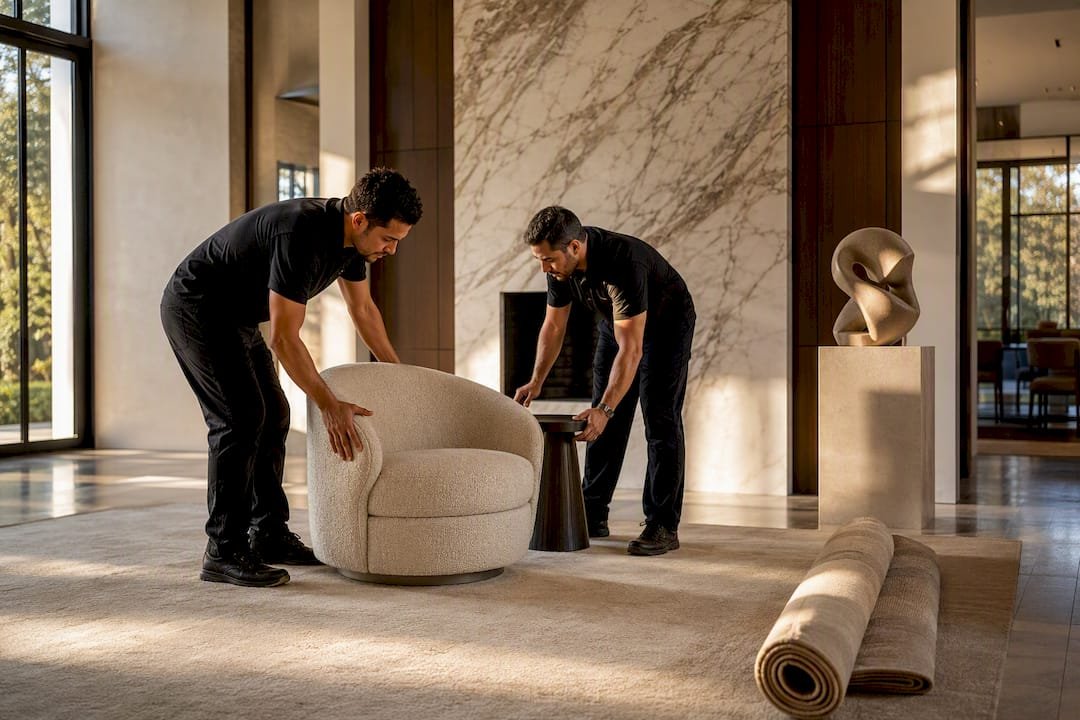
Timelines compress more than most sellers expect. Large-scale projects typically run 2 to 3 weeks from initial design approval to move-in ready, with custom fabrication eating most of that window and physical installation completing in 1 to 2 days on site. Smaller luxury projects can move faster, sometimes inside a single week if inventory is in stock rather than custom-built.
Staging proposals should spell out:
- Whether furniture and art are rented or purchased outright, and what happens to unsold inventory at closing
- A clear itemized cost breakdown separating design fees, inventory, delivery, and insurance
- Whether the stager offers a clause letting sellers recoup staging costs if furnishings or artwork sell along with the house
For a full breakdown by property size and market, a detailed cost guide is worth reviewing before setting a budget.
The Staging Process, Step by Step
Getting from an empty listing to market-ready photography follows a predictable sequence, whether the home is 3,000 square feet or 15,000.
- Assessment and brief. The stager walks the property, identifies its strongest features, and sets a design direction with the agent and seller.
- Design plan. Room-by-room layouts, furniture selections, and art placement get approved before anything is ordered.
- Sourcing and fabrication. Custom pieces get built or pulled from inventory; this stage consumes most of the timeline.
- Installation. Crews complete the physical setup, typically in 1 to 2 days for large homes.
- Photography. The home gets shot once staging is complete and every detail is in place.
- Listing launch. Marketing goes live with staged images as the centerpiece.
Virtual staging is a legitimate alternative when a property is occupied, access is limited, or turnaround needs to be fast. It is faster and cheaper than physical staging, but every virtually staged photo must carry a clear disclosure, and the rendering quality has to match what a buyer touring in person would expect. For prestige properties, physical staging remains the default because it delivers the turnkey, move-in-ready walk-through that high-net-worth buyers expect; virtual staging works best as a supplement, not a substitute, for the flagship listing photos.
On install day, the agent’s job is to clear the schedule, confirm photographer access for right after installation wraps, and do a final walk for scale checks, light and flow, and curb appeal before the camera comes out. A staging and prep checklist helps keep that day organized, and lining up a photographer who specializes in listing work in advance avoids a costly delay between install and launch.
How to Choose a Luxury Home Staging Professional
Portfolio quality tells you more than a sales pitch ever will. Look for evidence of white-glove logistics, fine-art handling experience, and a track record of coordinating directly with photographers rather than treating photography as an afterthought.
Ask these questions in the first meeting:
- What is the guaranteed timeline from contract to installation complete?
- Can you provide an itemized cost breakdown, separated by design, inventory, delivery, and insurance?
- Who owns the furniture and art during the listing, and what are the purchase or rental terms if a buyer wants a piece?
- Do you carry insurance for fine art and high-value pieces on site?
- Can you share references from listings in a comparable price range?
Red flags to walk away from: catalog-style staging with the same furniture set showing up in every portfolio photo, vague or shifting timelines, no client references, and no coordination plan with the listing photographer. At the top of the market, staging is not an optional add-on. Some agents now make it a non-negotiable line item for listings above roughly $2 million, building the cost directly into the listing strategy rather than treating it as a seller favor.
Pro Tip: Ask a prospective stager how they would handle your home’s single hardest feature, an awkward great room, an oddly shaped primary suite. Their answer reveals whether they have solved that exact problem before or are guessing.
Who Is Behind This Guide
Laxmi Penupothula has closed more than $650 million in sales across 570-plus transactions over 8 years in Santa Clara County and the greater South Bay, and has ranked in RealTrends Verified’s top 1% nationally for five consecutive years. That volume means seeing staging decisions play out across hundreds of closings, not theory. For sellers preparing a listing, the Bay Area staging guide and the Mountain View townhouse case study show how these principles play out on real listings.
An Editorial Take on What Actually Drives Staging ROI
The staging industry loves talking about beauty. The data says the real driver is speed of buyer comprehension. A buyer who understands a room’s purpose in three seconds bids differently than one who has to work at it, and that is the whole mechanism behind the ROI figures Inman and Vesta report. Luxury staging is not decoration. It is a comprehension tool aimed at people who are comparing your listing against three others in the same afternoon.
Where conventional advice falls short is in treating staging cost as a single number to minimize. The smarter frame is staging cost as a percentage of expected price uplift, and negotiating the contract terms, purchase versus rental, recoupment clauses on sold furniture, so the net expense shrinks regardless of the upfront figure.
If you take one thing from this guide, prioritize the timeline conversation before the design conversation. A gorgeous staging plan that misses your photography date and delays launch by two weeks can cost more in lost momentum than a mediocre plan executed on schedule. Get the calendar locked first.
— Mr
Ready to Plan Your Staging and Listing Strategy?
For Santa Clara County sellers, some staging conversations now include a concierge process that ties staging directly to pricing strategy, professional photography, and 3D tours, coordinated by one team instead of three separate vendors to manage.

That coordination is what separates a listing that stalls at day 20 from one that closes above ask. Rather than hiring a stager, then hunting for a photographer, then hoping your agent ties it all into a coherent marketing plan, the concierge model handles pre-sale inspections, staging, photography, videography, and floor plans as one sequence built around your launch date. If you are weighing whether staging makes sense for your home, the home staging and prep guide breaks down what to expect for Bay Area properties specifically. Ready to see where your home stands? Request a free home value and selling strategy consultation to get a staging and pricing plan built around your listing.
Sources
- Vesta Home — Home staging FAQs and market outcomes
- Luxury home staging — IACrea (virtual staging guide)
FAQ
How Much Does Luxury Home Staging Cost?
Luxury staging can run from the low five figures for smaller condos up to $30,000 to $50,000 for large estates with custom furniture and insured art.
How Long Does Luxury Staging Take?
Large-scale projects typically take 2 to 3 weeks from design approval to installation, with physical setup completing in 1 to 2 days on site.
Is Virtual Staging Acceptable for Luxury Listings?
Virtual staging works for occupied homes or fast turnarounds, but it must be disclosed in the listing and the rendering quality must match buyer expectations for the price point.
Can Sellers Recoup Staging Costs?
Some staging agreements include a clause letting sellers recover costs when furniture or artwork sells along with the home, which lowers the net expense.
Does Staging Really Increase Sale Price?
Industry data shows staged homes can sell for 1 to 10% over listing price and spend significantly less time on market compared to unstaged listings.
Recommended
- Home Staging Cost in 2025–2026: What Sellers Need to Know
- Home Staging & Prep Guide: Getting Your Bay Area Home Ready to Sell
- 5 Data Backed Pricing Strategies to Sell Luxury Homes in the Bay Area
- Home Staging Checklist: Get Show-Ready and Sell Faster

Laxmi Penupothula
RealTrends Verified Top 1% REALTOR® Nationwide (2021–2025) • CA DRE #02047105
SCCAOR Top 1% Santa Clara County • Intero Chairman Circle 2023–2025 • \$650M+ Closed • 570+ Transactions
Silicon Valley & Bay Area Specialist — Cupertino, San Jose, Fremont, Milpitas, Sunnyvale & surrounding cities.
Get a Free Home Valuation →