


Cupertino remains a tightly held, highly competitive market. Average home values sit near $3.0 million, up modestly over the past year, while well-presented listings in top school zones still draw multiple offers and close above asking. Buyers should lock in financing and move fast on quality homes; sellers who prep properly can still command a premium if they price and launch strategically.
TL;DR:
- Cupertino’s active inventory remains extremely low with only around 3.2 months of supply, favoring sellers and keeping prices steady despite slow growth.
- Homes near top schools like Monta Vista or Lynbrook continue to command premium prices, often selling around 5% above asking within roughly two weeks.
- Buyers should secure pre-approval, budget for offers above asking, and narrow their search to specific neighborhoods or school zones for better chances.
- Sellers benefit most from professional staging, pre-listing inspections, and strategic pricing to attract multiple offers in a competitive market.
- New developments mainly consist of condos and townhomes in high-density areas, unlikely to significantly impact prices of existing single-family homes.
Table of Contents
- What Do Current Cupertino Real Estate Trends Show?
- Why Is Cupertino So Expensive Right Now?
- How Should Buyers Approach the Cupertino Market Today?
- What Should Sellers Do to Maximize Their Sale Price?
- How Do Neighborhoods and School Zones Change the Math?
- Which Local Cupertino Agents Should You Consider?
- Why Trust This Cupertino Market Analysis?
- What New Housing Developments Could Change Cupertino’s Supply?
- What Does the Rental Market Look Like in Cupertino?
- How Are Demographic Shifts Shaping Housing Demand?
- How Do Zoning Rules Affect What Gets Built and Sold?
- What This Market Actually Rewards
- Ready to Move on a Cupertino Home? Here’s the Concierge Advantage
- Where to Verify the Numbers Yourself
- Sources
- FAQ
What Do Current Cupertino Real Estate Trends Show?
Cupertino’s average home value stands at roughly $3,008,438] up about 3.2% year over year as of data through July 2026. That’s a slow, steady climb rather than a spike, which tells you the market has cooled from its most frenzied years without losing its footing.
Local broker data adds texture to that headline figure. Median sale price is running closer to $3.06 million, with homes typically selling around 5% above asking and moving from list to pending in about 16 days. Redfin independently scores Cupertino as a very competitive market, with average prices closer to $2.94 million depending on the snapshot window, reflecting normal month-to-month variation across data providers rather than a contradiction.
Inventory is the real story. Months of supply hovers around 3.2, a level that still favors sellers, and active listings on Realtor typically number in the dozens rather than the hundreds at any given time.
| Metric | Figure | Source Window |
|---|---|---|
| Average home value | $3,008,000 (about 3.2% YoY) | Zillow, through July 2026 |
| Median sale price | ~$3.06M | Local broker snapshot, 2026 |
| Sale-to-list ratio | slightly above asking price | Local broker snapshot, 2026 |
| Months of supply | ~3.2 months | Aegis Luxury Real Estate, Sept. 2026 |
| Median days to pending | about two weeks | Zillow / broker data, 2026 |
Pro Tip: Different platforms pull from different rolling windows, so don’t panic if Zillow, Redfin, and a local broker report show figures $100,000 to $200,000 apart. Treat the range, not any single number, as your baseline.
At 3.2 months of supply, Cupertino is nowhere near the six-month mark that defines a balanced market. Anything under five months still tilts toward sellers, and Cupertino has stayed well below that threshold for years.
Why Is Cupertino So Expensive Right Now?
Three forces converge here: concentrated tech employment, top-rated schools, and a supply base that barely moves. Apple’s headquarters presence anchors a buyer pool with unusually high, dual-income household earnings, and that income floor keeps price competition intense even when rates rise.
School boundaries do heavy lifting on value. Homes zoned for Monta Vista High School or Lynbrook High School routinely command premiums over comparable homes just outside those lines, because families are often buying the boundary as much as the house.
Supply barely budges because most owners have no reason to sell. Many bought decades ago at a fraction of today’s price and locked in property tax basis under Proposition 13, so trading up often means a materially higher tax bill and a materially higher mortgage rate. That keeps resale inventory thin year after year.
- Single-family homes in top school zones remain the strongest, most contested segment.
- Condos and townhomes show more price flexibility and longer days on market.
- Rate-sensitive buyers are increasingly active in the $2 million to $2.5 million band, where financing math is less brutal.
- Ultra-luxury listings above $4 million move slower and reward patient, well-marketed campaigns.
Pro Tip: At Cupertino’s price levels, a quarter-point move in mortgage rates can shift monthly payments by several hundred dollars. Run the math before you fall for a listing photo.
How Should Buyers Approach the Cupertino Market Today?
- Get a firm pre-approval, not a pre-qualification. Lenders need to verify income and assets now, because a soft pre-qualification letter won’t survive a competitive multiple-offer situation.
- Budget for over-ask pricing. With homes averaging around 5% over asking in recent snapshots, add that cushion to your target price range before you start touring.
- Narrow your search to specific school zones or streets. Broad searches waste time in a market this thin; a neighborhood-level guide helps you target realistically.
- Use escalation clauses carefully. They can win a deal, but they also reveal your ceiling to the seller if the listing agent isn’t careful with disclosure.
- Know when to walk away. If a home has sat for over 30 days with no price cut, that’s usually a valuation or condition problem, not a bargain waiting to happen.
Pro Tip: Waiving an appraisal contingency can win a bidding war, but only do it if you have the cash reserves to cover a gap. A pre-approval that models several rate scenarios protects you from overcommitting.
What Should Sellers Do to Maximize Their Sale Price?
Preparation drives outcomes here more than almost anywhere else in the Bay Area, so consider consulting a California Israeli Real Estate Lawyer if you face complex closing or cross-border transaction issues. Homes that get professional staging, high-end photography, and a pre-listing inspection consistently outperform homes that skip that step, based on the pattern of multiple-offer activity versus stalled listings tracked across recent months.
- Order a pre-sale inspection so you can address issues before a buyer’s inspector finds them mid-escrow.
- Invest in staging and a 3D Matterport tour; buyers in this price range expect a polished digital-first presentation.
- Price at or slightly under recent comps to spark competition rather than pricing at your ceiling and hoping.
- Require proof of pre-approval or a strong lender letter before entertaining any offer above asking.
- Consider launching just ahead of the spring wave rather than in the middle of it, when competing listings crowd the same buyer pool.
A detailed staging and prep guide walks through the specific upgrades that tend to pay for themselves before you list.
How Do Neighborhoods and School Zones Change the Math?
Cupertino isn’t one market. It’s several overlapping micro-markets defined by school attendance lines, and the price gap between them can run into the hundreds of thousands of dollars for otherwise similar homes.
- Homes zoned for Monta Vista and Lynbrook high schools typically carry the strongest premiums and the fastest sales.
- Condos and townhomes offer meaningfully more negotiating room than detached single-family homes in the same zones.
- Streets just outside a premium boundary often sell for less despite near-identical square footage and lot size.
- Always verify exact attendance boundaries with the school district directly, since maps circulating online can be outdated.
Buyers willing to look one boundary line over from Monta Vista or Lynbrook sometimes find real value without sacrificing much on commute or amenities.
Which Local Cupertino Agents Should You Consider?
Cupertino has a small pool of agents who specialize locally rather than working the county broadly. The right choice depends on whether you’re selling, buying, or managing an investment property.
| Agent | Google Rating | Core Services | Best For |
|---|---|---|---|
| Laxmi Penupothula — Selling Agent San Jose | 4.8★ (101 reviews) | Concierge listing services, staging, 3D tours, buyer representation across Santa Clara County | Sellers wanting high-touch marketing and negotiation in Cupertino and nearby areas |
| Jesus Zazueta | Real Estate Agent | 5★ (61 reviews) | Investment property sales, leasing, 1031 exchange guidance |
| Cupertino Realtor — Alex Aung : Real Estate Consultant Team | 4.9★ (44 reviews) | General local consulting for buyers and sellers | Buyers or sellers wanting a locally based consultant team |
Jesus Zazueta’s practice leans heavily toward investors handling leasing and 1031 exchanges, a distinct niche from residential listing work. Alex Aung’s team offers straightforward local consulting for residents who want a familiar name in the neighborhood. For sellers who need full-service marketing, concierge prep, and a documented track record of closed transactions across Santa Clara County, Laxmi Penupothula’s listing services cover that specific job most directly.
Why Trust This Cupertino Market Analysis?
This snapshot draws on Zillow’s Cupertino home value data through July 2026, Redfin’s competitiveness metrics, and local broker figures. Laxmi Penupothula has closed $650 million-plus across 570-plus transactions and holds RealTrends Top 1% and SCCAOR Top 1% rankings for five straight years. Want numbers specific to your street? Ask for a personalized micro-market report.
What New Housing Developments Could Change Cupertino’s Supply?
Cupertino’s biggest supply story remains the Apple Park expansion area and adjacent mixed-use projects near North De Anza Boulevard, where city planning has permitted higher-density housing to offset the jobs-housing imbalance that concentrated tech employment created. These projects add condos and townhomes rather than single-family homes, since Cupertino has very little vacant land left for detached construction.

Don’t expect these developments to meaningfully soften prices on existing single-family homes. New multifamily supply mostly serves renters and first-time condo buyers, a different segment from the school-zone detached-home market that drives Cupertino’s headline prices. The Vallco Town Center redevelopment site, long stalled through multiple ownership changes, illustrates how slowly large parcels move through Cupertino’s approval process even when the city wants more housing built.
For buyers hoping new construction will ease competition on resale homes, the realistic expectation is a longer horizon. Entitlement and construction timelines in Cupertino commonly run several years from approval to occupancy, and community pushback on density has historically slowed projects further. If you’re weighing new construction against a resale purchase, factor in that most new units coming online will be attached housing, not the detached homes competing hardest for buyer attention today.
What Does the Rental Market Look Like in Cupertino?
Cupertino’s rental market runs tight for the same structural reasons that keep the sale side competitive: limited buildable land, strong school demand, and a workforce anchored by well-paying tech employers. Tenant demand skews toward professionals and families who want access to Cupertino schools without committing to a multimillion-dollar purchase, which keeps single-family rental homes and larger townhomes in especially high demand.
Investors evaluating Cupertino rentals should note that cap rates here run lower than in less expensive Bay Area cities, since purchase prices are high relative to achievable rents. That math pushes many investors toward leasing strategies paired with long-term appreciation rather than pure cash flow. Agents who specialize in that structure, including 1031 exchange guidance for investors rolling gains from one property into another, serve a genuinely different client than a first-time homebuyer chasing a starter condo.
How Are Demographic Shifts Shaping Housing Demand?
Cupertino’s buyer pool skews toward dual-income households employed in tech, and that concentration shows up directly in bidding behavior. Households with two strong salaries can absorb higher monthly payments even as rates fluctuate, which is part of why price growth has stayed positive despite broader affordability pressure across the Bay Area.
Family formation and school-age children remain the dominant demand driver. Buyers with kids approaching kindergarten or middle school often accelerate their timeline specifically to lock in a Monta Vista or Lynbrook attendance zone before enrollment deadlines, adding a seasonal urgency that shows up every spring. A two-income household buying-power guide can help combined-income buyers model exactly what that qualification looks like at Cupertino price points.
An aging cohort of longtime owners also matters here. Many households that bought decades ago are aging in place, reluctant to sell and trigger a higher property tax basis, which keeps a meaningful share of Cupertino’s housing stock effectively off the market for years at a stretch.
How Do Zoning Rules Affect What Gets Built and Sold?
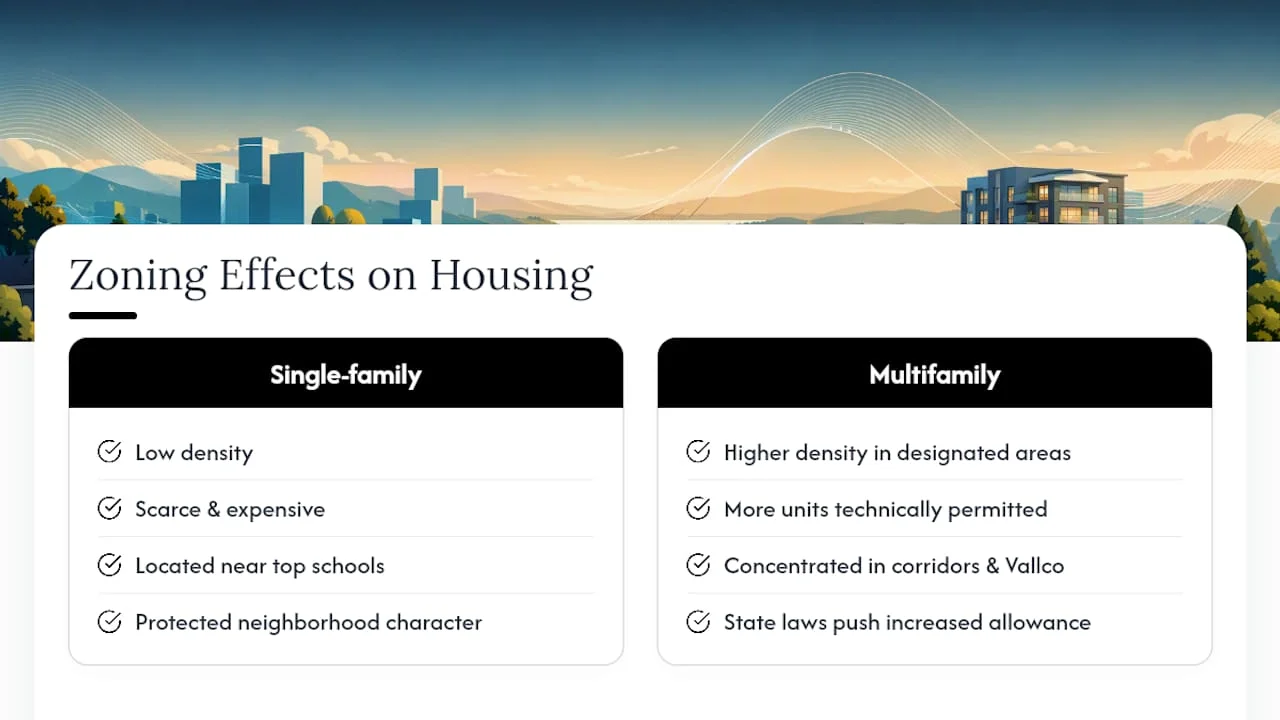
Cupertino’s zoning code has historically favored low-density single-family neighborhoods, which is exactly why detached homes stay scarce and expensive while multifamily construction concentrates in a handful of designated corridors. State housing laws, including California’s density bonus rules and streamlined approval requirements for qualifying projects, have pushed the city toward allowing more units than its traditional zoning once permitted, but implementation still moves through a slow local review process.
For buyers and sellers, the practical effect is straightforward: zoning protects the character, and the premium, of established single-family neighborhoods near top schools, while directing higher-density growth toward commercial corridors and redevelopment sites like Vallco. That split explains why detached-home prices keep climbing even as the city technically permits more housing overall. Anyone considering redevelopment potential on a lot, an accessory dwelling unit, or a lot split should verify current allowances directly with Cupertino’s planning department before assuming what’s buildable, since rules have shifted meaningfully in recent years.
What This Market Actually Rewards
The conventional advice you’ll hear about Cupertino, wait for a correction, time the rate cycle, hold out for a deal, doesn’t match what the data shows. Supply has stayed under five months for years, and school-zone demand doesn’t soften just because a headline says the Bay Area is cooling. Chasing a market-wide downturn here has cost more buyers a home than it’s saved them money.
What actually matters is preparation speed. Buyers who have firm financing, a defined school-zone target, and a plan for escalation clauses move on the right homes while others are still scheduling a second showing. Sellers who invest in staging and pricing strategy before listing consistently outperform sellers who list first and adjust later, based on the gap between well-presented homes and stalled listings this market keeps producing.
If there’s one thing overrated in most general advice, it’s national rate forecasts. At Cupertino price points, your specific loan structure and school-zone choice matter more to your outcome than whatever the Federal Reserve does next quarter. Start with the local math, not the headline.
— Mr
Ready to Move on a Cupertino Home? Here’s the Concierge Advantage
If you’re comparing agents based on reviews and specialties, the gap that matters most is preparation. A concierge alternative to a bare-bones listing service in Cupertino includes pre-sale inspections, professional staging, 3D Matterport tours, and custom marketing designed to attract multiple offers rather than hope for one.

Laxmi Penupothula has closed over $650 million across 570-plus Santa Clara County transactions and has ranked in RealTrends’ Top 1% nationally for five straight years, alongside SCCAOR’s Top 1% recognition every year since 2021. Whether you’re pricing a sale this season or need a financing-ready buyer strategy, request a free home value estimate and selling strategy to see exactly where your property stands in today’s market.
Where to Verify the Numbers Yourself
Sources
- Cupertino, CA Housing Market (Redfin)
- Cupertino house price trend: what is the market telling you? (Aegis Luxury Real Estate)
- Cupertino Housing Market 2026 | Prices, Trends & Data (Melanie Tan / 8 Blocks)
FAQ
Why Is Cupertino So Expensive?
Concentrated tech employment, particularly around Apple, combined with top-ranked schools and a housing stock that barely turns over, keeps demand well ahead of supply. Months of supply has stayed near 3.2, far below the five to six months that would signal a balanced market.
Are Housing Prices Dropping in the Bay Area?
Some Bay Area submarkets have softened, but Cupertino has kept posting modest gains, with average home values up about 3.2% year over year. Broad regional headlines about price drops rarely apply evenly across every city.
Is Cupertino Better Than Sunnyvale?
It depends on your priorities rather than a simple better-or-worse answer. Cupertino generally offers stronger school-zone premiums and tighter supply, while Sunnyvale and neighboring Santa Clara often provide more housing variety and somewhat more negotiating room.
Is Cupertino, CA a Wealthy Area?
Yes. Median home values near $3 million and an average price near $3.0 million reflect a buyer pool concentrated in high-earning tech households, and that income profile is a core driver of the city’s sustained price levels.
Recommended
- Santa Clara County Housing Market: 2026 Guide
- Milpitas CA Real Estate Market Trends 2026 | Buyers & Sellers Guide – Laxmi Penupothula
- Bay Area Real Estate Market Insights 2026 – Laxmi Penupothula
- Sunnyvale Housing Market: 2026 Trends and Prices

Laxmi Penupothula
Top 1% Realtor SCCAOR, RealTrends Verified (2021–2025) • CA DRE #02047105
SCCAOR Top 1% Santa Clara County • Intero Chairman Circle 2023–2025 • \$650M+ Closed • 570+ Transactions
Silicon Valley & Bay Area Specialist — Cupertino, San Jose, Fremont, Milpitas, Sunnyvale & surrounding cities.
Get a Free Home Valuation →