


A change in ownership or completed new construction triggers property tax reassessment in California under Proposition 13, resetting your base year value to current market value. Proposition 19 tightened that rule for family transfers starting February 16, 2021, so a home passed to a child today can face reassessment where it once would not have. Supplemental assessments follow their own prorated timeline, with separate appeal deadlines from your annual bill.
TL;DR:
- Changing ownership or completing new construction can trigger property reassessment, with transfers to children now subject to partial reassessment under Proposition 19.
- Supplemental assessments are calculated based on the market value at the event date and usually result in one or two bills depending on timing within the fiscal year.
- Certain transfers, such as between spouses or involving legal entities with unchanged proportional ownership, remain exempt from reassessment, but many protections tightened in 2021.
- Proper timing, filing the change-of-ownership documents, and consulting professionals can prevent unexpected tax increases from reassessment.
- County assessors actively cross-reference deeds, permits, and inspections to identify unreported transfers that may lead to penalties and back taxes.
Table of Contents
- What Events Trigger a Property Tax Reassessment in California?
- How Supplemental Assessments Are Calculated and When They Hit
- Exclusions and Proposition 19: Who Avoids Reassessment (and Who No Longer Does)
- How to Challenge a Reassessment: Appeals, Timelines, and Practical Steps
- Practical Planning Steps to Limit Surprise Reassessments
- Penalties and How Assessors Actually Find Out
- A Bay Area Realtor’s Local Checkpoints for Reassessment
- What the Reassessment Rules Actually Reward
- How a Local Realtor Fits Into Your Reassessment Planning
- Where to Verify These Rules Yourself
- Sources
What Events Trigger a Property Tax Reassessment in California?
Two events reset your property’s taxable value: a change in ownership and completed new construction. Everything else, including the two percent annual inflation adjustment under Proposition 13, happens automatically without touching your base year value.
A “change in ownership” means a transfer of the present interest in real property, including the right to possess it. That sounds abstract until you see it in practice. It covers a sale, a gift, an inheritance, a partition among co owners, and even the transfer of a long-term lease or possessory interest. The Santa Cruz County Assessor’s office confirms that reassessment typically follows a transfer or the completion of new construction, with only the new portion of a project subject to revaluation.
Common triggers include:
- Selling your home to a new owner, whether at market rate or a discounted family sale
- Gifting property to a relative or friend outside a qualifying exclusion
- Inheriting a home after a parent or relative passes away
- Dividing jointly owned property among co owners (a partition)
- Transferring a leasehold with a term of 35 years or more, including renewal options
Partial transfers only reassess the portion transferred. If you deed 50% of your home to your adult child while keeping the other half, the assessor typically reassesses just that half interest. The remaining 50% keeps its original base year value untouched.
New construction is narrower than most homeowners assume. Adding a bedroom, building a swimming pool, or converting a garage into an accessory dwelling unit counts, according to guidance from the Los Angeles County Assessor. Routine repairs, like replacing a roof or repainting, do not. The assessor values only the new improvement. Your original home, and the land under it, keeps its existing base year value.
How Supplemental Assessments Are Calculated and When They Hit
Your property’s taxable value rests on two numbers: the base year value, set at acquisition or new construction, and the factored base year value, which climbs at most 2% a year under Prop 13. Each year, the Santa Clara County Assessor and BOE guidance enroll whichever is lower, your factored base year value or current market value, which is why some owners briefly saw reduced bills during downturns under Proposition 8.
When a reassessment event occurs mid-year, the county does not wait for the next tax cycle. It issues a supplemental assessment, calculated by BOE rules as:
- Determine the new market value as of the date of the change in ownership or completion of construction.
- Subtract the prior assessed value on the roll for that same period.
- Prorate the difference based on the number of months remaining in the fiscal year, starting the first day of the month following the event.
Here’s where timing gets interesting for Bay Area buyers closing escrow mid-quarter.
Pro Tip: Close escrow on the last day of a month rather than the first few days of the next one. It can shift your proration window by a full month and change which fiscal year absorbs the supplemental bill.
Events between January and May typically generate two supplemental bills, one for the remainder of the current fiscal year and one for the following year, because the assessment straddles the July 1 fiscal year boundary. Events between June and December usually produce a single supplemental bill covering the balance of that fiscal year. A San Jose home purchased in March, for example, often triggers separate supplemental notices in spring and again over the summer, and both arrive independently of your regular annual tax bill. Homeowners frequently assume the supplemental notice is a duplicate or an error. It is not. Both bills are legally due, and ignoring one because you already paid your regular bill leads straight to penalties and interest.

Exclusions and Proposition 19: Who Avoids Reassessment (and Who No Longer Does)
Not every transfer triggers reassessment, but the list of protections got noticeably shorter in 2021. Several statutory exclusions still apply, and most require a timely claim filed with the county assessor rather than automatic protection.
- Interspousal transfers. Transfers between spouses or registered domestic partners, including through divorce, are excluded regardless of when they occur.
- Proportional interest transfers. Moving property between co owners without changing their proportional ownership share does not trigger reassessment.
- Legal entity exclusions. Certain transfers into or out of legal entities avoid reassessment if proportional ownership stays the same, though the rules here are technical enough to warrant a tax attorney’s review.
- Parent-child and grandparent-grandchild transfers. These still exist, but Proposition 19 narrowed them dramatically.
Before February 16, 2021, a parent could transfer a primary residence or up to $1 million of assessed value in other property to a child without reassessment, no strings attached. Proposition 19 eliminated that blanket protection. Now, the exclusion applies only if the child moves into the home as their primary residence within one year, and even then, the assessor adds any difference between the property’s current market value and its factored base year value (plus $1 million, adjusted for inflation) back onto the new base year value, according to Los Angeles County Assessor guidance on Prop 19.
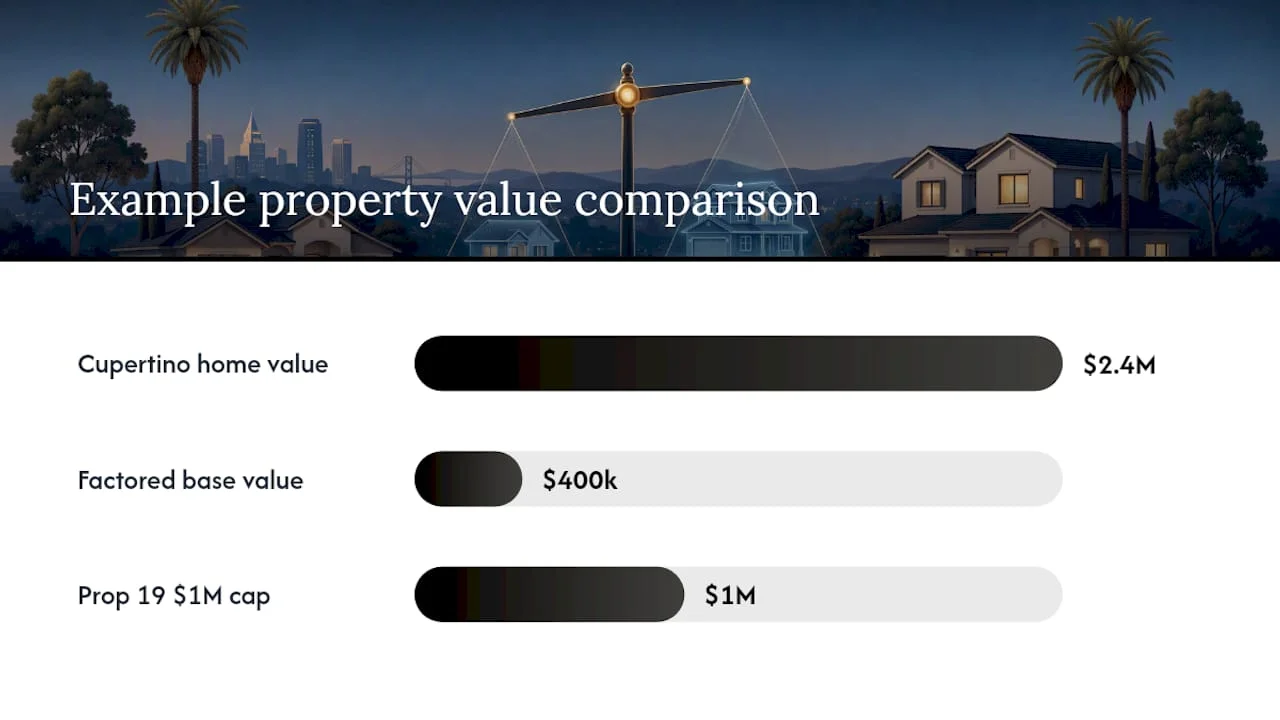
Consider two siblings inheriting a Cupertino home worth $2.4 million with a factored base year value of $400,000. A transfer completed in December 2020 would have kept that $400,000 base intact if it qualified under the old rules. The identical transfer today reassesses upward unless a sibling actually occupies the home as a primary residence, and even then, a portion of the market value gain gets added to the base.
Proposition 19 gave something back, too: portability. Homeowners 55 or older, severely disabled, or victims of a wildfire or other qualified disaster can transfer their factored base year value to a replacement home anywhere in California, up to three times in a lifetime. That is a genuine planning tool for empty nesters looking to downsize without a tax penalty, and our Prop 19 move-up tax savings guide walks through the mechanics in more detail.
How to Challenge a Reassessment: Appeals, Timelines, and Practical Steps
If a reassessed value looks too high, you have a real, time-limited path to challenge it, but the clock starts the moment the notice mails, not when you get around to reading it.
- Confirm your filing window. Regular annual assessment appeals in most counties, including Santa Clara, run from July 2 through either September 15 or November 30, depending on the county, per Santa Clara County’s appeal deadlines page. Supplemental assessment appeals have a separate, tighter window: 60 days from the mailing date on the notice.
- Understand what you’re contesting. An appeal challenges the new base year value or the current market value the assessor assigned, not the tax rate itself, which is fixed by Prop 13 at roughly 1% plus voter-approved bonds and assessments.
- Start with an informal review. Many county assessors, including Santa Clara’s, will reconsider a value informally before you file a formal appeal, often resolving disputes without a hearing.
- Gather evidence. Comparable sales from the assessment date, recent appraisal reports, photos documenting property condition, and permit records all strengthen your case.
- File with the county assessment appeals board if informal review doesn’t resolve it, using the county’s official appeal application before the deadline closes.
Practical Planning Steps to Limit Surprise Reassessments
The single best defense against an unwelcome supplemental bill is paperwork discipline, done early rather than after the county comes asking.
- File the Preliminary Change of Ownership Report (PCOR) or Change of Ownership Statement (COS) at the time you record a deed, and keep a signed copy for your own records.
- Time major transfers deliberately. A transfer completed in June versus July can shift which fiscal year absorbs the supplemental bill and how many notices you receive.
- Coordinate building permits with your contractor before starting a remodel, since permitted work gets flagged for reassessment while unpermitted work, though not advisable for other reasons, often escapes notice longer.
- Consult an estate planning attorney before gifting property or restructuring ownership between family members, especially anything touching the post Prop 19 parent-child exclusion.
- Loop in a local real estate professional early when timing a sale or transfer around fiscal year boundaries; a realtor familiar with Santa Clara County’s calendar can flag PCOR requirements you might otherwise miss.
Pro Tip: If you’re adding an ADU, ask your contractor for the estimated new construction value before you finalize plans. It gives you a realistic supplemental tax estimate instead of an unpleasant surprise eight months later. Our homebuilding partners at Well-known Home Builders cover how ADU projects typically get valued for tax purposes.
Penalties and How Assessors Actually Find Out
Failing to file a required change of ownership statement carries a real cost. Under Revenue and Taxation Code Section 482, penalties start at the greater of $100 or 10% of the taxes applicable to the new base year value, and county recorders add separate late filing fees on top, according to BOE’s change in ownership guidance.
Assessors don’t rely on homeowners to self-report everything voluntarily. They cross-reference:
- Recorded deeds and PCOR/COS filings submitted at the county recorder’s office
- Building permits pulled for remodels, additions, and ADUs
- Field inspections and other public records tied to a parcel
If an event slips through and surfaces later, the county can issue an escape assessment covering back taxes plus interest, so silence is never a safe assumption.
A Bay Area Realtor’s Local Checkpoints for Reassessment
Working residential real estate across Santa Clara County for many years with substantial transaction volume has shown a consistent pattern: the homeowners who avoid reassessment surprises are the ones who ask about PCOR filing and Prop 19 eligibility before they sign anything, not after.
Before closing a transfer or wrapping up a remodel, confirm the PCOR or COS is filed correctly, check whether your timing pushes a supplemental bill into this fiscal year or the next, and flag any ADU or major addition with your local assessor’s office early. For anything touching a parent-child transfer or a complex trust, a referral to an estate attorney is worth the conversation before recording a deed. Santa Clara County’s own assessment appeal resources and the county’s property tax guidance are good starting points for verifying deadlines specific to your parcel.
What the Reassessment Rules Actually Reward
Most articles on this topic treat Prop 19 as a footnote to Prop 13. That gets the emphasis backward for anyone in Santa Clara County right now. Prop 13 is stable and well understood; Prop 19 is where the actual planning decisions live, and where households lose money through simple timing mistakes rather than bad intentions.
The conventional advice, “talk to an attorney before you transfer property,” is correct but incomplete. The more useful discipline is treating the calendar itself as a planning tool. Whether a transfer happens in May or July, whether a child moves in within eleven months or thirteen, whether a permit gets pulled before or after a sale closes, these details determine tax outcomes as much as any legal exclusion does.
If there’s one priority worth acting on first, it’s this: don’t wait for the assessor’s notice to learn whether an exclusion applies. Verify eligibility and filing requirements before the transfer happens, not after. The rules reward preparation far more than they reward a strong argument after the fact.
— Mr
How a Local Realtor Fits Into Your Reassessment Planning
A local realtor can provide Santa Clara County homeowners assistance with tracking transaction timing, escrow dates, and county filing windows as part of their services. If you’re weighing a sale, a family transfer, or a remodel that might trigger new construction reassessment, a knowledgeable realtor can help you sequence the paperwork correctly and flag when a PCOR or COS needs to accompany a recorded deed.

That coordination matters most for moves involving Prop 19 portability or an inherited property, where the assessor’s timeline and your own selling timeline need to line up. For complex transfers, a realtor may refer clients to qualified estate attorneys rather than guess at legal specifics. Start by running your numbers through the Prop 19 property tax calculator to see your estimated Bay Area impact, or reach out through the Bay Area real estate FAQ page to get a straight answer on your specific situation before you file anything.
Where to Verify These Rules Yourself
For primary source verification, start with the BOE’s Change in Ownership FAQ and its Supplemental Assessment overview, both of which explain PCOR/COS requirements and proration math directly from the state agency that oversees county assessors.
The BOE’s Letters to Assessors and Property Tax Annotations cover the statutory detail behind Revenue and Taxation Code Sections 75 through 75.72 and Section 482. For anything county-specific, Santa Clara County’s assessment appeal calendar and your local assessor’s new construction page, like Los Angeles County’s, spell out filing deadlines and forms specific to your parcel.
Sources
- Change in Ownership – Frequently Asked Questions — BOE
- New construction — Santa Cruz County Assessor
Recommended
- Prop 13 Property Tax Explained for Homeowners
- Prop 19 Move-Up Tax Savings: Carrying Your Low Property-Tax Base (Over 55)
- Prop 19 Property Tax Calculator: Estimate Your Bay Area Savings
- Filing for the Homeowners Property Tax Exemption

Laxmi Penupothula
Top 1% Realtor SCCAOR, RealTrends Verified (2021–2025) • CA DRE #02047105
SCCAOR Top 1% Santa Clara County • Intero Chairman Circle 2023–2025 • \$650M+ Closed • 570+ Transactions
Silicon Valley & Bay Area Specialist — Cupertino, San Jose, Fremont, Milpitas, Sunnyvale & surrounding cities.
Get a Free Home Valuation →