


A California preliminary title report (prelim) is the title company’s written offer to issue title insurance, showing every recorded encumbrance it will exclude from coverage unless cleared. The moment you receive one, take three immediate steps:
- Confirm vesting — verify the owner of record matches the purchase contract exactly, including trust or LLC designations.
- Scan for unexpected liens and judgments — tax liens, mechanic’s liens, and unreleased mortgages all appear here and must be resolved before close.
- Flag easements and unreleased loans — an easement running through a planned addition or an old deed of trust never reconveyed can stall or kill a transaction.
Your immediate next step: forward any unfamiliar exceptions to your agent and escrow officer the same day you receive the report and request a written clarification or cure timeline.
Table of Contents
- What a California preliminary title report actually is
- Why the prelim matters for your California transaction
- What a California prelim contains, section by section
- How to read a California prelim: a step-by-step walkthrough
- Who prepares the prelim and when it arrives in California escrows
- Cost of a California prelim and who customarily pays
- How to obtain a California preliminary title report
- Common title issues in California prelims and how they are cleared
- Immediate steps to protect yourself when the prelim shows red flags
- Typical timeline from prelim to final policy in California
- Who does what: roles and responsibilities around the prelim
- Bay Area and Silicon Valley checklist: local nuances to watch on a prelim
- Key Takeaways
- What experienced Bay Area agents see in prelims that most buyers miss
- Laxmitoprealtor: prelim review and closing coordination for Bay Area transactions
- Authoritative sources and further reading
What a California preliminary title report actually is
The California Land Title Association (CLTA) defines a prelim precisely: it is a statement issued by a title insurance company showing the terms and conditions under which it will issue a title insurance policy, listing every recorded encumbrance it plans to exclude from coverage. It is not a guarantee of title condition, not a comprehensive chain-of-title history, and not the final policy itself.
Three related concepts are easy to confuse:
The title search is the underlying investigation. Title companies examine deeds, mortgages, wills, judgments, tax records, liens, encumbrances, and maps through their title plants and public records. The prelim is the summary document that reports those findings.
The prelim (or commitment) is the offer to insure. It tells you what the insurer will cover and, more critically, what it will not cover unless exceptions are cleared.
The final title insurance policy is issued at close of escrow after all requirements are met and a final date-down search confirms no new recordings. The policy creates actual insurer liability. The prelim does not.
“A preliminary report is not a written representation as to the condition of title and may not be relied upon as such. No contract of insurance or liability exists until a policy is issued.” — California Land Title Association, Understanding Preliminary Reports
California Insurance Code §12340.11 codifies this distinction: title insurer liability for errors in prelim preparation is explicitly limited. Treating the prelim as a guarantee is a costly misunderstanding.
Why the prelim matters for your California transaction
The prelim is the operational blueprint for closing. Every payoff demand, reconveyance, quitclaim deed, and escrow holdback traces back to something the prelim identified. Without reviewing it carefully, buyers and sellers are negotiating blind.
Specifically, the report identifies:
- Owner of record — confirms the seller has legal authority to convey title.
- Recorded liens — mortgages, home equity lines, tax liens, and judgment liens that must be paid off at or before close.
- Easements — utility corridors, access easements, and prescriptive rights that survive the sale and bind the new owner.
- CC&Rs and HOA restrictions — recorded covenants that limit how the property can be used, modified, or rented.
- Unpaid property taxes — delinquent taxes appear as liens and must be cleared for the policy to issue.
California has its own common title clouds. Mechanic’s liens from recent contractor work are frequent in the Bay Area, where renovation activity is high. Unreleased deeds of trust from loans paid off years ago but never formally reconveyed show up regularly on long-held properties. HOA CC&Rs in planned developments often contain restrictions that surprise buyers who did not read them before making an offer.
The prelim also shapes negotiation. A seller who discovers a significant judgment lien must either pay it off, negotiate a credit, or lose the sale. A buyer who spots an easement running through the garage footprint can request a survey, renegotiate price, or walk away during the contingency period. Legal and title professionals treat the prelim as a roadmap for what must be cleared to achieve marketable title — use the review period to negotiate removal or resolution of objectionable exceptions.

What a California prelim contains, section by section
Title companies produce the prelim by searching title plants and public records, then organizing findings into a standardized report structure. Here is what each section contains and why it matters.
Schedule A is the foundation. It states the effective date of the report, the proposed vesting (how the buyer will hold title), the legal description of the property, and the assessor’s parcel number (APN). Every other section flows from this one.
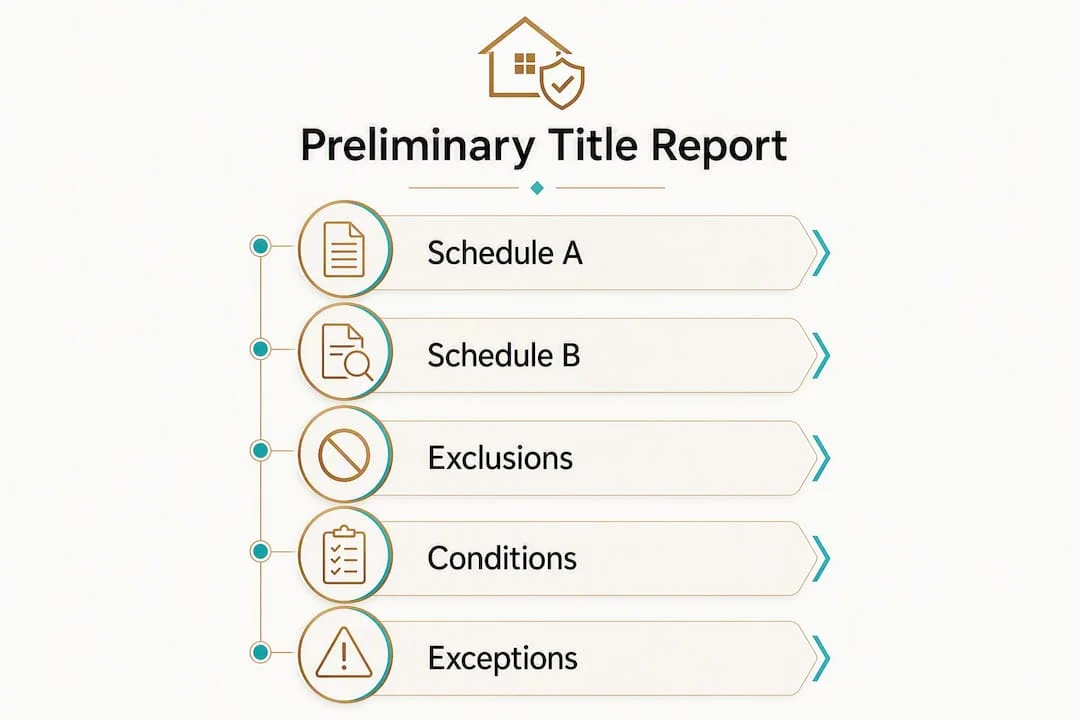
Schedule B-1 (Requirements) lists conditions that must be satisfied before the title company will issue the policy. Common requirements include payoff of existing loans, release of judgment liens, execution of a new deed, and HOA transfer documentation.
Schedule B-2 (Exceptions) is where most of the work happens. This section lists every recorded matter the policy will exclude from coverage. Standard exceptions cover items like property taxes not yet due, rights of parties in possession, and survey discrepancies. Specific exceptions are the property-specific items: a recorded easement, an HOA declaration, a deed of trust, a judgment.
“Standard exceptions apply to virtually every property; specific exceptions are unique to the parcel and represent the actual title risks the buyer and lender must evaluate and, where possible, clear before close.” — Title industry practice guidance
Exhibits typically include a plat map showing the property’s boundaries, dimensions, and neighboring parcels. Some title companies also attach copies of the underlying recorded documents referenced in Schedule B-2, or provide hyperlinked versions that allow attorneys and agents to pull up the full text of each exception.
Understanding the difference between standard and specific exceptions matters for coverage. A buyer can purchase an ALTA extended coverage policy (with a survey or inspection) to eliminate some standard exceptions. Specific exceptions require active clearance or negotiation.
How to read a California prelim: a step-by-step walkthrough
Reading a prelim efficiently means working in the right order. Here is the sequence that experienced agents and title officers use.
- Start with Schedule A — confirm vesting. Cross-check the proposed vesting against the purchase contract. If the buyer intends to hold title in a trust or LLC, the vesting language must be correct before the deed is drafted. A name misspelling here can require a corrective deed after close.
- Verify the legal description and APN. The legal description should match any prior deed, survey, or county assessor record. If the APN differs from what is on the purchase contract, flag it immediately — it may indicate a data entry error or, in rare cases, a boundary dispute.
- Review Schedule B-1 requirements. These are your to-do list. Each requirement must be satisfied before the policy issues. Assign responsibility: which items fall to the seller, which to the buyer, and which to the lender?
- Work through Schedule B-2 exceptions one by one. For each specific exception, ask: Is this a routine item (HOA declaration, utility easement) or a potential problem (unreleased deed of trust, judgment lien, mechanic’s lien)? Routine items need acknowledgment; problem items need a cure plan.
- Review the plat map and exhibits. Confirm the parcel boundaries match your understanding of the property. Look for easements that cross the building footprint or driveway. An access easement benefiting a neighbor can restrict fencing, landscaping, or additions.
- Check underlying documents for complex exceptions. For any exception you cannot interpret from the summary description alone, request the full recorded document from the title officer. Many title companies now provide hyperlinked prelims where attorneys can pull up the underlying encumbrances directly.
- Compile your question list and send it to escrow. Do not wait. The sooner the title officer receives your objections, the more time escrow has to clear them before the closing date.
Pro Tip: The two places buyers most often miss problems are the name spelling on vesting (which affects future refinancing and estate planning) and easements described only by recording number. Always request the actual recorded easement document — the summary description rarely tells you where on the lot the easement runs.
Who prepares the prelim and when it arrives in California escrows
Escrow officers typically order the preliminary title report shortly after escrow opens, usually within one to two business days of receiving the signed purchase contract and escrow instructions. The title company then conducts its search and delivers the prelim, often within 24–72 hours for standard residential properties.
Who receives the prelim depends on the transaction structure. The buyer, seller, buyer’s agent, listing agent, and lender all typically receive copies. The buyer and buyer’s agent should review it first, since the buyer bears the primary risk of undiscovered title defects and has the contingency rights to object.
“Once received, the buyer and agent should identify any items requiring resolution before the title policy can be issued and the sale can close. Delay in reviewing the prelim is one of the most common causes of last-minute closing problems.” — firsttuesday Journal
Three key contacts to know:
- Title officer — the specialist at the title company who interprets exceptions, coordinates payoffs, and prepares clearance documents. This is your first call for any question about a specific exception.
- Escrow officer — manages the transaction timeline, collects payoff demands, and coordinates recording. Contact for scheduling and document logistics.
- Real estate attorney — appropriate when exceptions involve disputed vesting, probate issues, pending litigation, or complex lien structures that the title officer cannot resolve through standard clearance.
Cost of a California prelim and who customarily pays
Title insurance in California is a one-time premium paid at close of escrow. The prelim itself may carry a separate report fee, though many title companies absorb it into the overall transaction. The premium is negotiable between buyer and seller, and regional customs vary significantly across the state.
| Policy / Fee | Who Typically Pays | Notes |
|---|---|---|
| Owner’s CLTA policy | Seller (Southern California) | Buyer often pays in Northern California; negotiable statewide |
| Owner’s ALTA policy | Buyer | Provides broader coverage; buyer usually requests and pays |
| Lender’s title policy | Buyer | Required by virtually all lenders; paid statewide by buyer |
| Prelim / report fee | Varies | Often bundled into escrow or title fees; confirm with title company |
Regional customs affect negotiation strategy. In Southern California, sellers customarily pay for the owner’s CLTA policy. In Northern California, including the Bay Area, buyers more often pay for the owner’s policy. Confirming which custom applies early in escrow prevents surprises at the closing table. For a full breakdown of how these costs fit into your total closing picture, the buyer closing costs guide and seller closing costs guide cover the regional specifics in detail.
The CLTA policy covers recorded defects. An ALTA lender’s policy may include additional protections tied to lender requirements and physical inspections, which is why lenders require it separately from the owner’s policy.
How to obtain a California preliminary title report
Ordering a prelim is straightforward. Here is the standard process for buyers, sellers, and outside parties.
- Open escrow or contact a title company directly. In a standard purchase transaction, the escrow officer places the order automatically. Outside a transaction, anyone can contact a title company and request a report on any property.
- Provide the property address and APN. The assessor’s parcel number is the most reliable identifier. If you do not have it, the county assessor’s website can look it up from the street address.
- Supply current owner information and expected vesting. For a purchase transaction, the title company needs the seller’s name as it appears on the current deed and the buyer’s intended vesting (individual, joint tenancy, community property, trust, LLC).
- Include lender contact information if a loan is involved. The lender will need its own requirements added to Schedule B-1, and the title company coordinates directly with the loan officer.
- Pay any required report fee. For transactions, this is typically handled through escrow. For standalone orders by attorneys or curious buyers, the title company will quote a fee upfront.
- Receive and review the prelim. Standard residential properties typically produce a prelim within 24–72 hours. Complex properties, probate sales, or parcels with long ownership histories may take longer.
Outside a transaction, attorneys can order a prelim at any time and often receive a hyperlinked version that allows direct review of the underlying recorded documents. This is particularly useful for pre-acquisition due diligence or dispute resolution.
Common title issues in California prelims and how they are cleared
Most title problems are routine. The key is identifying them early and assigning a cure method before the closing deadline.
Unreleased deeds of trust are the single most common issue on California prelims. A loan paid off years ago may still appear as a lien if the lender never recorded a reconveyance. The title company contacts the original lender or its successor, obtains a payoff confirmation or reconveyance document, and records it. If the lender no longer exists, a trustee’s substitution and reconveyance may be required.
Judgment liens attach to all real property owned by the debtor in the county where recorded. Clearance requires either a payoff and recorded satisfaction of judgment or, in some cases, a court order. The seller typically handles this at close from sale proceeds.
Mechanic’s liens are common in the Bay Area, where renovation activity is constant. A contractor who was not paid can record a lien against the property. Clearance options include paying the lien, bonding around it (a surety bond substitutes for the lien), or obtaining a lien release. Escrow holdbacks are also used when the dispute is unresolved at closing.
CC&Rs and easements generally cannot be “cleared” — they run with the land. The goal is to understand them fully and, where they affect intended use, negotiate a price adjustment or walk away during the contingency period.
“Most title issues are resolved during escrow via payoffs, recorded reconveyances, quitclaim deeds, or escrow holdbacks. Complex issues — pending litigation, disputed vesting, probate recording problems — require attorney involvement and should not be left to the escrow officer alone.” — 805 Title
For probate-related vesting problems, the clearance process often involves court confirmation, which adds weeks to the timeline. Buyers in probate transactions should build that buffer into their closing date expectations.
Immediate steps to protect yourself when the prelim shows red flags
Speed matters. A problem identified on day three of escrow is far easier to resolve than one surfaced the week before closing.
- Notify your escrow officer and title officer the same day. Request a written explanation of each flagged exception and an estimated cure timeline.
- Request a payoff demand for any monetary lien. The escrow officer can order payoff statements from lenders and judgment creditors. Knowing the exact payoff amount lets the seller confirm net proceeds and the buyer confirm the transaction still pencils.
- Involve the seller and listing agent. Seller-side liens are the seller’s responsibility to clear. Your agent should communicate the objections formally and request a written cure commitment.
- Consider an escrow holdback for unresolved items. If a mechanic’s lien or minor repair issue cannot be cleared before closing, an escrow holdback allows the transaction to close while funds are held pending resolution. This is a practical tool that preserves the closing date without forcing the buyer to accept unresolved risk.
- Escalate to an attorney when the issue is complex. Pending litigation, encroachments affecting planned use, disputed vesting, and large unpaid tax liens all warrant legal counsel. Do not rely solely on the title officer for legal interpretation.
- Postpone closing only as a last resort. If a material issue cannot be resolved or bonded around, postponing is better than closing with an uninsured defect. Confirm with your lender whether a rate lock extension is needed.
Typical timeline from prelim to final policy in California
For a standard residential transaction, the prelim arrives within 24–72 hours of escrow opening. Routine clearance items — payoffs, reconveyances, and HOA transfer documents — typically resolve within one to two weeks. Mechanic’s liens and judgment liens can take two to four weeks depending on lender or creditor responsiveness. Probate and trust vesting issues are the outliers; court confirmation can add four to eight weeks or more.
“The preliminary report is a snapshot taken at a specific moment. Between that snapshot and closing, new documents can be recorded — a new lien, a lis pendens, a deed. The date-down search is what catches those late recordings.” — firsttuesday Journal
The date-down search is the title company’s final check, run immediately before recording the closing documents. It covers the period between the original prelim and the close date. If anything new appears, the title officer must address it before the policy issues. The final title insurance policy reflects this later search, not the original prelim. This is why last-minute recordings — a contractor filing a mechanic’s lien the day before close, for example — can delay funding even when everything else is in order.
Who does what: roles and responsibilities around the prelim
Clear role assignment prevents items from falling through the cracks.
Title company:
- Orders and produces the prelim after escrow opens.
- Coordinates payoff demands, reconveyances, and lien releases.
- Prepares all documents for recording at close and performs the date-down search.
Escrow officer:
- Manages the transaction timeline and document flow.
- Collects payoff funds and coordinates with the title officer on clearance.
- Distributes the prelim to all parties and tracks outstanding requirements.
Buyer:
- Reviews the prelim promptly and raises formal objections within the contingency period.
- Coordinates lender requirements with the loan officer.
- Decides whether to accept, negotiate, or object to specific exceptions.
Seller:
- Clears seller-side liens (mortgages, judgment liens, mechanic’s liens) from sale proceeds.
- Provides documentation for trust or estate vesting if applicable.
- Negotiates credits or price adjustments for exceptions that cannot be cleared.
Lender:
- Reviews the prelim for compliance with underwriting requirements.
- Confirms conditions for issuing the lender’s title policy.
- Coordinates with the title company on endorsements required by the loan program.
Real estate agent:
- Interprets prelim entries for clients and flags items requiring professional review.
- Negotiates cures, credits, and escrow protections on behalf of the client.
- Recommends holdbacks or endorsements when appropriate.
Attorney:
- Handles complex vesting disputes, probate clearance, litigation holds, and lien bonding.
- Reviews underlying recorded documents for legal interpretation.
- Provides opinion letters when title company requirements cannot otherwise be satisfied.
Bay Area and Silicon Valley checklist: local nuances to watch on a prelim
The Bay Area has its own title patterns that differ from the rest of California, and missing them in a fast-moving Silicon Valley market can be expensive.
HOA and CC&R traps. Planned developments in Cupertino, Sunnyvale, and San Jose often carry detailed CC&Rs that restrict ADU construction, exterior modifications, and short-term rentals. Confirm the full HOA declaration is attached as an exhibit and read it before removing contingencies.
Unreleased trust deeds on long-held homes. Properties held by the same family for 20 or 30 years frequently show old deeds of trust from loans paid off before electronic recording became standard. These require reconveyance and can take two to three weeks to clear if the original lender has been acquired or dissolved.
Mechanic’s lien risk from recent contractor work. In a market where pre-sale renovations are common, any contractor work completed within 90 days of listing carries mechanic’s lien risk. Ask the seller for lien releases from all contractors before close, and consider a holdback if work was recently completed.
Trust and LLC vesting. Silicon Valley buyers frequently purchase in revocable trusts or LLCs. Confirm the vesting language is correct before the deed is drafted. A deed to “the Smith Family Trust” without the trustee’s name and date of trust is defective under California law.
Rural parcel notes. Properties in the Santa Cruz Mountains or rural Santa Clara County foothills may carry water rights notations, well agreements, or shared road easements that require separate legal review.
“In the Bay Area, the two prelim items that most often surface late are informal access easements — where a neighbor has been using a path for years without a recorded easement — and unreleased deeds of trust from the 1990s and early 2000s. Both are fixable, but neither is fast.” — Bay Area title practice observation
Pro Tip: In tight Bay Area closings with a 21-day escrow, request the prelim within 48 hours of opening escrow and review it the same day it arrives. If you spot a potential mechanic’s lien or an unreleased deed of trust, ask the title officer immediately whether a holdback can preserve the closing date while clearance proceeds. Delaying that conversation by even two days can push the close date past the rate lock.
Key Takeaways
A California preliminary title report is a title company’s offer to insure, not a guarantee of title, and every buyer and seller should review it within 24 hours of receipt to identify liens, easements, and vesting issues that must be cleared before close.
| Point | Details |
|---|---|
| Prelim = offer to insure | The prelim shows what the insurer will exclude; no liability exists until the final policy issues. |
| Check vesting immediately | Confirm the owner of record and proposed vesting match the purchase contract exactly, including trust or LLC designations. |
| Flag liens and easements | Unreleased deeds of trust, judgment liens, mechanic’s liens, and easements all require active clearance or negotiation before close. |
| Confirm who pays title premiums | In Northern California buyers often pay the owner’s policy; in Southern California sellers typically pay; the lender’s policy is paid by the buyer statewide. |
| Date-down search is the final check | The title company runs a date-down search immediately before close to catch any new recordings; the final policy reflects this later search, not the original prelim. |
| Laxmitoprealtor’s role | Laxmitoprealtor reviews prelim exceptions with clients, coordinates cure timelines with escrow, and recommends holdbacks or endorsements to protect Bay Area transactions. |
What experienced Bay Area agents see in prelims that most buyers miss
The prelim is where a transaction either holds together or begins to unravel, and the difference usually comes down to how quickly the right people review it. Buyers who skim the exceptions and assume the title company will handle everything often discover, days before closing, that a 1998 deed of trust was never reconveyed or that a contractor filed a lien the week before the listing went live.
The practical recommendation: treat the prelim review as a 24-hour task, not a background item. Have your agent walk through Schedule B-2 with you line by line, request the underlying recorded documents for any exception you do not recognize, and confirm in writing that the title officer has a cure plan for every flagged item. For buyers purchasing in a trust or LLC, have your estate attorney confirm the vesting language before the deed is drafted. For sellers, pull your own prelim before listing — knowing what is on title before a buyer does gives you time to clear routine items without negotiating under pressure.
Laxmitoprealtor: prelim review and closing coordination for Bay Area transactions
Closing a Bay Area transaction cleanly requires more than reading a prelim — it requires knowing which exceptions are routine, which need immediate escalation, and how to negotiate cures without losing the deal. Laxmitoprealtor brings that expertise to every transaction, with $650M+ in closed sales across 570+ transactions in Santa Clara County and a track record of resolving title issues before they reach the closing table.

Whether you are buying in Cupertino, selling in Sunnyvale, or navigating a complex trust or probate transaction anywhere in Silicon Valley, Laxmitoprealtor coordinates directly with escrow and title officers, recommends escrow holdbacks when appropriate, and ensures every prelim exception has a resolution plan before you remove contingencies. Ready to move forward with confidence? Connect with Laxmitoprealtor to get expert guidance on your next California transaction.
Authoritative sources and further reading
Verifying title-related facts means going to primary sources, not secondary summaries. The following are the most reliable references for California title matters.
- California Department of Insurance — Title Insurance Consumer Guide: The state regulator’s plain-language explanation of how title insurance works, what prelims contain, and consumer rights. Start here for regulatory context.
- California Land Title Association (CLTA): The industry association that sets standard policy forms used across California. Their consumer series on preliminary reports is the most authoritative non-regulatory source on prelim definitions and limitations.
- California Department of Insurance — Main Site: For filing complaints, verifying title company licensing, and accessing rate filings.
- American Land Title Association (ALTA): Sets national standards for ALTA policies and endorsements; relevant when your lender requires ALTA coverage beyond the standard CLTA form.
This article provides general information about California preliminary title reports and is not legal advice. Confirm current rules, fees, and transaction-specific requirements with a licensed California title company, escrow officer, or real estate attorney.
Recommended
- Probate Sale California: What Buyers Need to Know
- Capital Gains on a Home Sale in California: What Sellers Need to Know – Laxmi Penupothula
- Seller Closing Costs in California: What They Are and What They Run – Laxmi Penupothula
- Buyer Closing Costs in California: Smart 2026 Guide

Laxmi Penupothula
Top 1% Realtor SCCAOR, RealTrends Verified (2021–2025) • CA DRE #02047105
SCCAOR Top 1% Santa Clara County • Intero Chairman Circle 2023–2025 • \$650M+ Closed • 570+ Transactions
Silicon Valley & Bay Area Specialist — Cupertino, San Jose, Fremont, Milpitas, Sunnyvale & surrounding cities.
Get a Free Home Valuation →