


An escalation clause in a real estate offer automatically increases your bid above a competing offer by a set dollar increment, up to a maximum price you define in advance. Used correctly, it keeps you competitive in a multiple-offer market without requiring you to guess how high to go. Freddie Mac advises buyers to consider one when they are confident multiple bona fide offers will appear, and the North Carolina Real Estate Commission (NCREC) cautions that careless drafting creates disclosure and verification problems that can unravel a deal. The short version: escalation clauses work well in a genuine seller’s market with verified competing offers, but they expose your ceiling price and carry real appraisal and financing risk if the escalated number exceeds appraised value.
Key Takeaways
An escalation clause only works when it is drafted precisely, capped at an appraised-value-supported ceiling, and deployed in a market where competing offers are confirmed.
| Point | Details |
|---|---|
| Activation requires proof | The clause only fires when a documented, bona fide competing offer exists; no competing offer means you pay your original price. |
| Increment size matters | In mid- to high-price markets, a meaningful increment above the competing bid is recommended to effectively influence sellers. |
| Appraisal risk is real | If the escalated price exceeds appraised value, your lender bases the loan on the appraisal; plan for the gap or include an appraisal contingency. |
| Sellers can decline escalators | Some sellers prefer a highest-and-best round; submitting an escalation clause when one is not accepted signals inexperience. |
| Laxmitoprealtor’s approach | Laxmitoprealtor reviews comparable sales and financing approval before setting any cap, ensuring the escalation clause strengthens rather than undermines the offer. |
Table of Contents
- What is an escalation clause and how does the math work?
- How escalation clauses trigger and what changes in the contract
- Benefits, pitfalls, and the seller’s perspective
- When escalation clauses make sense — and when they backfire
- How to write an escalation clause: annotated sample language
- Agent checklist and red flags before you include an escalation clause
- A Bay Area case study: escalation clause in a Cupertino multiple-offer situation
- A practitioner’s perspective on when escalation clauses actually work
- Laxmitoprealtor’s offer strategy services for Bay Area buyers
- Sources
What is an escalation clause and how does the math work?
An escalation clause (also called an escalator clause or escalation addendum) is a contractual provision added to a purchase offer that instructs the seller: “I will pay $X above the next highest bona fide offer, up to a maximum of $Y.” The clause does not change your initial offer price; it only activates when a competing offer exists.
Three elements appear in virtually every well-drafted escalation clause:
- Initial offer price: The base price you are willing to pay regardless of competition.
- Escalation increment: The fixed dollar amount by which your offer beats the competing bid.
- Cap (ceiling price): The absolute maximum you will pay, no matter how high competing offers go.
Quick numeric example:
You offer $1,400,000 on a Sunnyvale home with an escalation increment of $10,000 and a cap of $1,450,000. A competing buyer submits $1,420,000. Your clause activates, and your offer escalates to $1,430,000 — beating the competition by $10,000 while staying $20,000 below your ceiling. If the competing offer had been $1,445,000, your escalated price would reach $1,450,000 (your cap), and you would be tied or outbid depending on the seller’s terms.
How escalation clauses trigger and what changes in the contract
The clause is dormant until the seller receives at least one other documented, bona fide offer. Freddie Mac confirms that if no competing offers arrive, you are legally bound only to your original offer price — the escalator never fires.
Step-by-step mechanics:
- You submit your offer with the escalation addendum attached.
- The seller receives a competing offer at a higher price.
- The listing agent (or seller) notifies your agent that escalation has been triggered.
- Your offer price adjusts upward by the increment above the competing bid, subject to your cap.
- The seller typically provides a redacted copy of the competing offer as proof, though the exact verification standard varies by state and by how the clause is drafted.
The Oklahoma Real Estate Commission’s 2026 Escalation Addendum illustrates standard state-form language: it requires specific proof of a competing offer, sets out financing-handling options, and includes confidentiality and buyer-disclaimer language that directly affects enforceability. That structure is a useful model even if you are buying in California or another state.
When multiple buyers all submit escalation clauses, the seller works through each one in turn. The buyer with the highest cap and the most favorable non-price terms generally wins, but the seller is not obligated to accept the highest escalated price — they can still counter or reject.
Financing and appraisal interaction. This is where escalation clauses create their sharpest risk. If your escalated price exceeds the appraised value, your lender will base the loan on the appraised figure, not the contract price. Experian’s guidance recommends including an appraisal contingency or planning explicitly for an appraisal gap when an escalator could push the agreed price above market value. Without that protection, you either cover the gap in cash or risk losing the deal.
Pro Tip: Specify in the clause exactly what constitutes acceptable proof of a competing offer. Sample trigger language: “Seller shall provide Buyer with a copy of the competing offer, redacted to remove personal identifying information, within 24 hours of escalation being triggered.” Vague verification language is the single most common drafting failure.
An escalation clause addresses only price. Sellers weigh closing speed, contingency count, financing strength, and possession timing alongside the dollar figure. A lower offer with cleaner terms can — and regularly does — beat a higher escalated price.
Benefits, pitfalls, and the seller’s perspective
Buyer benefits
- Keeps your offer competitive without requiring a single high-stakes guess at the right number.
- Sets a firm budget ceiling, reducing the risk of emotional overbidding in a heated market.
- Can speed the negotiation cycle by eliminating multiple back-and-forth counteroffers.
- Signals to the seller that you are a serious, prepared buyer.
Buyer risks
- Reveals your maximum price to the seller immediately, removing negotiation leverage.
- Creates appraisal-gap exposure if the escalated price exceeds appraised value.
- Does nothing to improve non-price terms (contingencies, close timeline, earnest money), which sellers often weigh heavily.
- A poorly drafted clause with weak verification language opens the door to phantom-bid disputes.
Realtor.com notes that escalation clauses can help an offer stand out but expose how high a buyer will go — a tradeoff worth weighing carefully before attaching one.
Seller perspective and regulatory cautions
Sellers and listing brokers sometimes decline escalation clauses outright, preferring a clean highest-and-best-offer round. Their reasons are practical: managing multiple escalators requires careful math, verification creates disclosure obligations, and some sellers simply do not want to reveal competing offer details even in redacted form.
The NCREC’s bulletin on escalation clause pitfalls stresses that brokers must follow careful drafting and verification procedures to avoid misunderstandings and improper disclosures. State real estate commissions in several jurisdictions have issued similar guidance, and some provide standardized addendum forms precisely because ad hoc escalation language generates disputes.
| Factor | Buyer impact | Seller impact |
|---|---|---|
| Price competitiveness | Higher chance of winning in a multiple-offer situation | Potentially higher sale price |
| Negotiation leverage | Ceiling price is disclosed upfront | Seller knows buyer’s maximum |
| Appraisal risk | Escalated price may exceed appraised value | Financing may fall through at higher price |
| Verification burden | Buyer must specify acceptable proof | Seller must provide documentation |
| Non-price terms | Clause does not improve contingencies or timeline | Seller may still prefer a cleaner offer |
When escalation clauses make sense — and when they backfire
Situations that favor using one
- Active multiple-offer market: Your agent has confirmed competing offers are likely or already present.
- Strong financing: You are pre-approved at or above your cap, and your lender has reviewed the escalation scenario.
- Low appraisal risk: The property is priced at or below recent comparable sales, reducing the chance of an appraisal gap.
- Motivated buyer: You have a firm budget ceiling and want to avoid the emotional pressure of live bidding.
For buyers navigating competitive multiple-offer situations in Silicon Valley, an escalation clause paired with strong financing and minimal contingencies can be a decisive combination.
Situations to avoid one
- The seller or listing agent has explicitly requested highest-and-best offers by a deadline — submitting an escalation clause in that context often signals inexperience and may be rejected.
- Your financing is conditional or your pre-approval has not been stress-tested at the cap price.
- Comparable sales suggest the property is already priced above market, making an appraisal gap nearly certain.
- The market is balanced or favors buyers; no competing offers are expected.
Freddie Mac’s buyer guidance is direct: use an escalation clause only when you and your agent are confident multiple bona fide offers will appear. Without that condition, you reveal your ceiling for no benefit.
Alternatives worth considering
- Clean non-contingent offer: Removing financing or inspection contingencies can be more persuasive than a higher price in some seller situations. Review the tradeoffs of a non-contingent offer carefully before waiving protections.
- Appraisal-gap coverage language: Commit in writing to covering a defined dollar gap between appraised value and contract price, without escalating the headline number.
- Larger earnest money deposit: A substantial good-faith deposit signals commitment and financial strength.
- Best-and-final submission: When the seller requests it, submit your single strongest offer with clean terms rather than an escalator.
How to write an escalation clause: annotated sample language
The two samples below are illustrative templates. Have your buyer’s agent or real estate attorney review and adapt any clause language to your state’s forms and the specific transaction before signing.
Sample A — Standard escalation clause (buyer-friendly)
“Buyer offers a purchase price of $1,400,000. In the event Seller receives a bona fide competing written offer with a purchase price higher than Buyer’s offer, Buyer agrees to increase the purchase price to an amount equal to $10,000 above such competing offer, up to a maximum purchase price of $1,450,000. Seller shall provide Buyer with a copy of the competing offer, redacted to remove personal identifying information, within 24 hours of triggering escalation. This clause does not modify any other terms of this Agreement.”
Annotation:
- “bona fide competing written offer” — limits activation to real, documented offers; prevents phantom bids.
- “$10,000 above” — the increment. RISMedia recommends increments of $5,000 or more in mid- to high-price markets; $1,000 increments rarely move a seller.
- “maximum purchase price of $1,450,000” — your hard ceiling; never set this above what your lender has approved.
- “redacted copy within 24 hours” — verification procedure; specifies timing and format.
Sample B — Conservative variant with appraisal protection

“Buyer offers a purchase price of $1,400,000. Should Seller receive a bona fide competing written offer at a higher price, Buyer’s purchase price shall escalate by $10,000 above such offer, up to a maximum of $1,450,000. In the event the escalated purchase price exceeds the appraised value as determined by Buyer’s lender, Buyer’s obligation to close shall be contingent upon Buyer’s ability to obtain financing at the escalated price, and Buyer shall have the right to renegotiate or withdraw if the appraisal gap exceeds $25,000. Seller shall provide written verification of the competing offer within 24 hours.”
Annotation:
- Adds an appraisal contingency tied directly to the escalated price — not just the base offer.
- Sets a defined appraisal-gap threshold ($25,000) above which the buyer retains the right to renegotiate or exit.
- Financing mechanics: the loan amount adjusts to the escalated price; if the appraisal comes in short, the buyer’s down payment requirement increases by the gap amount unless the contingency is exercised.
Key drafting considerations:
- Always specify what “proof” means: a redacted copy of the competing offer is the standard.
- Set the increment at a level that genuinely beats the competition — in Bay Area price ranges, $5,000–$10,000 is common.
- Confirm your lender has reviewed the cap price and approved financing at that level before submitting.
- In California, consult your agent about whether the California Association of REALTORS® addendum forms apply to your transaction.
This sample language is provided for educational purposes only and does not constitute legal advice. Always have your buyer’s agent and/or a licensed real estate attorney review escalation clause language before submitting an offer.
Agent checklist and red flags before you include an escalation clause
Questions to confirm with your agent
- Has the listing agent confirmed that escalation clauses are accepted, or has the seller requested highest-and-best offers?
- What evidence will the seller provide to verify a competing offer, and in what timeframe?
- What is the realistic appraisal risk given recent comparable sales for this property?
- Has your lender reviewed and approved financing at the cap price?
- If the escalated price triggers an appraisal gap, what is your cash reserve to cover it?
Red flags that should stop you from using an escalator
- The listing agent has stated the seller will not accept escalation clauses.
- The seller has issued a deadline for highest-and-best offers — a clear signal they want a single clean number.
- The property is already priced above recent comparable sales, making an appraisal shortfall likely.
- You cannot verify that competing offers are real and arm’s-length (non-family, non-related-party transactions).
- Your financing pre-approval has not been stress-tested at the cap price.
If red flags appear
Submit a clean best-and-final offer at your strongest price with the most favorable non-price terms you can offer: minimal contingencies, a flexible close date, and a meaningful earnest money deposit. For a deeper look at assembling a competitive offer in the Bay Area, the full strategy guide covers each lever in detail.
A Bay Area case study: escalation clause in a Cupertino multiple-offer situation
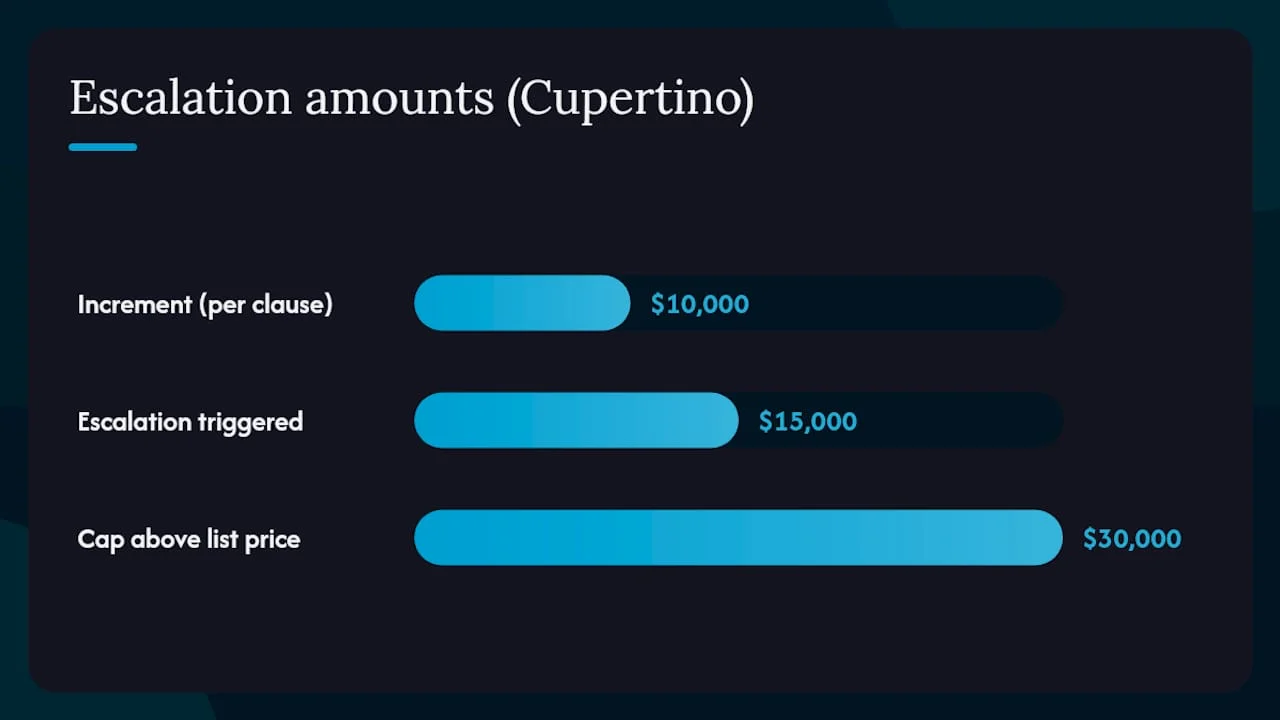
In a recent Cupertino transaction handled by Laxmitoprealtor, a well-priced single-family home attracted four offers within 72 hours of listing. The buyer client had strong financing and a clear budget ceiling, making an escalation clause a logical tool. The clause was drafted with a $10,000 increment, a cap set $30,000 above the list price, and explicit verification language requiring a redacted competing offer within 24 hours.
The outcome: the clause activated against one competing bid, and the buyer’s offer escalated to $15,000 above that bid — well within the cap. The appraisal came in at the escalated price, so no gap coverage was needed. Three lessons emerged from that transaction:
- Set the increment to matter. A $10,000 increment on a $1.5M+ property is meaningful; a $2,000 increment would have been ignored.
- Draft the verification clause precisely. The listing agent provided the redacted competing offer within the specified window, preventing any dispute about whether escalation was properly triggered.
- Run the appraisal scenario before submitting. The agent reviewed recent comparable sales before setting the cap, confirming the ceiling was within appraised-value range for that submarket.
In competitive Silicon Valley markets, the escalation clause is not a shortcut — it is a precision instrument. Set the increment too low and it signals inexperience. Set the cap above what the property will appraise for and you have created a financing problem. The drafting details are where deals are won or lost.
Pro Tip: *Before setting your cap, ask your agent to pull the three most recent closed comparable sales within a half-mile radius.
For the full negotiation breakdown, the Evergreen, San Jose case study details how offer strategy and risk mitigation played out across a similarly competitive transaction.
A practitioner’s perspective on when escalation clauses actually work
Escalation clauses get oversold as a universal competitive tool, and that is where buyers get into trouble. The clause is only as strong as the drafting behind it and the market intelligence informing the cap. In Bay Area transactions at the $1.2M–$2M price point, a $10,000 increment is typically the floor for a meaningful escalator; anything lower rarely influences a seller’s decision. The more important variable is the cap: setting it too high exposes the buyer to an appraisal gap that can derail financing, while setting it too low defeats the purpose.
The situations where an escalation clause genuinely earns its place are narrow: confirmed multiple-offer competition, solid financing pre-approved at the cap, and comparable sales that support the ceiling price. When those three conditions are not all present, a clean offer with strong non-price terms — a shorter inspection period, a larger earnest money deposit, a flexible possession date — tends to be more persuasive than a higher escalated number the seller cannot rely on to close.
Laxmitoprealtor’s offer strategy services for Bay Area buyers
Knowing when to use an escalation clause and how to draft one correctly is the difference between winning a competitive offer and revealing your ceiling for nothing.

For buyers working in Santa Clara County’s high-stakes multiple-offer environment, the services include full buyer representation, offer structure analysis, escalation addendum drafting and review, appraisal-gap planning, and concierge negotiation support from first showing through close. Every offer is built around the specific property, the seller’s priorities, and your financing position — not a generic template.
Explore buyer representation services or review client success stories to see how these strategies have performed in transactions across Cupertino, Sunnyvale, San Jose, and the broader South Bay. Contact Laxmitoprealtor directly to discuss your offer strategy before your next showing.
Sources
The sources below are the primary references used throughout this guide. Each is directly relevant to U.S.-based buyers and agents evaluating escalation clauses.
- Should My Offer Include an Escalation Clause? – My Home by Freddie Mac
- The Pitfalls of Using Escalation Clauses – NCREC Bulletins
- How to Use an Escalation Clause in Real Estate Contracts — RISMedia
- PURCHASE PRICE ESCALATION ADDENDUM – Oklahoma Real Estate Commission (2026 Escalation Addendum)
- What Is an Escalation Clause? – Experian
Recommended
- Strategic Negotiation & Risk Mitigation: A Case Study in Evergreen, San Jose – Laxmi Penupothula
- Making a Competitive Offer in the Bay Area (Smart 2026)
- Weibel Fremont Home Sale | $50K Over Asking Case Study | Laxmi DRE #02047105
- Client Success Stories – Laxmi Penupothula

Laxmi Penupothula
Top 1% Realtor SCCAOR, RealTrends Verified (2021–2025) • CA DRE #02047105
SCCAOR Top 1% Santa Clara County • Intero Chairman Circle 2023–2025 • \$650M+ Closed • 570+ Transactions
Silicon Valley & Bay Area Specialist — Cupertino, San Jose, Fremont, Milpitas, Sunnyvale & surrounding cities.
Get a Free Home Valuation →