


Yes, most sellers should offer a listing home warranty. For homes with aging systems or appliances, it protects the transaction while it’s active and transfers to the buyer at closing — all for a cost that commonly runs in a moderate range, a fraction of what a single HVAC repair can cost mid-listing.
Two immediate benefits worth knowing:
- Coverage during the listing period: Seller listing plans typically activate immediately and cover repairs for up to approximately six months while the home is on the market, so a broken water heater doesn’t derail a pending sale.
- Buyer reassurance at closing: A transferable warranty signals to buyers that covered systems and appliances are backed, which can reduce repair-credit demands and inspection-driven renegotiations.
The exception: if your home is newly built or recently renovated with documented manufacturer warranties still in force, a seller listing plan may add less value. For most resale homes in Silicon Valley and across the U.S., the math favors offering one.
Table of Contents
- What is a seller’s home warranty, and how does it differ from homeowners insurance?
- Why should a seller offer a home warranty?
- What does a seller listing warranty typically cost?
- What seller warranties usually don’t cover
- How to get a seller’s home warranty and when to order it
- How to compare home warranty providers as a seller
- What a listing agent sees that provider pages don’t tell you
- Key Takeaways
- A listing agent’s perspective on seller warranties
- Work with Laxmitoprealtor on your listing strategy
- Useful sources and further reading
What is a seller’s home warranty, and how does it differ from homeowners insurance?
A seller’s home warranty, also called a listing plan or listing warranty, is a service contract that covers the repair or replacement of specific home systems and appliances when they fail due to normal wear and tear. It is not insurance. Homeowners insurance covers sudden, accidental events like fire, theft, or storm damage. A listing warranty covers the slow, predictable breakdown of a furnace, dishwasher, or electrical panel.
The critical distinction: homeowners insurance responds to disasters; a home warranty responds to deterioration. Sellers who confuse the two often discover mid-transaction that neither policy covers what they assumed it would.
Structurally, seller coverage is almost always an add-on to a buyer warranty rather than a standalone product. The seller enrolls during the listing period, coverage begins immediately, and at closing the plan converts to a full buyer warranty. Payment is typically deferred to closing proceeds, so there’s no out-of-pocket cost upfront. The FTC advises consumers to read these contracts carefully, noting that exclusions and waiting periods vary significantly by provider.
One more distinction matters in California specifically: state licensing requirements apply to home warranty providers, and sellers should confirm any provider they use is authorized to operate in their state before signing.
Why should a seller offer a home warranty?
The practical case for seller coverage comes down to three things: marketing lift, transaction protection, and financial predictability.
Marketing lift is real but often overstated. A listing warranty signals to buyers that the seller is confident in the home’s condition. Research from U.S. News shows seller coverage can increase buyer confidence and may shorten time on market, though the effect varies by local market conditions. In a competitive Silicon Valley market where buyers are already stretched, removing one more source of post-closing anxiety matters.
Transaction protection is where the value is most concrete. If a covered system fails between listing and closing, the seller calls the warranty provider rather than scrambling for a contractor. The provider dispatches a vetted technician, the seller pays only the service-call fee, and the repair gets handled without derailing the timeline. That’s the scenario that saves deals.
Financial predictability comes from the structure of the contract itself. Coverage caps and service-call fees shift the risk of a large, unexpected repair bill away from the seller. Instead of absorbing a $4,000 HVAC replacement, the seller pays a $100 service-call fee and the provider covers the rest, up to the plan’s cap.
- Vetted contractor networks mean faster scheduling than finding a licensed technician independently.
- Claim handling is managed by the provider, reducing the seller’s administrative burden during an already demanding period.
Pro Tip: If you’re on the fence about offering coverage, ask your listing agent to pull recent comparable sales in your neighborhood and check whether seller-paid warranties appeared in the transaction notes. In markets where it’s common, not offering one can make your listing look comparatively less attractive.
What does a seller listing warranty typically cost?
Typical seller listing plans run in a moderate cost range for the coverage period, with some providers offering the listing-period coverage at no charge if the seller commits to the buyer purchasing a full plan at closing. Service-call fees generally fall within a moderate range per visit, per LegalClarity’s coverage analysis.

| Cost Component | Typical Range | Notes |
|---|---|---|
| Listing plan premium | in a moderate cost range | Some providers waive if buyer plan purchased at closing |
| Service-call fee | a moderate range per visit | Paid by whoever files the claim |
| Optional add-ons | a moderate range per visit | Pool, spa, septic, secondary HVAC, well pump |
| Coverage cap per item | Varies by plan | Coverage caps vary; read the contract |
Example claim cost breakdown: A covered HVAC repair costs $1,800. The seller pays a $100 service-call fee. The provider covers the remaining $1,700, assuming it falls within the plan’s per-item cap. Without a warranty, the seller absorbs the full $1,800.
Several factors push the price higher:
- Older homes with aging systems (pre-1990 construction often triggers higher premiums or exclusions)
- Multiple units or ADUs on the property
- Optional coverages for pools, septic systems, or secondary HVAC units
- State-specific licensing and underwriting requirements, which affect pricing in California
Payment is almost always deferrable to closing proceeds, meaning the seller pays nothing out of pocket until the transaction closes. If the sale falls through, cancellation terms and refund eligibility vary by provider, so confirm this before enrolling.
What seller warranties usually don’t cover
Pre-existing conditions are the most common source of claim denials, and the most misunderstood. Listing plans routinely exclude defects that existed before coverage began, and issues identified in a pre-listing inspection are typically ineligible until the repair is completed and documented.
Read the exclusions section of any contract before signing. The FTC specifically warns consumers that home warranty contracts often contain exclusions and waiting periods that aren’t obvious from marketing materials. A system that “works but is old” may be covered; a system flagged as defective in an inspection report almost certainly is not.
Other standard exclusions across most plans:
- Structural components (foundation, framing, roof structure)
- Cosmetic damage and finish materials
- Roof leaks (some plans offer limited roof-leak coverage as an add-on)
- Manufacturer defects and improper installation
- Neglect or lack of maintenance
- Code upgrades required during repair
Coverage caps create a second layer of exposure. A plan may cover HVAC repairs up to $1,500, but a full system replacement can run $8,000–$12,000. The seller or buyer is responsible for the overage. California sample contracts illustrate how these caps and optional coverage restrictions appear in real plan documents.
Two transactional traps to avoid: first, never rely on a verbal promise from a provider representative about what’s covered. Get it in writing. Second, a home warranty does not substitute for disclosure. Sellers must still disclose known defects regardless of whether a warranty is offered.
How to get a seller’s home warranty and when to order it
The listing agent typically initiates the process, though sellers can order directly. Most providers require basic property information: address, square footage, home age, number of HVAC units, and whether optional systems (pool, septic) need coverage.
Best timing: Order after the listing agreement is signed but before showings begin. This maximizes the coverage window and ensures any claim filed during early showings is covered. Waiting until a buyer requests coverage as a negotiating point is reactive; proactive enrollment gives the seller more control.
Follow these steps to handle it cleanly:
- Confirm the provider’s state license — In California, home warranty companies must be registered. Verify through the state’s Department of Insurance or the NMLS Consumer Access registry.
- Add a short clause to the purchase agreement — Example language: “Seller to provide a [Provider Name] home warranty plan, Policy No. [XXXXX], transferable to Buyer at closing, with coverage for [listed systems]. Annual premium of $[amount] to be paid from Seller’s proceeds at closing.”
Pro Tip: Order a pre-listing inspection before enrolling in a warranty. Knowing which systems are flagged lets you repair documented defects before coverage begins, which prevents those items from being excluded as pre-existing conditions.
How to compare home warranty providers as a seller
The provider you choose matters as much as the plan itself. Claims handling speed and contractor quality vary significantly across the industry, and a slow repair during escrow can cost you a buyer.
Use this checklist when evaluating options:
- Coverage scope: Does the plan cover the systems most likely to fail in your home (HVAC, water heater, electrical, plumbing)?
- Per-item and aggregate caps: What’s the maximum payout per system? Is there an annual aggregate limit?
- Service-call fee: Lower premiums often come with higher service fees. Calculate the total cost of a likely claim under each plan.
- Transferability rules: Confirm the listing plan converts automatically at closing without requiring a new application from the buyer.
- Waiting periods: Most listing plans have no waiting period for seller coverage, but confirm this in writing.
- Claim process: How are claims filed? Is there 24/7 phone access? What’s the average technician dispatch time?
- Contractor network quality: Ask whether you can request a different technician if the first dispatch is unsatisfactory.
- Dispute resolution: What’s the process if a claim is denied? Is there an appeal mechanism?
- BBB rating and complaint history: Check the provider’s Better Business Bureau rating and read recent complaints. ConsumerAffairs aggregates seller-focused plan reviews and pricing comparisons that can accelerate this research.
- State licensing: Verify the provider is licensed to operate in your state.
Three providers consistently appear in seller-focused plan comparisons: American Home Shield (AHS) offers immediate listing coverage with real-estate-specific add-ons and a well-established contractor network. Home Warranty of America (HWA) markets directly to real estate agents and offers listing-period coverage with flexible transfer options. Select Home Warranty tends to offer lower base premiums but with tighter coverage caps, which matters more on older homes.
Red flags to watch for:
- No sample contract available before purchase
- Vague language about “pre-existing conditions” without a clear definition
- Provider not licensed in your state
- No clear cancellation or refund policy if the sale falls through
- Agent incentives that steer toward a specific provider without disclosure
What a listing agent sees that provider pages don’t tell you
The warranty decision looks different from the transaction side. In a negotiation case study in Evergreen, San Jose, the difference between a clean close and a renegotiation often came down to whether a repair credit was demanded or a warranty was already in place. When a warranty existed, buyers had less leverage to demand cash credits for aging systems because the coverage was already documented and transferable.
The real value of a seller listing warranty isn’t the coverage itself. It’s the negotiating position it creates. A buyer who knows covered systems are backed by a third-party provider has less reason to demand a repair credit or price reduction. That shift in leverage is worth more than the premium in most transactions.
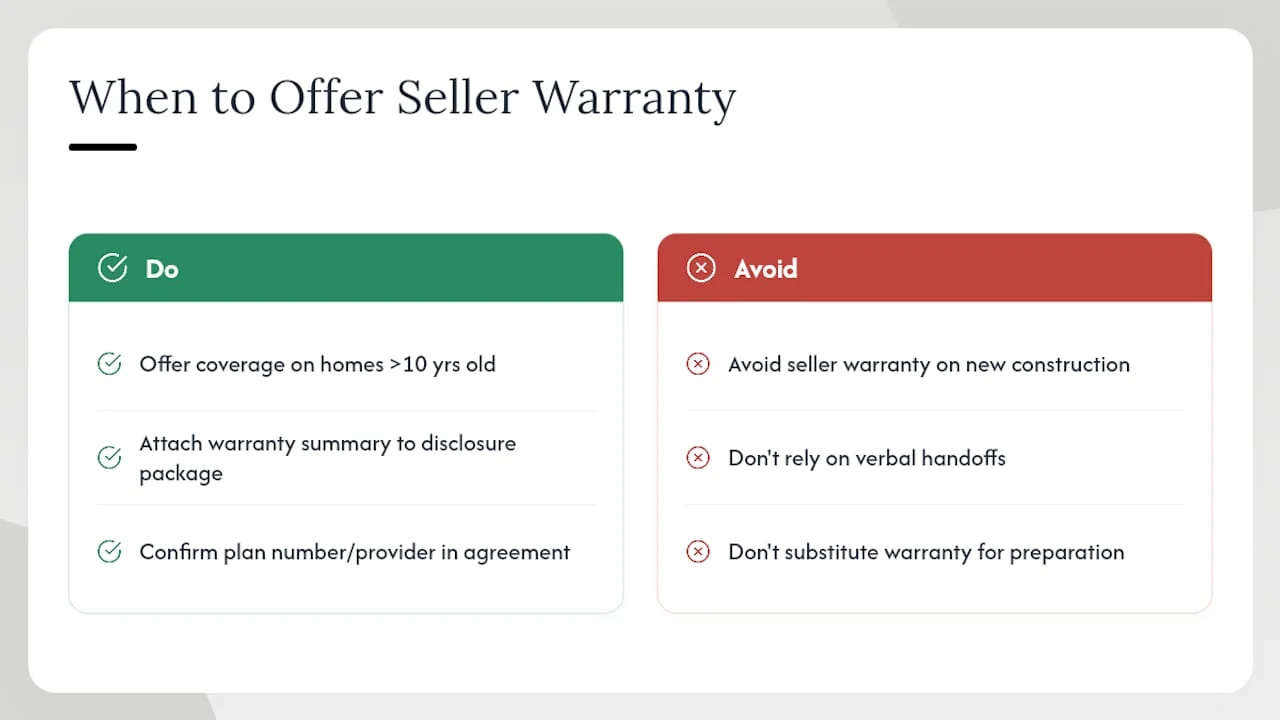
The rule of thumb used in practice: offer seller-paid coverage on homes older than 10 years, or any home where the HVAC, water heater, or electrical panel is within five years of its expected service life. Skip it on new construction or homes where all major systems were recently replaced with documented warranties.
Two documentation practices that prevent post-closing disputes: first, attach the warranty policy summary to the seller’s disclosure package so the buyer’s agent sees it before the offer is written. Second, confirm in the purchase agreement that the plan number and provider contact have been provided to escrow. Verbal handoffs get lost.
A seller warranty fits naturally into a broader concierge seller strategy that includes pre-listing inspection, professional staging, and strategic pricing. The warranty is one layer of risk management, not a substitute for preparation.
Key Takeaways
A seller listing home warranty typically costs between $300 and $700, activates immediately, and transfers to the buyer at closing, making it one of the lowest-cost ways to protect a transaction and reduce renegotiation risk.
| Point | Details |
|---|---|
| Order before showings | Enroll after listing agreement is signed so coverage is active from day one of marketing. |
| Cost range | Listing plans typically cost $300–$700; service-call fees fall between $65 and $175 per visit. |
| Pre-existing conditions | Items flagged in inspection reports are excluded; complete a pre-listing inspection first to document repaired systems. |
| Transfer at closing | Confirm in the purchase agreement that the policy number and provider contact are delivered to escrow before closing. |
| Laxmitoprealtor’s approach | Laxmitoprealtor coordinates warranty enrollment as part of a full concierge seller strategy, including pre-listing inspection and staging, to maximize sale price and protect the transaction. |
A listing agent’s perspective on seller warranties
Having worked through hundreds of transactions across Santa Clara County, the pattern is consistent: sellers who proactively offer a listing warranty spend less time renegotiating after inspections and more time focused on closing. The warranty doesn’t eliminate buyer concerns, but it reframes them. Instead of “this HVAC is old, we want a $5,000 credit,” the conversation becomes “the HVAC is covered under the warranty that transfers at closing.” That’s a fundamentally different negotiation.
The concierge seller services at Laxmitoprealtor, including pre-listing inspection, professional staging, and warranty coordination, are designed precisely to remove these friction points before they become deal risks. Sellers who want to understand how this fits their specific home and market conditions are welcome to reach out for a consultation.
Work with Laxmitoprealtor on your listing strategy
Sellers in Silicon Valley deserve more than a sign in the yard. Laxmitoprealtor delivers a full concierge listing experience: pre-listing inspection coordination, professional staging, high-impact photography, and warranty enrollment handled as part of the listing process, not as an afterthought.

With $650M+ in closed sales and Top 1% recognition from RealTrends Verified for five consecutive years, Laxmitoprealtor brings the negotiation experience and market depth that turns a listing into a result. Warranty coordination is one piece of a broader strategy that consistently outperforms the Santa Clara County market. To discuss your home’s specific situation and get a free comparative market analysis, request your free CMA or review the complete Silicon Valley seller’s guide to see what a strategic listing looks like from start to close.
Useful sources and further reading
- So what’s the deal with home warranties? | FTC Consumer Alerts
- How does a home warranty work for sellers: Costs & coverage – LegalClarity
- What Does a Home Warranty Cost a Seller? — This Old House
- Seller’s Home Warranty: Is It Worth It? (2026 Guide) | First American
- Home Warranties for Home Buyers and Sellers | AHS
- Best Home Warranty for Sellers (2026 Guide) — ConsumerAffairs
- Buyers’ vs. Sellers’ Incentives To Buy a Home Warranty | U.S. News
- CRES preferred coverage home warranty plan| CALIFORNIA — ORHP (sample contract)
Recommended
- Pre-Listing Inspection: Your 2026 Seller’s Guide
- First-Year Homeowner Checklist for Bay Area Buyers
- Selling Your Home in Wible, Fremont: Sellers Need to Know
- Strategic Negotiation & Risk Mitigation: A Case Study in Evergreen, San Jose – Laxmi Penupothula

Laxmi Penupothula
Top 1% Realtor SCCAOR, RealTrends Verified (2021–2025) • CA DRE #02047105
SCCAOR Top 1% Santa Clara County • Intero Chairman Circle 2023–2025 • \$650M+ Closed • 570+ Transactions
Silicon Valley & Bay Area Specialist — Cupertino, San Jose, Fremont, Milpitas, Sunnyvale & surrounding cities.
Get a Free Home Valuation →