

When you buy a home in Santa Clara County, your property is reassessed at the purchase price under Proposition 13 — meaning your annual tax bill is calculated on what you paid, not what the previous owner paid years ago. Long-term owners, by contrast, carry a Factored Base Year Value that grows by no more than 2% annually, often far below current market value. The Santa Clara County Assessor sets that new base, and Laxmi Penupothula, a Top 1% Santa Clara County REALTOR®, helps buyers and sellers account for these costs before closing.
Immediate next steps after a purchase or sale:
- Review your escrow statement’s tax proration clause to confirm who owes what through the close date.
- Expect one supplemental bill if you close June through December, or two supplemental bills if you close January through May 31.
- Confirm with your lender whether supplemental bills will be paid through your impound account — they typically are not.
- Contact the Santa Clara County Department of Tax and Collections (DTAC) at dtac.santaclaracounty.gov to verify your APN and payment status.
Table of Contents
- How Santa Clara County property tax works for buyers and sellers
- Laxmitoprealtor helps you close with full tax clarity
- Key Takeaways
How Santa Clara County property tax works for buyers and sellers
Proposition 13 mechanics. Your assessed value is locked at purchase price on closing day. Each year, the Factored Base Year Value rises by the lesser of 2% or the California CPI — never more. A neighbor who bought the same floor plan in 2005 may pay a fraction of what you owe today. That gap is structural, not an error.
Estimating your bill. The formula is straightforward:
The ~1.20% nominal combined rate for new buyers in Santa Clara County reflects the Prop 13 base of 1% plus voter-approved bonds. Mello-Roos Community Facilities District taxes are a separate line item, not capped by Prop 13, and can add $1,500–$7,000+ annually in newer subdivisions.
| Scenario | Assessed Value | Rate | Est. Annual Tax |
|---|---|---|---|
| No Mello-Roos (San Jose) | — | 1.20% | — |
| With Mello-Roos CFD | — | 1.20% + CFD | — |
| After Homeowners’ Exemption | — | 1.20% | ~$84 savings at a 1.20% county rate |
Supplemental assessments. A change of ownership triggers an immediate reassessment, separate from the annual bill. The supplemental tax covers the gap between the prior assessed value and your purchase price, prorated for the months remaining in the fiscal year (July 1–June 30). Close between January 1 and May 31, and state law can generate two supplemental bills — one for the current fiscal year, one for the next.
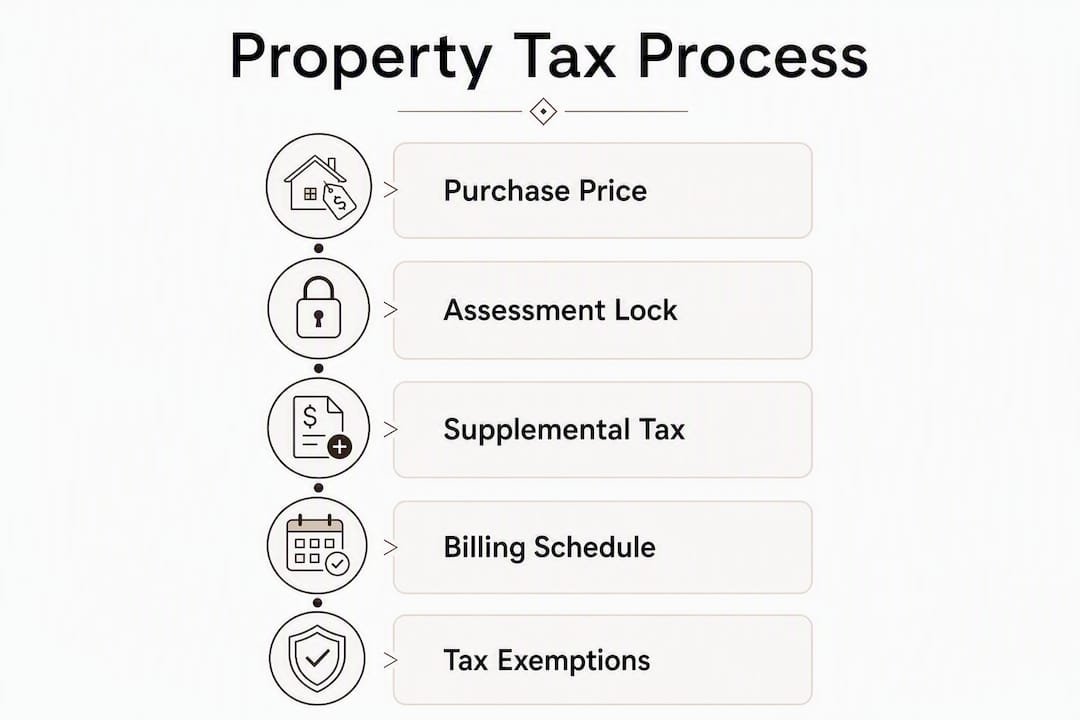
Billing schedule. Annual secured taxes arrive in two installments: the first is due November 1 and delinquent after December 10; the second is due February 1 and delinquent after April 10. Supplemental bills follow their own mailing-based delinquency schedule, printed on the bill itself.
Pro Tip: Pay online via the DTAC portal using eCheck — it’s free. Credit and debit card payments carry a 2.22% convenience fee (minimum $1.49), and a returned payment costs $85.

Escrow proration. Sellers credit buyers for any prepaid taxes covering the post-close period. Buyers take on the new supplemental obligation from day one. Because supplemental bills go to the property owner, not the mortgage lender, buyers who assume the lender will handle them are often caught off guard.
Exemptions and relief. The $7,000 Homeowners’ Exemption reduces taxable value by $7,000 and typically saves about $84 per year at a 1.20% rate — file form BOE-266 with the County Assessor. Disabled veterans qualify for additional reductions. Homeowners 55 or older may transfer their base-year value to a replacement home under Prop 19.
Appeals. The County Assessor mails assessed value notices in July. If you believe your reassessment is too high, file with the County Assessment Appeals Board — the deadline is typically November 30. Missing that window means waiting another year.
Laxmitoprealtor helps you close with full tax clarity

Property tax surprises at closing are avoidable — with the right agent running the numbers before you sign. Laxmi Penupothula builds accurate tax estimates directly into offer analysis, flags Mello-Roos CFD exposure on specific parcels, and coordinates with escrow to ensure supplemental bill responsibilities are clearly allocated between buyer and seller. She has closed 570+ transactions across Santa Clara County — Cupertino, Sunnyvale, San Jose, Saratoga, Milpitas, and beyond — and has ranked in the Top 1% of SCCAOR members every year from 2021 through 2025. Whether you are buying property or preparing to sell your home, bring your APN and escrow timeline to a consultation and get a clear picture of your tax exposure before the deal closes.
Key Takeaways
Santa Clara County property tax resets to your purchase price at closing under Proposition 13, making accurate pre-offer estimation a critical part of every transaction.
| Point | Details |
|---|---|
| Prop 13 reassessment | Your assessed value equals your purchase price; it grows by no more than 2% annually thereafter. |
| Estimated tax rate | New buyers use ~1.20% as a baseline; Mello-Roos CFD taxes can add $1,500–$7,000+ on top. |
| Supplemental bill timing | Closing January–May 31 can generate two supplemental bills; June–December typically produces one. |
| Payment deadlines | Annual installments are due November 1 and February 1; delinquency falls on December 10 and April 10. |
| Laxmitoprealtor | Laxmi Penupothula integrates tax estimates into offer strategy and escrow coordination across Santa Clara County. |
This article is general information, not tax or legal advice. Confirm current rates, deadlines, and exemption eligibility with the Santa Clara County Assessor or a qualified tax professional for your specific situation.
Recommended
- Santa Clara County Housing Market: 2026 Guide
- Prop 13 Property Tax Explained for Homeowners
- Capital Gains on a Home Sale in California: What Sellers Need to Know – Laxmi Penupothula
- Real Estate Floor Plans: A Santa Clara County Guide

Laxmi Penupothula
RealTrends Verified Top 1% REALTOR® Nationwide (2021–2025) • CA DRE #02047105
SCCAOR Top 1% Santa Clara County • Intero Chairman Circle 2023–2025 • \$650M+ Closed • 570+ Transactions
Silicon Valley & Bay Area Specialist — Cupertino, San Jose, Fremont, Milpitas, Sunnyvale & surrounding cities.
Get a Free Home Valuation →