


The fastest way to market and sell a luxury home is to pair cinematic, story-driven creative with a tightly targeted distribution plan aimed at 3–5 premium buyer channels. High-net-worth buyers do not respond to feature lists or boosted social posts. They respond to lifestyle storytelling that frames the property as a legacy, a curated experience, or an architectural statement. The Institute for Luxury Home Marketing publishes monthly market benchmarks that help agents set accurate seller expectations before the first listing conversation. The NAR Luxury Homes Certification (LHC) signals credibility to sellers who are vetting agents. And practitioners like Laxmi Penupothula, ranked in the Top 1% nationally by RealTrends Verified for five consecutive years, demonstrate what this playbook produces in verified closed transactions.
First-meeting checklist for a luxury seller presentation:
- Commission a cinematic hero video (30–90 seconds, with vertical cuts for social distribution)
- Book twilight photography and drone exterior shots
- Build a Matterport 3D digital twin of the property
- Create a dedicated property microsite with its own domain
- Draft a geo-targeted and interest-layered paid media plan
- Schedule an invitation-only broker preview before any public launch
Six-step positioning sequence to open the pitch:
- Define the single buyer persona this property serves (legacy buyer, entertainer, privacy seeker, architecture collector)
- Anchor all creative to one narrative thread, not a list of amenities
- Establish the comp set and price band before any photography brief
- Sequence assets: microsite and hero film first, then paid distribution
- Set seller expectations on timeline, spend, and qualified-showing benchmarks
- Confirm confidentiality and privacy protocols before any public exposure
Table of Contents
- What do the current luxury market benchmarks tell agents?
- How do you build creative assets that position a property as luxury?
- Where should you place your luxury listing to reach qualified buyers?
- How do pricing and comps work differently for luxury listings?
- Which certifications actually move the needle for luxury agents?
- What KPIs should you track and report to luxury sellers?
- A concierge listing in action: process, assets, and results
- How do you implement this plan in the next seven days?
- Legal and compliance considerations unique to luxury property marketing
- How do you tailor your strategy for different luxury buyer personas?
- How do influencer partnerships and exclusive events amplify a luxury listing?
- Key Takeaways
- Why concentrated distribution beats mass exposure in luxury markets
- Laxmitoprealtor’s concierge listing services for Silicon Valley sellers
- Useful sources and further reading for luxury agents
What do the current luxury market benchmarks tell agents?
Agents who walk into a listing presentation without current data lose credibility fast. The U.S. luxury segment showed a median price of $1,348,065 in April with a 6.5% year-over-year rise, yet pending sales softened simultaneously, a split signal that demands nuance when advising sellers. Price appreciation and sales velocity are moving in opposite directions in several coastal and high-tech markets, including Silicon Valley.
The Institute for Luxury Home Marketing releases monthly market reports segmented by price band and geography. These reports are the most reliable source for days-on-market data, inventory levels, and buyer-to-seller ratio shifts in the $1M+ tier. Agents should pull the current month’s report before every listing appointment and cite the specific figures rather than speaking in generalities.
| Benchmark | Typical Range | Notes |
|---|---|---|
| Median luxury price (U.S., April) | notable median price level | observed year-over-year rise; pending sales softening |
| Days on market, $3M+ listings | 30–90 days | Varies by market; coastal markets trend longer |
| Marketing budget, $3M–$10M listing | $5,000–$25,000+ | Roughly 1–3% of expected commission |
| Photography budget, luxury tier | $5,000–$25,000+ | Includes twilight, drone, and editorial sessions |
| Qualified showings to offer ratio | 3:1 to 6:1 | Varies by price band and market conditions |
Benchmark note: Geographic variance is significant. A $3M listing in Silicon Valley behaves differently from a $3M listing in a secondary market. Always layer the Institute’s national data with local CRMLS or MLS actives when presenting to a seller. Seasonality also matters: spring and early fall typically produce the strongest qualified-buyer activity in most U.S. luxury markets.
For agents working Silicon Valley luxury listings, the local supply-demand dynamic often compresses days on market relative to national averages, particularly in guard-gated communities and neighborhoods with strong school district ratings.
How do you build creative assets that position a property as luxury?
The single most important creative decision is choosing the narrative before booking any vendor. Luxury buyer psychology is driven by aspiration and exclusivity, not square footage or appliance brands. Every asset, from the hero film to the brochure paper stock, should reinforce one story.
Positioning checklist before any vendor brief:
- Identify the buyer persona: legacy buyer, privacy seeker, entertainer, or architectural collector
- Write a single-sentence narrative anchor (example: “A private hilltop estate designed for the collector who values silence and light”)
- Confirm staging decisions against that narrative before any photography day
- Brief the videographer on the emotional arc, not just the shot list
Concrete deliverables and production specs
Cinematic video remains the highest-impact asset. The hero film runs 60–90 seconds with a clear narrative arc, a custom score, and lifestyle scenes that show how the space lives. Vertical cuts (15–30 seconds) are produced simultaneously for Instagram Reels and TikTok, where younger luxury buyers increasingly begin their discovery process. Twilight photography, drone exterior motion shots, and editorial-style interior vignettes complete the visual package.
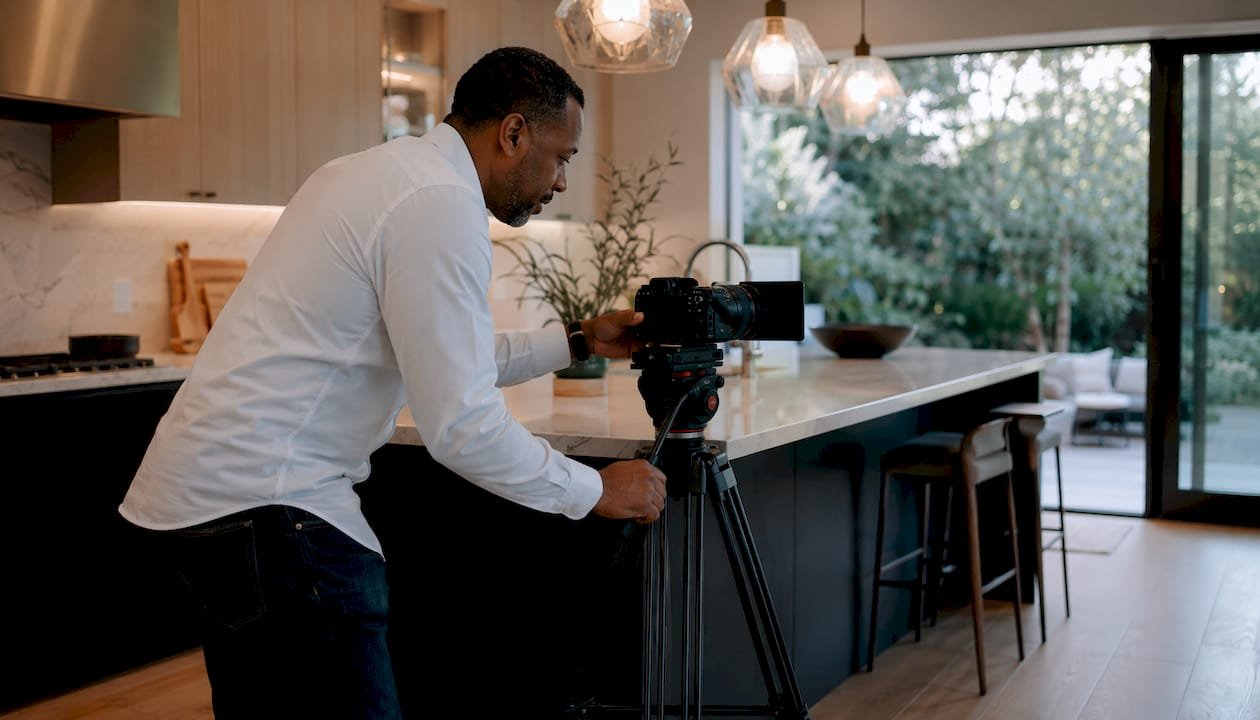
The Matterport 3D digital twin serves a specific function: it qualifies remote and international buyers before they commit to a flight. Integrated into the property microsite rather than linked externally. It becomes part of a seamless digital experience rather than a standalone tool. The microsite itself should carry its own custom domain, a cinematic film as the hero element, interactive floor plans, and a lifestyle section covering neighborhood culture and local amenities.
Print still carries weight at this price point. A hardcover property brochure printed on heavy, uncoated stock functions as a keepsake, not a handout. The presentation box, with vellum floor plans and a handwritten note on custom stationery, creates an unboxing experience that signals the level of care the agent brings to every detail.
Production checklist (vendor brief items):
- Shot list segmented by interior, exterior, twilight, and lifestyle vignettes
- Usage rights for all digital, print, and social placements
- Deliverables: RAW files, web-optimized JPEGs, vertical video cuts, and 4K master
- Privacy-preserving guidelines: confirm which rooms, art, and personal items to exclude
- Staging confirmation: full staging vs. partial staging decision made before shoot day
- Brief the stager with the buyer persona narrative, not just a style preference
- Confirm exterior shot timing for optimal seasonal light
- Review all images for privacy compliance before any distribution
Pro Tip: Frame “invitation-only” distribution as a feature, not a limitation. Telling a seller that the first 10 days will be private broker previews only, before any MLS exposure, preserves exclusivity and often produces competing offers from buyers who value discretion as much as the property itself.
Where should you place your luxury listing to reach qualified buyers?
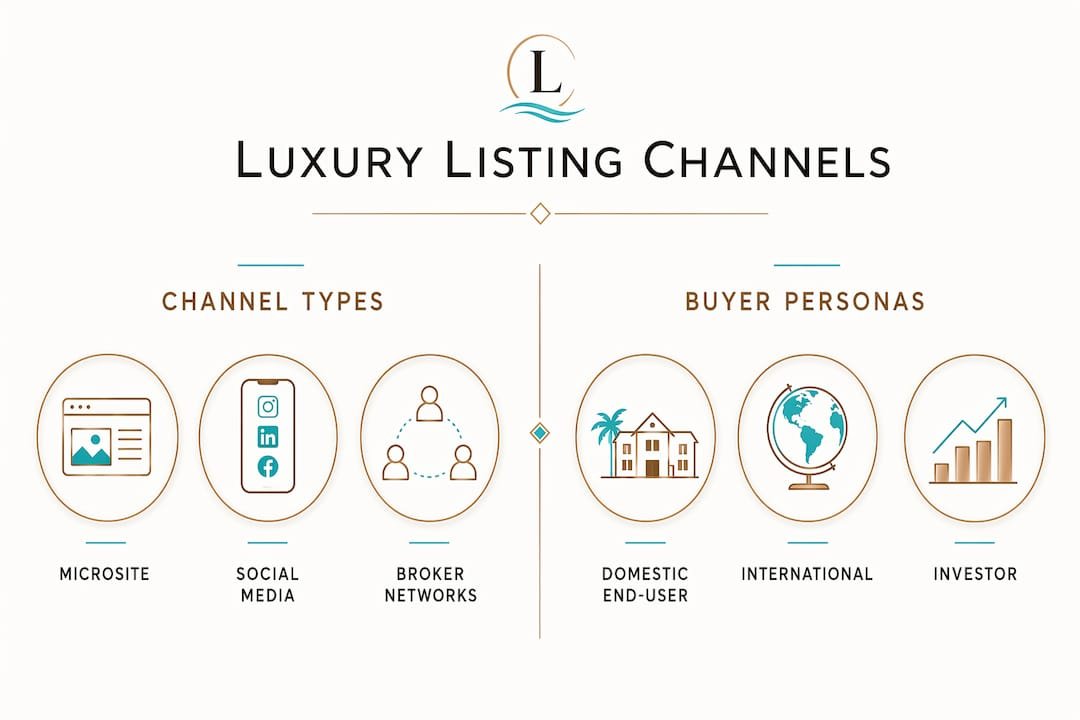
Channel selectivity is the defining discipline of high-end property promotion. Investing heavily in 3–5 premium channels and executing each flawlessly outperforms a broad presence across a dozen platforms. Being everywhere dilutes perceived exclusivity and can suppress the final sale price by signaling that the property is struggling to find a buyer.
Channel selection and audience layering
Meta and YouTube audience-layered campaigns place the cinematic property film directly in front of qualified prospects by combining geo-fencing (country clubs, private airports, yacht marinas) with interest segments covering aviation, equestrian, golf, and yacht ownership. Lookalike audiences built from past buyer data refine targeting further. Google Ads capture high-intent searches using ultra-specific, amenity-driven long-tail keywords such as “guard-gated estate Saratoga” or “architectural home with guest house Cupertino” rather than broad terms like “luxury homes.”
Curated luxury portals and broker networks provide reach into the professional community that controls access to qualified buyers. Invite-only broker previews, held before any public launch, generate internal momentum and often surface the first serious offer. Selected print placements in regional lifestyle publications remain relevant for the domestic HNW audience that still reads physical media.
Pro Tip: Affluent buyers increasingly use AI-powered research tools to build their shortlists. Structure your property microsite with clear headings, direct answers to likely buyer questions, and structured data markup so the property appears in AI-generated search results, not just traditional SERPs.
| Channel | Best for | Sequencing |
|---|---|---|
| Property microsite + hero film | All luxury listings | Launch first, before any paid spend |
| Meta audience-layered campaigns | Domestic HNW, lifestyle buyers | Days 3–30 |
| YouTube pre-roll, cinematic cuts | Aspirational and international buyers | 7–10 days |
| Google Ads, long-tail amenity keywords | High-intent active searchers | Days 1–60 |
| Broker network + invite-only preview | Agent-represented qualified buyers | Pre-launch, days 1–7 |
| Luxury portals | International and relocation buyers | Days 1–90 |
| Print, regional lifestyle publications | Domestic HNW, legacy buyers | One placement at launch |
Coastal estate vs. urban penthouse: two sample approaches
A coastal estate targets a buyer motivated by privacy, outdoor living, and architectural pedigree. The media plan leads with drone footage distributed via YouTube pre-roll to aviation and yacht interest segments, supported by a print placement in a regional architecture or lifestyle magazine. The broker preview is held at twilight to showcase the property’s most compelling feature.
An urban penthouse targets a buyer motivated by status, city access, and design. The plan leads with vertical social cuts on Instagram Reels and a Meta campaign geo-fenced around financial districts and private clubs. The broker preview is a catered evening event with a curated guest list drawn from the agent’s network.
For agents working the Union City and South Bay corridor, location-data-driven advertising that targets tech-sector buyers by employer campus proximity has produced measurable improvements in qualified inquiry rates.
How do pricing and comps work differently for luxury listings?
Luxury pricing is not a per-square-foot exercise. The scarcity premium, architectural pedigree, lot privacy, and neighborhood positioning each carry weight that a standard CMA cannot capture. Agents who present a price purely on adjusted price-per-square-foot lose credibility with sellers who already know their property is not comparable to the three sales the MLS surfaces automatically.
Comp selection checklist:
- Include sold, active, and off-market comparables within the past 12–18 months
- Extend the search radius to adjacent neighborhoods with similar architectural character
- Weight lot size, privacy features, and notable architect or builder pedigree
- Note any unique amenities (guest house, sport court, wine cellar) that have no direct comp
- Document the scarcity premium: how many properties of this type have sold in the past 24 months?
Price-band psychology and launch sequencing
Round-number thresholds affect buyer perception at every price band. A property priced at $4,995,000 attracts a different search pool than one at $5,100,000, even though the difference is marginal. Agents should model which price band captures the largest qualified buyer pool before recommending a list price.
The strategic positioning decision also involves timing. A “coming soon” window of 7–10 days, shared only with the broker network, builds anticipation without accumulating days on market. The private broker preview follows. Public MLS exposure, if used at all, comes only after the private phase has run its course.
- Establish the comp set and price band in the first seller meeting
- Run a “coming soon” window exclusively through the broker network (7–10 days)
- Hold an invitation-only broker preview before any public listing
- Launch the microsite and paid media simultaneously on the public launch date
- Set a 30-day review point: if no qualified offer, evaluate price, distribution, or both
Seller expectations on timeline deserve a direct conversation. For $3M+ listings, a typical path from launch to first qualified offer runs 30–90 days depending on market conditions, price positioning, and the quality of the marketing execution. Marketing spend in the $5,000–$25,000+ range is the standard investment for this price tier.
Which certifications actually move the needle for luxury agents?
Two credentials appear consistently in luxury seller vetting conversations: the Certified Luxury Home Marketing Specialist (CLHMS), awarded by the Institute for Luxury Home Marketing, and the NAR Luxury Homes Certification (LHC). Both signal that the agent has completed formal training specific to the high-end segment, but they serve slightly different purposes in a pitch.
How each credential works:
- CLHMS (Institute for Luxury Home Marketing): Requires completion of the Institute’s training program plus documented production criteria (closed transactions in the luxury tier). The Institute also publishes the monthly Luxury Market Report, which members can use directly in seller presentations as a third-party benchmark source.
- NAR Luxury Homes Certification (LHC): Offered through the National Association of REALTORS®, this certification covers luxury buyer psychology, marketing strategy, and negotiation. It is accessible to NAR members and is recognized by sellers who are familiar with the NAR credential ecosystem.
| Credential | Issuing body | Key requirement | Primary use in pitch |
|---|---|---|---|
| CLHMS | Institute for Luxury Home Marketing | Training + production criteria | Market report access, production proof |
| NAR LHC | National Association of REALTORS® | NAR membership + course completion | Buyer psychology, marketing strategy |
Displaying credentials effectively means placing them in the agent bio section of the property microsite, in the listing presentation cover, and in the brochure trust bar, without overloading the materials with acronyms. One or two credentials, clearly explained, carry more weight than a wall of designations that a seller cannot interpret.
Certification matters most when the agent is new to the luxury tier or entering a market where they lack a local track record. For agents with verified closed transactions above the luxury threshold, the production record itself is the most persuasive credential. The CLHMS enrollment process and official training materials are available directly through the Institute for Luxury Home Marketing.
What KPIs should you track and report to luxury sellers?
Luxury sellers are not impressed by vanity metrics. Impressions and follower counts mean nothing to a seller whose property has been on the market for 60 days. The KPIs that matter are the ones that connect marketing activity to qualified buyer behavior.
Primary KPI set:
- Microsite average session duration (benchmark: 3+ minutes indicates genuine interest)
- Hero video completion rate (benchmark: 40%+ completion signals qualified engagement)
- Qualified broker inquiries per week (track separately from general inquiries)
- Private showings scheduled and completed
- Showings-to-qualified-offer ratio
- Days to first qualified offer from public launch date
A monthly seller report should be concise: one page, three sections. The first section covers reach and engagement (microsite sessions, video completions, paid media performance). The second covers pipeline (broker inquiries, showings scheduled, showings completed). The third covers decision points: which channels are producing qualified activity, which are not, and what the agent recommends adjusting.
| Listing price band | Recommended marketing spend | Expected reach impact |
|---|---|---|
| $1M–$3M | $5,000–$25,000+ | Local and regional qualified buyers |
| $3M–$10M | $5,000–$25,000+ | National and select international reach |
| $10M+ | $25,000+ | International, ultra-HNW, curated networks |
Analytics inform the pivot decision. If microsite sessions are high but showings are low, the property is attracting interest but not converting, which points to a pricing or presentation issue rather than a distribution problem. If video completion rates are strong but broker inquiries are flat, the creative is working but the professional network needs activation. Each data point tells a specific story.
A concierge listing in action: process, assets, and results
The most credible proof of a luxury marketing playbook is a documented transaction. The following process reflects the concierge listing approach Laxmitoprealtor applies to high-end Silicon Valley properties, drawn from verified case studies across Santa Clara County.
Pre-launch phase (weeks 1–2):
- Pre-sale inspection completed and report reviewed with seller
- Staging decision made: full staging for vacant properties, partial curation for occupied
- Photography and videography brief prepared with buyer persona narrative
- Matterport 3D scan scheduled alongside the photography session
- Property microsite domain registered and shell built
Launch phase (weeks 3–4):
- Hero film and twilight photography delivered and approved
- Microsite goes live with cinematic film as the hero element
- Invitation-only broker preview held for top-producing agents in the network
- Paid media campaigns activated: Meta audience-layered, Google long-tail, YouTube pre-roll
- Print mailer dispatched to curated neighborhood and feeder-market list
Results from verified Laxmitoprealtor case studies:
- A Fremont 94539 listing sold $250,000 over asking price using this full-asset approach
- A San Jose Almaden property closed $100,000 over asking in a challenging market
- A San Jose Oak Flat Road listing sold $200,000 over asking, with the microsite and invitation-only preview cited as key drivers
Result pattern: Properties marketed with the full concierge asset pack, cinematic video, Matterport 3D, dedicated microsite, and invitation-only preview, consistently closed above asking price across multiple Silicon Valley markets.
How to present results in a seller pitch without overpromising:
Present the process and the asset pack as the controllable variables. The final sale price depends on market conditions, buyer competition, and pricing accuracy, none of which the agent controls entirely. Frame the case studies as proof of execution quality, not a guarantee of outcome. Confidentiality is preserved by presenting aggregate patterns rather than seller-specific details.
How do you implement this plan in the next seven days?
Most agents delay luxury listing preparation because the full playbook feels large. It is not. The first seven days are about booking vendors and building the shell; the first 30 days are about execution and reporting.
7-day sprint checklist:
- Day 1: Confirm buyer persona and narrative anchor with the seller
- Day 2: Book photographer, videographer, and stager; confirm shoot dates
- Day 3: Register property microsite domain; brief web designer on shell structure
- Day 4: Complete audience research; build geo-fence and interest-segment targeting plan
- Day 5: Draft invite list for broker preview; confirm venue logistics
- Day 6: Review comp set and confirm price band with seller
- Day 7: Deliver pre-listing inspection report and staging brief to seller
30-day launch calendar:
- Week 1: Pre-sale inspection, staging, and production shoot
- Week 2: Microsite build, hero film edit, brochure design
- Week 3: Broker preview event; microsite and paid media go live simultaneously
- Week 4: First weekly seller report; review KPIs and adjust channel allocation
Templates to build now:
- Microsite wireframe: hero film slot, gallery, 3D tour embed, lifestyle section, contact form
- Hero film shot list: exterior approach, key interior vignettes, lifestyle scenes, twilight exterior
- Seller report CSV headers: date, microsite sessions, avg. session duration, video completion rate, broker inquiries, showings scheduled, showings completed, qualified offers
For agents preparing a Milpitas or South Bay listing, the pre-sale inspection and staging timeline should be confirmed in the first week to avoid production delays that push the launch date into a less favorable market window.
Legal and compliance considerations unique to luxury property marketing
Luxury property marketing carries a specific set of legal obligations that standard residential marketing does not always surface. Agents must understand these before drafting any materials or distributing any content.
Fair Housing Act compliance in luxury marketing. The Fair Housing Act applies regardless of price point. Lifestyle-framing copy that references the demographic character of a neighborhood, describes buyers in terms of family structure, or implies a preference for any protected class creates legal exposure. Copy should describe the property and its features, not the type of person who should live there. Phrases like “perfect for a family” or “ideal for empty nesters” are problematic even when well-intentioned.
Disclosure obligations. California and most U.S. states require material fact disclosure regardless of how a property is marketed. Off-market or invitation-only distribution does not exempt a seller or agent from disclosing known defects, easements, or encumbrances. Agents should confirm that the pre-sale inspection report and all required disclosures are complete before any distribution, public or private.
Privacy and image rights. Luxury sellers often have specific privacy requirements. Photography and videography releases should confirm that no identifiable personal property, art, or security features are captured without explicit consent. Drone footage may require FAA Part 107 certification and local airspace authorization. Agents should confirm both before booking aerial production.
Advertising accuracy. Claims made in marketing materials, including microsite copy, video narration, and print brochures, must be accurate and not misleading. Describing a property as “the finest estate in Silicon Valley” is puffery and generally permissible. Stating a specific square footage, bedroom count, or lot size that differs from public records creates liability.
MLS rules and off-market compliance. NAR’s Clear Cooperation Policy governs when a listing must be submitted to the MLS. Agents using invitation-only or private distribution strategies must confirm their local MLS rules on timing and exemptions before withholding a listing from the MLS. Violations carry fines and can affect the agent’s standing.
This article is general information for real estate professionals, not legal advice. Agents should confirm current disclosure requirements, MLS rules, and advertising regulations with a licensed real estate attorney or their broker for their specific market.
How do you tailor your strategy for different luxury buyer personas?
A $5M property in Silicon Valley attracts at least three distinct buyer types, and the marketing plan that converts a domestic tech executive will not resonate with an international investor or a legacy-estate buyer. Persona segmentation is not optional at this price point.
Domestic end-user buyer. This buyer is purchasing a primary or secondary residence. Emotional drivers dominate: privacy, school district quality, commute access, and architectural character. Marketing should lead with lifestyle storytelling, neighborhood context, and the experiential quality of the home. The school district’s effect on home value is a genuine decision factor for this buyer, particularly in Santa Clara County.
International buyer. This buyer is often purchasing remotely, which makes the Matterport 3D tour and the property microsite the primary decision tools. International buyer SEO targeting amenity-specific and neighborhood-specific long-tail keywords captures pre-qualified searches from buyers who have already narrowed their geography. Multilingual microsite content and a dedicated international inquiry pathway reduce friction. The financing decision, whether to pay cash or use U.S. financing, is a distinct consideration for this buyer; resources like luxury home financing guidance can address that question directly.
Investor buyer. This buyer evaluates the property through a return lens: rental yield potential, appreciation trajectory, and asset diversification. Marketing materials should include a market data section covering price appreciation trends, rental comparables, and neighborhood development pipeline. The emotional narrative is less important than the data narrative for this persona.
Relocation buyer. Often arriving from another high-cost market, this buyer is comparing Silicon Valley against alternatives. Neighborhood guides, commute data, and school district rankings carry outsized weight. The agent’s local expertise, demonstrated through market reports and verified transaction history, is the primary trust signal.
The channel mix shifts by persona. Domestic end-users respond to Instagram and broker network referrals. International buyers are captured through long-tail SEO, luxury portals with international reach, and targeted YouTube campaigns. Investor buyers engage with market data content and direct outreach through financial advisor networks.
How do influencer partnerships and exclusive events amplify a luxury listing?
Exclusive events and curated influencer partnerships work because they manufacture the scarcity signal that mass marketing cannot replicate. An invitation-only preview is not just a showing; it is a social proof mechanism that tells every attendee the property is worth being invited to see.
Broker preview events. The invitation-only broker preview, held before any public launch, serves two functions. It generates internal momentum within the professional community and often surfaces the first qualified offer from an agent-represented buyer who values discretion. The event itself should match the property’s positioning: a twilight champagne reception for a hillside estate, a catered morning preview for an urban penthouse. Branded invitations, custom signage, and a follow-up packet with the property brochure and microsite link complete the experience.
Lifestyle influencer partnerships. Partnering with a local lifestyle, architecture, or interior design influencer to feature the property in organic content extends reach into audiences that paid media cannot always access. The key is alignment: the influencer’s aesthetic and audience must match the property’s buyer persona. A Silicon Valley tech-culture influencer with an audience of high-earning professionals is a more precise fit for a Cupertino estate than a national luxury lifestyle account with a diffuse following. Compensation structures vary from gifted access to formal paid partnerships; agents should confirm disclosure requirements under FTC guidelines before any influencer content is published.
Private client events. For ultra-high-net-worth listings, the event precedes the marketing. A private dinner, an art preview, or a philanthropic roundtable held at the property introduces qualified prospects to the home in a context that feels social rather than transactional. This approach, borrowed from the branded residence development model, is increasingly used by top listing agents for $10M+ properties. The property becomes the venue; the experience becomes the marketing.
For agents building a luxury listing presence in Almaden Valley, invitation-only events tied to the neighborhood’s private club culture have proven particularly effective at generating qualified buyer interest from within the local HNW community.
Key Takeaways
Effective luxury home marketing pairs cinematic, story-driven creative with a 3–5 channel distribution plan that targets high-net-worth buyers through audience-layered, geo-targeted campaigns and invitation-only events that preserve exclusivity and drive qualified offers.
| Point | Details |
|---|---|
| Lead with storytelling, not features | Anchor all creative to one buyer persona narrative; aspiration and exclusivity outperform amenity lists. |
| Invest in a full asset pack | Cinematic video, twilight photography, Matterport 3D, and a dedicated microsite are the minimum standard for $3M+ listings. |
| Select 3–5 channels and execute flawlessly | Channel selectivity preserves perceived exclusivity; being everywhere dilutes the premium positioning. |
| Set data-backed seller expectations | Use Institute for Luxury Home Marketing monthly reports to anchor pricing, timeline, and marketing budget conversations. |
| Laxmitoprealtor’s concierge approach | Laxmi Penupothula’s full-asset listing strategy has produced verified results including $250K, $200K, and $100K over-asking sales in Silicon Valley. |
Why concentrated distribution beats mass exposure in luxury markets
The conventional wisdom in residential real estate is that more exposure equals a higher sale price. In the luxury segment, that logic inverts. A property that has been seen by everyone has, by definition, been passed over by everyone. The perception of scarcity is not a marketing trick; it is a genuine value signal to a buyer who is purchasing status and exclusivity alongside square footage.
The agents who consistently achieve the strongest results in the $3M+ tier are not the ones with the largest advertising budgets or the widest social media reach. They are the ones who have built a curated network of qualified buyers and buyer’s agents, and who know how to create the conditions under which a buyer feels fortunate to be considered. The invitation-only preview, the gated microsite, the private dinner at the property: these are not affectations. They are the mechanics of manufactured scarcity, executed with genuine craft.
Certification and credentials matter, but they matter less than most agents assume. A seller who is choosing between a CLHMS-certified agent with a thin transaction record and an uncertified agent with 20 verified closings above $3M will choose the track record every time. Credentials open the door to the conversation; the production record closes it. The most credible thing an agent can show a luxury seller is a case study with a verified sale price, a documented process, and a timeline that matches what the seller is hoping for.
The data also supports channel concentration. Analysis and practitioner surveys consistently favor investing heavily in a small set of premium channels over a mass-market presence for high-end listings. The agent who spends $20,000 on a flawless cinematic production and a precisely targeted Meta campaign will outperform the agent who spreads the same budget across eight platforms and produces mediocre assets for each.
Laxmitoprealtor’s concierge listing services for Silicon Valley sellers
Sellers in Santa Clara County who want results that consistently outperform the market have a direct path to the concierge listing experience that has produced $650M+ in closed sales across 570+ transactions. Laxmitoprealtor delivers the full luxury asset pack on every listing: pre-sale inspections, professional staging, cinematic video and twilight photography, Matterport 3D tours, 2D floor plans, and a dedicated property microsite, paired with a custom distribution plan built around the specific buyer persona for each property.
The strategy call is where the process begins. In 30 minutes, Laxmi reviews the property’s positioning, the current comp set, and the marketing approach that fits the listing. Sellers leave with a clear picture of the asset pack, the distribution plan, the expected timeline, and the benchmarks that will guide every reporting conversation. For agents who want to see the process in action, the Almaden case study documents a $100K over-asking result in a challenging market, with the full asset and distribution approach detailed. To schedule a strategy review or request a case-study packet, visit the Laxmitoprealtor agent page.
Useful sources and further reading for luxury agents
The following resources are cited throughout this guide and are worth bookmarking for ongoing reference in seller presentations and marketing planning.
- Institute for Luxury Home Marketing Monthly Market Report: The most reliable monthly benchmark source for U.S. luxury market data by price band and geography. Use the current month’s report in every listing presentation to anchor pricing and timeline expectations. Also the enrollment gateway for the CLHMS designation.
- National Association of REALTORS® Luxury Homes Certification (LHC): The NAR’s formal luxury certification covering buyer psychology, marketing strategy, and negotiation. Available to NAR members; confirm current enrollment requirements and course format directly with NAR.
- Luxury Real Estate Marketing Tactics for 2026, DMR Media: A practitioner-focused breakdown of the top digital tactics for the current cycle, including short-form video, VR tours, and AEO optimization. Use as a creative brief reference and to stay current on platform-specific distribution tactics.
- Luxury Real Estate Marketing Guide: SEO for $5M+ Listings, Jeff Lenney: The most detailed publicly available guide to luxury-specific SEO strategy, including long-tail keyword targeting, international buyer content, and amenity-driven neighborhood pages. Use when briefing a web developer or content writer on the property microsite.
- Tom Ferry: 5 Luxury Real Estate Marketing Tactics: Production standards and visual brief guidance from one of the industry’s most recognized coaching platforms. Use to set expectations with photographers and videographers on the editorial quality required at this price point.
- Luxury Home Sales Sink Nearly 10%, National Mortgage Professional: The source for the April median luxury price figure and the pending sales softening data cited in the market snapshot section. Cite the report name and date when presenting this benchmark to sellers.
Reminder: Always cite the specific report name and publication month when presenting benchmark data to a seller. “The Institute for Luxury Home Marketing’s May report shows…” carries more credibility than a generic market claim, and it positions the agent as a data-driven professional rather than someone offering an opinion.
Recommended
- Fremont 94539 Home Sold $250K Over Asking | Case Study
- San Jose Home Sold $100K Over Asking | Almaden Case Study
- Sell Your Mission San Jose Home | Market Reset Strategy 2026 | DRE #02047105
- Campbell Home Sale Case Study: Sold $80K Over Asking

Laxmi Penupothula
RealTrends Verified Top 1% REALTOR® Nationwide (2021–2025) • CA DRE #02047105
SCCAOR Top 1% Santa Clara County • Intero Chairman Circle 2023–2025 • \$650M+ Closed • 570+ Transactions
Silicon Valley & Bay Area Specialist — Cupertino, San Jose, Fremont, Milpitas, Sunnyvale & surrounding cities.
Get a Free Home Valuation →