


What does a non-contingent offer mean in real estate?
A non-contingent offer is a firm purchase commitment where the buyer agrees to buy a property without any conditions that would allow them to walk away after the seller accepts. Once the seller signs, the buyer is legally bound to proceed. There are no exit clauses tied to financing approval, inspection results, or appraisal outcomes. As defined in real estate practice, such offers waive common contingencies including financing, appraisal, and inspection protections.
This type of offer is also called a “clean offer” or a “firm offer” in U.S. real estate transactions. It signals to the seller that the buyer is financially prepared and serious about closing. In competitive markets like Santa Clara County, where multiple offers on a single property are common, a non-contingent offer can be the deciding factor.
Key elements of a non-contingent offer include:
- No financing contingency protecting the buyer if a mortgage falls through
- No home inspection contingency allowing withdrawal based on property condition
- No appraisal contingency if the property appraises below the agreed price
- No sale-of-current-home contingency tying the purchase to selling another property
- Full earnest money at risk upon acceptance, typically 1%–3% of the purchase price
Which contingencies do buyers typically waive?
Contingencies function as contractual safety nets. When buyers remove them, they accept the risks those clauses were designed to prevent.
- Financing contingency: Waiving this means the buyer must close even if their mortgage falls through. If financing fails, the buyer must cover any shortfall in cash or breach the contract.
- Home inspection contingency: Without this, the buyer cannot exit the deal based on property defects discovered after acceptance. Any repair costs become the buyer’s responsibility.
- Appraisal contingency: If the home appraises below the purchase price, the lender may not fund the full loan amount. The buyer must make up the gap out of pocket.
- Sale-of-current-home contingency: Buyers who need to sell an existing property before purchasing often include this clause. Waiving it means they must close regardless of whether their current home sells.
- Title contingency: Less commonly waived, but some buyers remove this protection, accepting any title defects or encumbrances that surface during escrow.
Why do buyers submit non-contingent offers?
The primary motivation is competitive advantage. Sellers strongly prefer no-contingency offers because they reduce the risk of deal collapse and shorten the timeline to closing. In a seller’s market, a clean offer often beats a higher-priced contingent offer.
The benefits are concrete:
- Higher acceptance rate: A non-contingent offer demonstrates financial readiness and serious intent, which can increase your chances of acceptance when multiple buyers are competing.
- Faster closing timeline: Fewer conditions mean fewer hurdles. Transactions move more quickly when there are no inspection periods or financing approval windows to satisfy.
- Stronger negotiating position: Sellers may accept a slightly lower price from a buyer offering certainty over a higher bid with conditions attached.
- Reduced deal collapse risk: Removing contingencies eliminates the most common reasons transactions fall apart before closing.
- Seller confidence: Non-contingent offers increase seller confidence by providing a high degree of certainty the transaction will close, which is critical in competitive markets like Santa Clara County.
What are the real risks of making a non-contingent offer?
The risks are financial and legal, and buyers should understand them clearly before waiving any protections.
- Earnest money forfeiture: If you back out without a valid legal reason, you lose your earnest money deposit. At 1%–3% of the purchase price, that can mean tens of thousands of dollars on a Bay Area home.
- Financing failure liability: A non-contingent offer is not the same as an all-cash offer. Buyers using a mortgage remain legally bound even if their lender declines the loan. Covering the shortfall in cash or breaching the contract are the only options.
- Hidden property defects: Skipping the inspection contingency means accepting the property as-is. Structural issues, roof damage, or code violations discovered after closing become entirely the buyer’s financial burden.
- Appraisal gap exposure: If the home appraises below the agreed price, the buyer must pay the difference between the appraised value and the purchase price.
- Legal enforceability: Contract law does not remove all buyer protections, but it does shift the majority of risk to the buyer. Backing out without cause exposes the buyer to breach-of-contract claims beyond just losing the deposit.
Key consideration: Buyers who can absorb the deposit risk and any additional cancellation costs may find non-contingent offers worthwhile in a seller’s market. Those who cannot should weigh the risks carefully before proceeding.
Contingent vs. non-contingent offers: what actually changes?
The core difference is who carries the risk and how much certainty the seller receives.

| Feature | Contingent offer | Non-contingent offer |
|---|---|---|
| Buyer exit options | Multiple, tied to conditions | None after acceptance |
| Seller certainty | Lower, deal may fall through | High, transaction likely closes |
| Transaction speed | Slower, conditions take time | Faster, fewer delays |
| Buyer financial risk | Limited by contingency protections | Full risk assumed by buyer |
| Competitive appeal | Lower in multiple-offer situations | Higher, preferred by sellers |
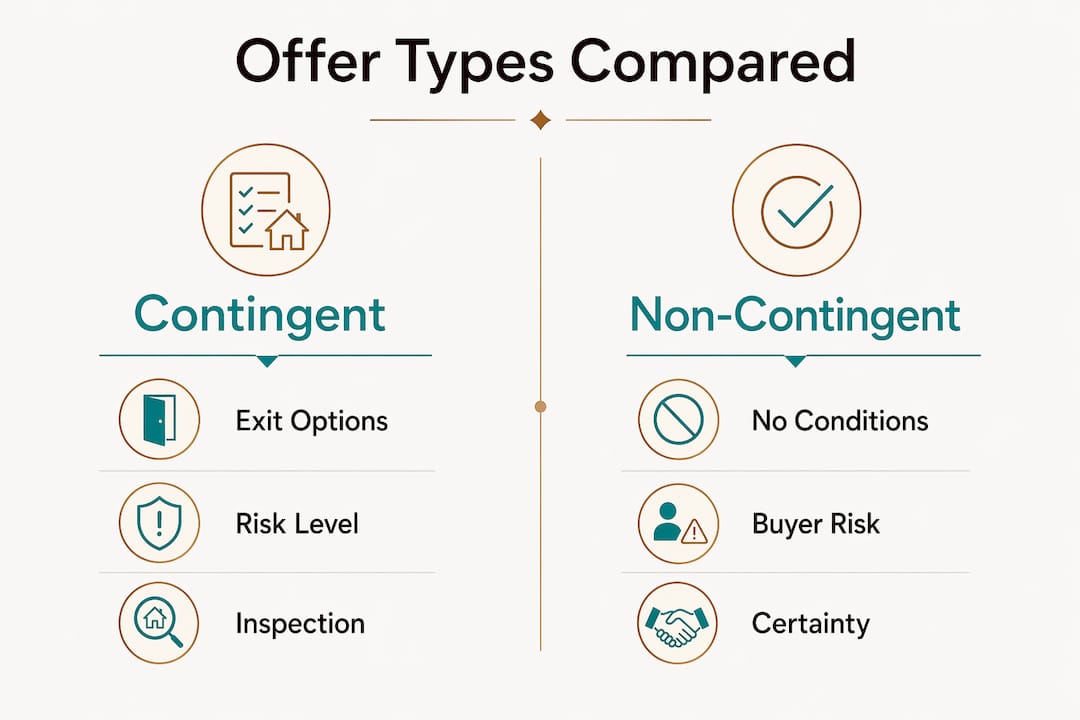
Contingent offers provide safety nets like financing or inspection contingencies. Non-contingent offers eliminate these to prioritize deal certainty and speed. For sellers, a clean offer means a smoother path to closing. For buyers, it means accepting that the contract is binding from the moment the seller signs.
When should you consider making a non-contingent offer?
Market conditions matter most here. In a seller’s market with low inventory and multiple competing offers, a non-contingent offer can be the only way to win. Santa Clara County regularly sees this dynamic, where well-priced homes attract five to ten offers within days of listing.
Before submitting a clean offer, evaluate these factors:
- Financial liquidity: Can you cover the earnest money loss if something goes wrong? Do you have cash reserves to bridge an appraisal gap?
- Property condition: Have you done enough due diligence, such as reviewing seller disclosures and conducting a pre-offer walkthrough, to feel confident about the property’s condition?
- Financing certainty: Are you fully pre-approved, not just pre-qualified? A mortgage contingency guide can help you understand exactly what protections you are giving up.
- Risk tolerance: Are you prepared to proceed even if minor issues surface after acceptance?
- Professional guidance: Consulting both a licensed REALTOR® and a real estate attorney before waiving contingencies is the standard recommendation from experienced practitioners.
Pro Tip: Before waiving any contingency, request all available seller disclosures and, if permitted, schedule a pre-offer property walkthrough. The more you know about the property upfront, the more confidently you can commit without protective clauses.
How to craft a strong non-contingent offer
A clean offer without contingencies is only as strong as the preparation behind it.
- Secure pre-approval or proof of funds: Attach a lender pre-approval letter or bank statement showing sufficient funds. Sellers and their agents scrutinize this documentation closely.
- Price competitively: A non-contingent offer at list price may still lose to a contingent offer priced higher. Know the local market well enough to price your offer at or above recent comparable sales.
- Time your offer strategically: In competitive Bay Area markets, submitting early in the offer review window with a clean offer can prompt sellers to accept before reviewing all bids.
- Leverage agent expertise: An experienced local agent understands what terms, beyond price, matter to a specific seller, such as a flexible closing date or a leaseback arrangement.
- Prepare backup financing plans: Even without a financing contingency, having a secondary lender or bridge loan option ready reduces your personal exposure if your primary mortgage encounters delays.
Pro Tip: Work with your agent to review the seller’s disclosure package thoroughly before submitting. Identifying any known issues in advance lets you price your offer to account for them, rather than discovering surprises after you are legally committed.
Expert perspective from a top Santa Clara County REALTOR®
Laxmi Penupothula, ranked in the Top 1% of U.S. real estate agents by RealTrends Verified for five consecutive years and a recipient of the SCCAOR REAL Award every year from 2021 through 2025, has guided buyers through non-contingent offer decisions across hundreds of Silicon Valley transactions.
Her approach to non-contingent offers centers on preparation and risk mitigation:
- Review all seller disclosures and inspection reports before committing to a clean offer
- Confirm financing is fully underwritten, not just pre-approved at the surface level
- Understand the specific property’s market position and days on market before pricing
- Consult a real estate attorney when waiving multiple contingencies simultaneously
- Build a cash reserve plan to cover potential appraisal gaps before submitting
In a case study from Evergreen, San Jose, Laxmitoprealtor demonstrated how expert negotiators use non-contingent offers strategically while maintaining backup plans to protect the buyer’s financial position. The result was a successful close in a highly competitive multiple-offer situation. Similarly, a Weibel, Fremont transaction showed how removing contingencies, paired with precise pricing, accelerated the closing timeline and delivered results well above asking price.
Legal experts note that a non-contingent offer shifts risk largely to the buyer but does not eliminate all buyer protections under contract law. Sellers can still breach the agreement, and buyers retain legal remedies in those circumstances. Professional legal counsel remains advisable when the stakes are high.
Pro Tip: Never treat a non-contingent offer as a shortcut. Treat it as a commitment you have already stress-tested against your worst-case financial scenario.
Quick reference: what you need to know about non-contingent offers
- A non-contingent offer is a binding purchase commitment with no conditions allowing the buyer to exit after acceptance
- Common contingencies waived include financing, inspection, appraisal, and sale-of-current-home clauses
- The primary benefit is competitive advantage in seller’s markets, where clean offers are strongly preferred
- The primary risk is financial exposure, including earnest money forfeiture and liability if financing fails
- Non-contingent offers are not limited to cash buyers; financed buyers can submit them but carry added risk
- Expert guidance from a licensed REALTOR® and a real estate attorney is the recommended standard before waiving contingencies
Non-contingent vs. contingent offers: real-world outcomes
Consider two buyers competing for the same home in Cupertino, listed at $2.1 million. Buyer A submits at $2.15 million with a financing contingency and a 17-day inspection period. Buyer B submits at $2.1 million with no contingencies and proof of full pre-underwriting approval.

Sellers in this scenario routinely choose Buyer B. The certainty of a clean close outweighs the $50,000 price difference because contingent deals in competitive Bay Area markets fall apart at a measurable rate, costing sellers time, relisting fees, and market momentum. A property that falls out of escrow often re-enters the market at a perceived disadvantage.
On the buyer side, the calculus is different. Buyer B accepted the full risk of the transaction. If an inspection would have revealed a $30,000 foundation issue, Buyer B owns that cost. If the appraisal comes in at $2.0 million, Buyer B must bring an additional $100,000 to closing or walk away and lose the deposit. Understanding when to sell a home as-is versus requiring repairs is a related decision sellers face, and it directly affects how buyers should approach contingency decisions on those properties.
The outcome of a non-contingent offer depends almost entirely on the preparation the buyer does before submitting it.
Key Takeaways
A non-contingent offer legally binds the buyer to purchase without exit conditions, shifting risk to the buyer in exchange for a stronger competitive position with the seller.
| Point | Details |
|---|---|
| Binding commitment | Once the seller accepts, the buyer must proceed or face contract breach and earnest money forfeiture. |
| Earnest money at risk | Buyers typically risk a small percentage of the purchase price if they back out without legal cause. |
| Competitive advantage | Clean offers are strongly preferred by sellers, especially in low-inventory markets like Santa Clara County. |
| Financing still applies | Non-contingent offers can involve a mortgage, but the buyer remains liable if financing falls through. |
| Expert guidance required | Consulting a licensed REALTOR® and a real estate attorney before waiving contingencies is the professional standard. |
Thinking about making a non-contingent offer in Silicon Valley’s competitive market? Laxmitoprealtor brings 570+ closed transactions and a Top 1% national ranking to every negotiation. See how record-breaking results in a challenging market are achieved through preparation, precision, and expert strategy.

Recommended
- Bay Area Home Pricing with Multiple Offers: A Seller’s Strategy Guide
- 2305 Oak Flat Road Sold $200K Over Asking in San Jose
- Bay Area Real Estate Market Insights 2026 – Laxmi Penupothula
- Strategic Negotiation & Risk Mitigation: A Case Study in Evergreen, San Jose – Laxmi Penupothula

Laxmi Penupothula
Top 1% Realtor SCCAOR, RealTrends Verified (2021–2025) • CA DRE #02047105
SCCAOR Top 1% Santa Clara County • Intero Chairman Circle 2023–2025 • \$650M+ Closed • 570+ Transactions
Silicon Valley & Bay Area Specialist — Cupertino, San Jose, Fremont, Milpitas, Sunnyvale & surrounding cities.
Get a Free Home Valuation →