


A probate sale in California is the court-regulated sale of real estate owned by a deceased individual, conducted under the California Probate Code to ensure proper asset distribution to heirs and creditors. Two legal paths govern these sales: Full Independent Administration of Estates Act (IAEA) authority, which closely resembles a standard real estate transaction, and Limited authority, which requires court confirmation and opens the door to competitive overbidding. Understanding which path applies to a given property determines your timeline, your deposit requirements, and your risk exposure. Buyers and households who grasp this distinction before making an offer gain a significant advantage in California’s probate market.
If you are the heir, executor, or administrator responsible for an inherited property, you may be approaching this process from the seller’s side rather than the buyer’s. Understanding how a probate sale works can help you prepare the property, set realistic expectations with your probate attorney, and evaluate what the home might be worth in today’s market. A free, no-obligation home valuation can give you a starting point before you decide how to move forward. Get a free home value estimate or learn more about selling an inherited property.
How does a probate sale work in California?
The probate process California courts oversee begins when a deceased person’s estate is filed with the Superior Court in the county where the decedent lived. The court appoints a personal representative, either an executor named in the will or an administrator when no will exists. That representative then manages the property and initiates the sale.
The authority type granted to the personal representative shapes everything that follows.
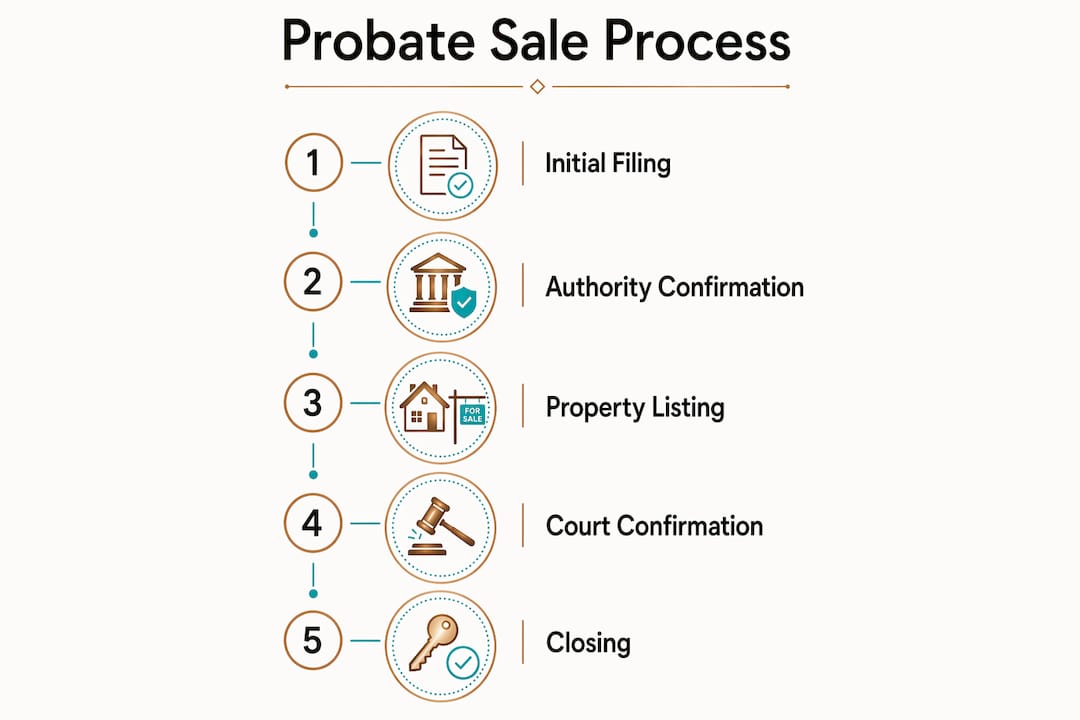
- Estate filing and representative appointment. The estate opens with a court petition. The court reviews the will and appoints the executor or administrator, typically within a few weeks of filing.
- Authority determination. The court grants either Full IAEA authority or Limited authority. Full IAEA authority allows the representative to sell property without court confirmation, making the process resemble a standard sale. Limited authority requires a court hearing to confirm every sale.
- Creditor claims period. California law requires a mandatory creditor notification period before the estate can distribute assets. This window affects the overall timeline regardless of authority type.
- Property listing and offer acceptance. The representative lists the property, reviews offers, and accepts the best one. Under Full IAEA authority, a Notice of Proposed Action (NOPA) goes to heirs, who have 15 days to object. If no objection is filed, the sale closes.
- Court confirmation hearing (Limited authority only). The accepted offer goes before a judge. Any buyer can appear and overbid. The overbid formula requires the first competing bid to equal 10% of the first $10,000 plus 5% of the remaining balance, and overbidders must bring a cashier’s check for 10% of their total bid to the hearing.
- Closing. Once the court confirms the sale or the NOPA period passes without objection, escrow closes and title transfers.
Full IAEA authority sales close in 45–90 days, comparable to a standard transaction. Limited authority sales add 30–90 or more days for the court confirmation hearing alone. The broader California probate timeline for simple estates runs 9–18 months, and complex cases with disputes can extend to 24–36 months.
Pro Tip: Ask the listing agent or estate attorney to confirm the authority type in writing before you spend money on inspections. That single piece of information tells you whether you face a 60-day close or a 12-month process.

All probate properties sell as-is. The personal representative has no legal obligation to make repairs or provide standard seller disclosures, so buyers must complete inspections before submitting an offer and price repair costs into their bids.
What are the risks of buying probate properties in California?
Probate properties carry real risks that standard listings do not. Buyers who treat these transactions like ordinary purchases often encounter costly surprises.
- As-is condition with no disclosures. Personal representatives frequently have limited knowledge of the property’s condition. Probate properties sell strictly as-is, with no seller repairs and no standard disclosure forms. Deferred maintenance, unpermitted additions, and hidden defects become the buyer’s problem after closing.
- Limited contingencies. Probate sales often restrict or eliminate financing and inspection contingencies, particularly in competitive situations. Buyers who cannot perform risk losing their deposit.
- The 90% pricing rule. In Limited authority sales, offers must equal at least 90% of the probate referee’s appraised value. That appraisal often lags behind current market values, which can create a pricing floor well below what comparable homes actually sell for.
- Higher deposit exposure. Buyers in Limited authority sales typically deposit 10% of their bid at the court hearing. Full authority sales require closer to 3%. That gap affects your liquidity and your risk if the deal falls apart.
- Overbid risk. Even after your offer is accepted in a Limited authority sale, any buyer can outbid you at the confirmation hearing. You may invest weeks of due diligence and lose the property to a higher bid on the courthouse steps.
- Title complications. Estates sometimes carry unresolved liens, tax obligations, or ownership disputes. A thorough title search before closing is non-negotiable.
Pro Tip: Order a preliminary title report as early as possible. Title issues in probate estates can take weeks to resolve, and discovering them late can kill a deal you have already invested significant time and money into.
The California probate process adds carrying costs that compound over time. Property taxes, insurance, and maintenance continue to accrue during the 9–18 month typical timeline. Buyers who factor only the purchase price into their analysis underestimate the true cost of a probate acquisition.
What advantages do probate sales offer buyers in California?
Despite the risks, California inheritance sales attract serious buyers for good reason. The financial upside is real when you enter with clear eyes and proper preparation.
- Below-market pricing. Probate properties typically sell 10–20% below market value. Estates prioritize speed and certainty over price maximization, which creates genuine buying opportunities in markets where every percentage point matters.
- Value-add potential. Because properties sell as-is, buyers who can manage renovations acquire homes at a discount and build equity through improvements. Silicon Valley properties with dated interiors but strong bones represent exactly this kind of opportunity.
- Faster closes under Full IAEA authority. Most probate sales proceed under Full IAEA authority, bypassing court auctions entirely. A 45–90 day close on a below-market property is a compelling proposition for prepared buyers.
- Appraisal arbitrage in Limited authority sales. When the probate referee’s appraisal lags behind market comps, the 90% pricing floor can still sit well below what the property would fetch in a standard sale. Buyers who understand this dynamic can negotiate from a position of knowledge.
- Less competition than standard listings. Many buyers avoid probate sales due to perceived complexity. That hesitation reduces competition and gives informed buyers more room to negotiate.
“Probate sales reward preparation. The buyers who do their homework on authority type, title, and repair costs before making an offer consistently outperform those who treat these transactions as ordinary listings.”
The key is treating the complexity as a filter, not a barrier. Every layer of process that discourages casual buyers is an advantage for the buyer who has done the work.
How to successfully navigate a probate sale purchase in California
Buying a probate property in California requires a more disciplined approach than a standard purchase. The following steps reflect what experienced buyers and their advisors actually do.
- Secure financing before you search. Lenders unfamiliar with probate timelines can create delays that cost you the deal. Get a pre-approval letter from a lender who has closed probate transactions before. Cash buyers have a structural advantage in this market.
- Confirm the authority type immediately. Determining whether the estate operates under Full or Limited IAEA authority shapes every decision that follows. If the estate holds Limited authority, ask whether the representative has considered petitioning for Full authority under Probate Code Section 10452. Converting to Full authority eliminates the overbid risk and shortens the timeline significantly.
- Hire a probate-experienced real estate agent. A general residential agent may not know the NOPA process, overbid mechanics, or how to read a probate court calendar. Ask the right questions before you commit to representation.
- Complete inspections before submitting an offer. Because properties sell as-is, your inspection results must inform your bid price, not serve as a negotiation tool after acceptance. Budget for a general inspection, roof inspection, and pest report at minimum.
- Understand the legal documents. The Notice of Proposed Action and the court confirmation hearing are mandatory legal safeguards, not bureaucratic obstacles. Knowing what each document requires and when it must be filed keeps your timeline on track.
- Prepare for the overbid scenario. If your sale requires court confirmation, arrive at the hearing with a cashier’s check for 10% of your maximum bid. Know your ceiling before you walk into the courtroom. Emotional bidding at a court hearing is how buyers overpay and erase the discount they came for.
Pro Tip: Work with a probate attorney alongside your real estate agent. The attorney handles court filings and creditor claim reviews; the agent handles property valuation and negotiation. These are two distinct skill sets, and you need both.
Tracking the estate’s progress through the court system is also worth the effort. Court calendars are public record in California. Buyers who monitor hearing dates and filing deadlines stay ahead of timeline shifts that catch unprepared buyers off guard.
Key Takeaways
A probate sale in California succeeds or fails based on the executor’s authority type, the buyer’s preparation, and the quality of the professional team guiding the transaction.
| Point | Details |
|---|---|
| Authority type determines everything | Full IAEA authority closes in 45–90 days; Limited authority adds court confirmation and overbid risk. |
| As-is sales require pre-offer inspections | No seller disclosures exist in probate; buyers must inspect and price repairs before submitting any offer. |
| Below-market pricing is real but conditional | Probate properties can sell 10–20% below market, but carrying costs and legal delays must factor into your analysis. |
| Overbid deposits are substantial | Limited authority buyers need a 10% cashier’s check at the court hearing, compared to roughly 3% in Full authority sales. |
| Expert representation is non-negotiable | A probate-experienced agent and attorney working together shorten timelines and protect buyers from costly procedural errors. |
What I have learned from California probate sales
The biggest misconception I encounter is that all probate sales involve a dramatic courtroom auction where buyers outbid each other in front of a judge. That picture is outdated. The majority of California probate sales today proceed under Full IAEA authority, which means no public auction, no overbid drama, and a closing process that looks and feels like a standard transaction. Buyers who avoid probate properties because of that outdated image are leaving real opportunities on the table.
The second thing I have learned is that the executor’s authority type is the single most important variable in the entire process. I have seen buyers spend weeks preparing for a Limited authority purchase, only to discover late that the estate could have petitioned for Full authority and avoided the court confirmation process entirely. That is a failure of early due diligence, and it is entirely preventable.
Probate sales also require a more cautious posture than standard listings. The as-is condition is not a negotiating tactic. Personal representatives genuinely may not know what is behind the walls or under the foundation. Buyers who skip inspections to move faster almost always regret it. The discount you gain on the purchase price can disappear quickly in unexpected repair costs.
My honest view is that probate properties represent some of the best acquisition opportunities in California real estate for buyers who prepare properly. The complexity filters out casual competition. The pricing reflects estate priorities, not market maximization. And with the right agent and attorney in your corner, the process is far more manageable than it appears from the outside.
— Laxmitoprealtor
Laxmitoprealtor’s guidance for probate property buyers
Probate transactions in California require a level of preparation and market knowledge that goes well beyond a standard purchase. Laxmitoprealtor brings $650 million in closed sales and deep familiarity with Santa Clara County’s real estate market to every client relationship, including buyers pursuing probate properties in San Jose, Cupertino, Sunnyvale, Saratoga, and the greater South Bay.

Whether you are evaluating your first probate listing or navigating a court confirmation hearing, Laxmitoprealtor provides the negotiation experience and local market insight to help you make confident, well-informed decisions. Explore Laxmitoprealtor’s trusted real estate expertise and connect directly to discuss your probate property goals in California.
FAQ
What is a probate sale in California?
A probate sale in California is the court-supervised sale of real estate belonging to a deceased person’s estate, governed by the California Probate Code to protect heirs and creditors during asset distribution.
How long does a probate sale take in California?
Full IAEA authority sales close in 45–90 days. Limited authority sales require a court confirmation hearing that adds 30–90 or more days, and the overall probate process for simple estates typically runs 9–18 months.
Can buyers negotiate the price in a probate sale?
Buyers can negotiate within the constraints of the authority type. In Limited authority sales, offers must meet at least 90% of the probate referee’s appraised value, which often sits below current market comparables.
Do probate properties sell as-is in California?
Yes. Probate properties sell strictly as-is with no seller repairs and no standard disclosure forms. Buyers must complete all inspections before submitting an offer and factor repair costs directly into their bid.
What is the overbid process in a California probate sale?
In court-confirmed Limited authority sales, any buyer can appear at the confirmation hearing and submit a higher bid. The first overbid must equal 10% of the first $10,000 plus 5% of the remaining balance, and overbidders must present a cashier’s check for 10% of their total bid at the hearing.
I inherited a property in California — how do I know if I should sell?
Every estate is different, and only you, your co-heirs, and your attorney can decide whether selling is the right choice. If you are leaning toward selling, a good first step is getting a clear picture of the property’s current market value. Request a free home valuation or explore seller resources to help inform that conversation with your attorney and co-heirs.
Recommended

Laxmi Penupothula
Top 1% Realtor SCCAOR, RealTrends Verified (2021–2025) • CA DRE #02047105
SCCAOR Top 1% Santa Clara County • Intero Chairman Circle 2023–2025 • \$650M+ Closed • 570+ Transactions
Silicon Valley & Bay Area Specialist — Cupertino, San Jose, Fremont, Milpitas, Sunnyvale & surrounding cities.
Get a Free Home Valuation →