


Measure E applies to any San Jose property transfer at or above $2,300,000.01, effective July 1, 2025. Below that figure, no city transfer tax applies beyond the standard county rate.
TL;DR:
- Measure E applies only to property transfers above $2.3 million, with the exemption adjusted for inflation every five years, so verify current thresholds before closing.
- The tax rate jumps at certain tiers and applies to the entire transaction amount once crossed, which can significantly impact net proceeds if the sale price is near a tier boundary.
- Transfer tax responsibility is negotiable; sellers often pay both Measure E and county transfer taxes, but contractual terms should specify who covers each cost explicitly.
- Alongside Measure E, buyers may face additional closing costs like title insurance and escrow fees, which are typically seller-paid but are negotiable.
- Proper planning involves modeling net proceeds across multiple pricing scenarios before listing, especially when the sale price nears a tax tier to avoid unexpected costs.
Table of Contents
- What Is the Transfer Tax in San Jose Under Measure E?
- How Do You Calculate San Jose Transfer Tax on a Sale?
- Who Pays Transfer Tax in California, Buyer or Seller?
- What Other Closing Costs Come With Transfer Tax in San Jose?
- Where Do You Record and Pay Transfer Tax in Santa Clara County?
- Local Resources for Transfer Tax and Closing Questions in San Jose
- How a San Jose Listing Agent Manages Measure E for Sellers
- Why the Standard Measure E Advice Misses the Point
- Get Local Help Pricing and Negotiating Around Measure E
- Sources
What Is the Transfer Tax in San Jose Under Measure E?
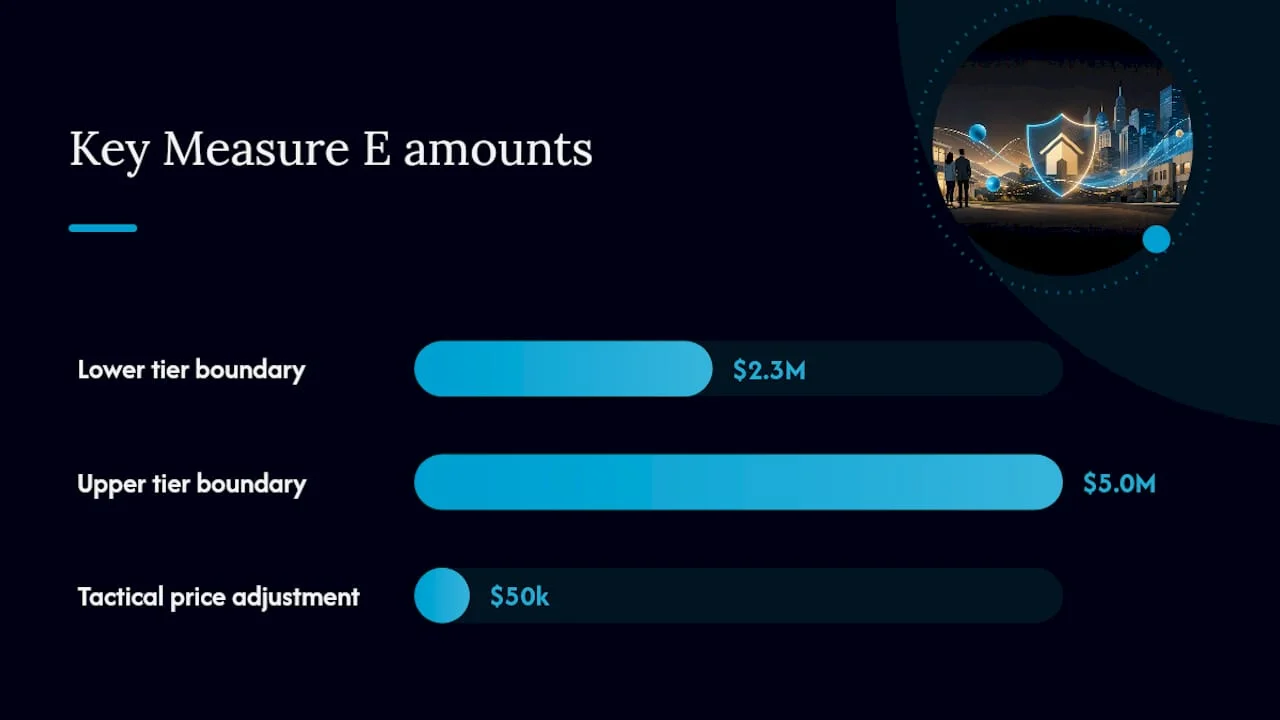
Measure E is San Jose’s Real Property Transfer Tax, layered on top of the countywide documentary transfer tax that applies to every recorded deed in Santa Clara County. Voters approved it in March 2020, and the City of San José’s own documentation confirms the tax is imposed on transfers above $2.3 million, with revenue earmarked for affordable housing and homeless services.
The current structure, per the Santa Clara County Clerk-Recorder:
- Under $2,300,000.01: No Measure E tax applies.
- $2,300,000.01 to $5,000,000: Taxed at 0.75%.
- $5,000,000.01 to $10,000,000: Taxed at 1.0%.
- Over $10,000,000: Taxed at 1.5%.
That $2.3 million threshold isn’t permanent. City documentation confirms it adjusts automatically for inflation every five years, so a transaction that clears the exemption today might not in 2030. Always verify the current threshold with your escrow officer before finalizing numbers, since exemptions also exist for specific transfer types, including transfers between family members, government entity transfers, and certain entity reorganizations. The ordinance text governs the fine print, so read it directly rather than relying on secondhand summaries.
How Do You Calculate San Jose Transfer Tax on a Sale?
Measure E doesn’t work like federal income tax brackets, where only the amount above a threshold gets taxed at the higher rate. It works on a cliff: once your sale price crosses into a tier, that entire tier’s rate applies to the full transaction value, not just the portion above the line.
That distinction can swing a seller’s net proceeds by tens of thousands of dollars over a price difference of a few dollars. As one analysis of the ordinance points out, this cliff effect is exactly why pricing strategy near a tier boundary matters so much.
Here’s how it plays out across three price points:
- $4,800,000 sale: Falls in the 0.75% tier. Measure E tax equals $36,000.
- $7,500,000 sale: Falls in the 1.0% tier. Measure E tax equals $75,000.
- $11,000,000 sale: Falls in the 1.5% tier. Measure E tax equals $165,000 on the full amount.
To get your total transfer tax due, add San Jose’s Measure E amount to the county documentary transfer tax and any applicable city conveyance tax that applies separately from Measure E. Your escrow officer calculates all three together on the closing statement.
Who Pays Transfer Tax in California, Buyer or Seller?
California law doesn’t assign transfer tax responsibility to either party. It’s entirely a matter of contract negotiation, which surprises a lot of first-time sellers who assume the cost is fixed by statute.
In most San Jose transactions, sellers customarily pay Measure E and the county transfer tax, following the pattern set by existing market convention. But “customary” isn’t “mandatory,” and in a competitive listing or a high-value deal, allocation becomes a real negotiating point. Sellers listing above $2.3 million should push their agent to address it directly in the purchase agreement rather than defaulting to habit.
Before signing, check these items:
- Does the purchase contract explicitly state who pays Measure E versus who pays the county base rate?
- Is the allocation contingent on final sale price if negotiations push the deal across a tier line?
- Has your agent modeled net proceeds under more than one price scenario?
Pro Tip: If your home is listed within $200,000 of a Measure E tier boundary, ask your agent to run net proceeds calculations at multiple offer prices before you counter. A slightly lower accepted offer can sometimes net you more cash than a higher one that trips the next tier.
What Other Closing Costs Come With Transfer Tax in San Jose?
Measure E is one layer, not the whole picture. Santa Clara County’s documentary transfer tax applies to every deed regardless of price, and you’ll also see title insurance, escrow fees, recording fees, and prorated property taxes on the settlement statement. Sellers typically cover the broker commission separately, which dwarfs every tax line combined on most transactions.

Buyers researching closing costs in California should note that most of these fees are customarily seller-paid in San Jose, but every line is negotiable, same as the transfer tax itself.
Where Do You Record and Pay Transfer Tax in Santa Clara County?
The Santa Clara County Clerk-Recorder’s Office records the deed and collects Measure E along with the county documentary transfer tax at the same time. Your escrow or title company handles this filing on your behalf, so you won’t typically visit the office yourself unless a question arises about a specific exemption claim.
If reassessment or supplemental tax bills come up after closing, that’s a separate matter handled by the County of Santa Clara County Office of the Assessor, not the Clerk-Recorder. Keep these two offices distinct in your mind, since escrow officers field questions meant for the other one constantly.
Expect these items to be requested during the recording process:
- Preliminary change of ownership report
- Grant deed with accurate legal description
- Any claimed exemption documentation
- Final settlement statement figures for tax calculation
Recording typically happens the same day escrow closes, so accurate figures matter well before that date arrives.
Local Resources for Transfer Tax and Closing Questions in San Jose
Handling Measure E well means knowing which local resource fits which question. Government offices confirm official figures and record documents. Tax preparers and attorneys handle filing and complex structuring. A listing agent coordinates pricing strategy and negotiation around the tax itself.
| Provider | Business Type | Best For | Core Services | Google Reviews |
|---|---|---|---|---|
| Laxmi Penupothula — Selling Agent San Jose | Realtor | Full-service listing and negotiation support for sellers navigating Measure E | Listing, pricing strategy, escrow coordination, tax-allocation negotiation | 4.8★ (100) |
| Santa Clara County Clerk-Recorder’s Office | County office | Official recording and transfer tax collection | Deed recording, Measure E collection | 4.3★ (280) |
| County of Santa Clara County Office of the Assessor | County office | Assessment and supplemental tax questions | Property valuation, reassessment guidance | 3.2★ (27) |
| Kim & Rosado LLP | Tax attorney | High-value or legally complex transfers | Tax controversy, entity structuring, IRS representation | 5★ (61) |
| First Tax Service, Inc | Boutique tax firm | Tax planning tied to transaction proceeds | Business tax planning, fractional CFO services | 4.9★ (34) |
| Pronto Tax Services | Tax preparer | Routine filing and advisory | General tax preparation | 4.8★ (74) |
| Fiesta Auto Insurance & Tax Service | Tax preparer / insurance | Basic tax prep alongside insurance needs | Tax filing, insurance products | 4.7★ (158) |
| San Jose Tax Services | Accountant | Accounting for individuals and small businesses | Tax prep, small-business accounting | 3.3★ (12) |
| Community Tax Services | Tax preparer | Standard tax filing support | Basic tax filing assistance | 2.8★ (9) |
| El quetzal Multiservices | Community tax assistance | Low-cost, community-level filing help | Basic tax assistance | 5★ (3) |
For a straightforward filing, a preparer like Pronto Tax Services or Fiesta Auto Insurance & Tax Service covers the basics. For a transfer that crosses into seven figures with legal complexity such as entity ownership or estate involvement, Kim & Rosado LLP brings former IRS counsel experience that a general preparer won’t have. For the pricing and negotiation strategy that determines which tier you land in, that’s where a listing agent’s role begins well before escrow opens.
How a San Jose Listing Agent Manages Measure E for Sellers
Getting Measure E right starts months before closing, not at the settlement table. A seller pricing a home near $2.3 million or $5 million needs a strategy conversation about tier positioning before the listing goes live, not after an offer arrives.
Practical steps that protect net proceeds:
- Model net proceeds at multiple price points before setting a list price near a tier boundary.
- Negotiate transfer tax allocation language directly into the purchase contract, not as an afterthought.
- Coordinate early with escrow so recording documents and exemption claims are ready before closing day.
- Bring in a CPA or tax attorney when the transfer involves entity ownership, estate transfers, or amounts near the 1.5% tier.
Local agents who work Measure E-affected properties regularly, as outlined in seller guidance, understand that a $50,000 price adjustment can sometimes preserve more net proceeds than holding firm on list price. That kind of tactical judgment comes from handling these transactions directly, not from reading the ordinance once.
Pro Tip: Ask any agent you’re interviewing how many Measure E-affected transactions they’ve personally closed, as understanding how different sale methods impact your net proceeds can be critical for high-value properties like those affected by San Jose’s transfer tax tiers, which is well explained in the Cash Offer vs. Opendoor vs. Agent in San Diego: What You Net | San Diego Cash For Houses analysis. The tax has only applied since mid 2025, so real experience with tier-boundary pricing is still concentrated among a smaller group of local specialists.
Why the Standard Measure E Advice Misses the Point
Most explainers stop at reciting the tier percentages, as if knowing the math solves the problem. It doesn’t. The real cost of Measure E isn’t the tax itself, it’s the pricing decisions sellers make without understanding the cliff effect until an offer is already on the table.
I’ve seen the conventional advice treat Measure E as a closing-cost line item to disclose late in the process. That’s backwards. The threshold and tier structure should shape your listing price from day one, especially for homes sitting within a few hundred thousand dollars of $2.3 million or $5 million. A seller who lists $50,000 too high can trigger a tax jump that costs more than the extra price would have earned.
The other overlooked piece is that allocation is negotiable. Too many sellers assume the customary seller-pays pattern is legally required and never raise it during contract negotiations. It isn’t required, and in a market where every dollar of net proceeds matters, that’s a conversation worth having with your agent before you sign anything.
— Mr
Get Local Help Pricing and Negotiating Around Measure E
Handling a Measure E transfer well takes more than knowing the tax tiers. It takes a pricing strategy built around them from the start, contract language that protects your proceeds, and coordination with escrow so nothing stalls your closing date. That’s the gap between a seller who reads about Measure E and one who has an agent actively managing it on their behalf.

Laxmitoprealtor brings direct experience pricing and negotiating San Jose transactions near Measure E’s tier boundaries, backed by concierge seller services including staging, professional marketing, and escrow coordination timed to protect your net proceeds. If your home’s value puts you within range of a tier threshold, request a free CMA and consultation to see how pricing strategy could change your bottom line before you list.
Recommended
- Santa Clara County Property Tax: What Buyers & Sellers Must Know
- Sell Your Home in San Jose, CA
- Prop 19 Property Tax Calculator: Estimate Your Bay Area Savings
- Prop 19 Move-Up Tax Savings: Carrying Your Low Property-Tax Base (Over 55)

Laxmi Penupothula
Top 1% Realtor SCCAOR, RealTrends Verified (2021–2025) • CA DRE #02047105
SCCAOR Top 1% Santa Clara County • Intero Chairman Circle 2023–2025 • \$650M+ Closed • 570+ Transactions
Silicon Valley & Bay Area Specialist — Cupertino, San Jose, Fremont, Milpitas, Sunnyvale & surrounding cities.
Get a Free Home Valuation →