


Before you list, determine whether your solar system is owned outright, financed through a solar loan, or third-party owned under a lease or power purchase agreement (PPA). That single distinction drives everything: appraised value, escrow complexity, and how your agent prices and discloses the system. A 2025 SolarReviews study found homes with solar panels sold for an average of 6.9% more than comparable homes without them. That premium is real, but only sellers who document and disclose correctly capture it.
Here is your immediate action plan before the listing goes live:
- Locate your solar contract. Pull the original lease, PPA, loan agreement, or purchase invoice. If you financed through a solar loan, note the remaining balance.
- Contact your solar provider and title company. Ask whether a UCC-1 fixture filing exists on the property. Many lease and loan providers file a UCC-1 that must be released before closing.
- Brief your listing agent. Ask them to prepare a Solar Listing Report and draft MLS language that leads with ownership type, average monthly savings, and transferable warranties.
Solar panels do not market themselves. Sellers who prepare performance documentation and hand a clear narrative to buyer agents and appraisers consistently capture the most value.
Table of Contents
- Do solar panels help sell a house? What the evidence shows
- How ownership type changes everything about your sale
- How appraisers and lenders value a solar system
- How to write your MLS listing and market a solar home
- How solar affects escrow timing and how to negotiate through it
- Common mistakes that slow or kill a solar home sale
- Solar seller’s document checklist
- How a top listing agent prepares and markets a solar home
- Key Takeaways
- Why sellers who treat solar as a marketable asset win
- Laxmitoprealtor’s concierge seller services for solar homes
- Useful sources for sellers and agents
Do solar panels help sell a house? What the evidence shows
The short answer is yes, when the system is properly disclosed and marketed. The evidence across multiple studies is consistent: Lawrence Berkeley National Laboratory research established that buyers pay a measurable premium for homes with owned solar systems. The U.S. Department of Energy’s multi-state analysis confirmed price premiums across varied markets, and the 2025 SolarReviews figure of 6.9% represents one of the more recent industry benchmarks.

Beyond the headline premium, three buyer-side benefits drive that number:
Lower operating costs. According to NAR survey data cited in industry research, 34% of homebuyers consider operating costs an important factor in their purchase decision. A home with documented monthly electric bill savings is a quantifiable advantage, not just a marketing claim.
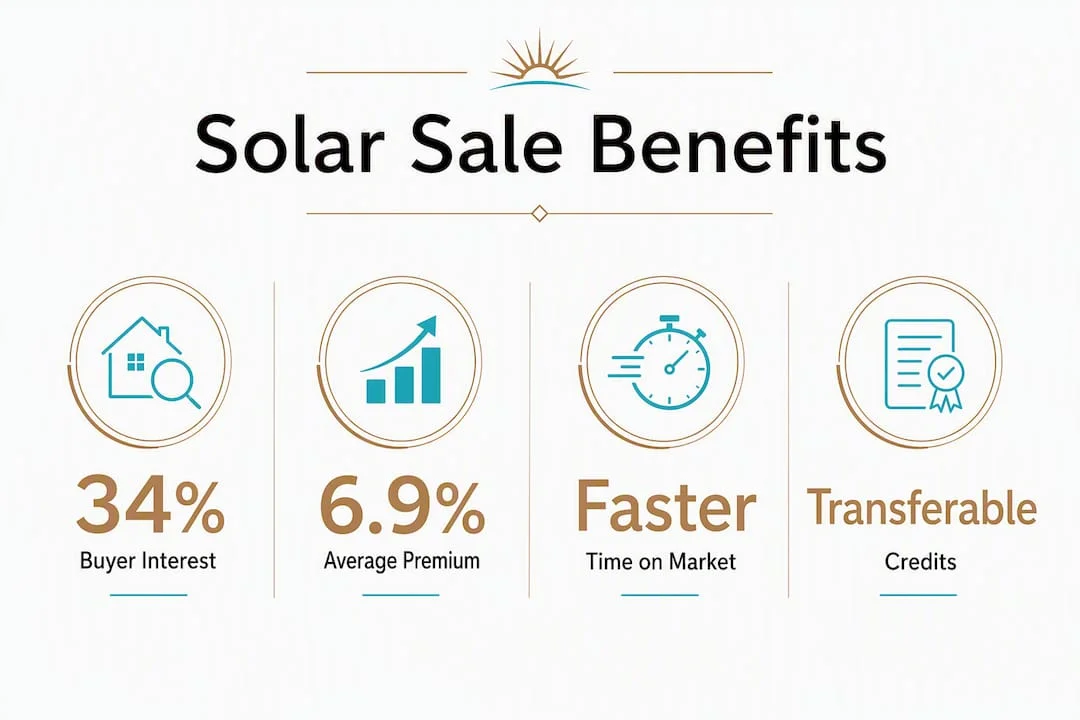
Faster time on market. Listings that explicitly mention solar tend to attract buyers already motivated by energy costs. A study of 500,000 homes found a 2% premium when solar was mentioned in the listing. Notably, one-third of homes with solar panels did not mention it at all, leaving that premium unclaimed.
Transferable net metering credits. In states with active net metering programs, the utility account and its credits can often transfer to the buyer, adding ongoing financial value. This is worth spelling out in the listing because most buyers do not know to ask.
The premium varies by market, system size, local electricity rates, and ownership type. Silicon Valley’s high electricity costs make solar savings particularly compelling to buyers, which is one reason solar panel home value tends to be more pronounced in the Bay Area than in markets with lower utility rates.
Pro Tip: Put the word “solar” in the MLS headline, not just the remarks section. Listings that lead with solar in the first 500 characters consistently outperform those that bury it in the property description.
How ownership type changes everything about your sale
The four ownership structures each create a different transaction path. Misidentifying yours is the most common source of escrow delays.

| Ownership Type | Transferability | Appraisal Impact | Escrow Friction | Common Lender Requirements |
|---|---|---|---|---|
| Owned (cash purchase) | Transfers with deed | Full value credit possible | Low | Standard disclosure |
| Owned (solar loan) | Transfers with deed; loan must be paid off or assumed | Full value credit possible | Moderate | Loan payoff or assumption docs |
| Leased | Requires provider approval and buyer credit check | No appraised value added | High | Lease assignment approval |
| PPA | Requires provider approval and buyer credit check | No appraised value added | High | PPA assignment approval |
Owned systems (cash and solar loan)
When you own the equipment outright, the system can be appraised as part of the home’s value. If you financed through a solar loan, you still own the equipment, but the outstanding balance must be addressed at closing. Sellers typically pay off the loan at closing or factor the remaining balance into the sale price, coordinating with the lender and title company to clear the lien.
Leased systems and PPAs
Third-party-owned systems are the most complex scenario. The solar company owns the equipment; you are paying for electricity or leasing the panels. Transferring a lease or PPA requires the buyer to pass a credit check and formally assume the contract. Because the buyer is not acquiring the asset, appraisers and lenders generally cannot credit its value toward the home’s appraised price.
UCC-1 fixture filings
Many solar providers file a UCC-1 financing statement that attaches the panels to the property as fixtures. This filing must be identified early and addressed before the deed can record. Ask your title company to run a UCC search at the start of escrow, not the week before closing.
Buyout vs. transfer: how to decide
A buyout makes sense when the remaining contract term is short, the buyout price is less than the appraised value the system would add, or the buyer is resistant to assuming the contract. Transfer makes sense when the buyout cost is prohibitive and the buyer qualifies and is willing. Get a current buyout quote from your provider before listing so you can negotiate from a position of knowledge.
- If the buyout quote is less than the solar premium the system would add to your appraised value, paying it off at closing is usually the cleaner path.
- If the remaining term is long and the buyout is expensive, prepare a clear one-page summary of contract terms to hand buyers and their agents upfront.
- Removing panels and taking them to your next home is rarely worth it. Removal and reinstallation typically costs $500–$2,500, and you will need new utility interconnection approval at the destination property.
How appraisers and lenders value a solar system
The core rule is straightforward: owned systems can add appraised value; leased and PPA systems generally do not. This is not a technicality. Because the buyer of a leased-system home is not acquiring the solar equipment as an asset, appraisers and lenders treat it as a contractual obligation rather than a property improvement. Freddie Mac’s appraisal guidance reinforces this distinction, and most conventional lenders follow it.
Appraisers vary widely in their solar expertise. Providing the right documentation dramatically increases the probability that the system is treated like other conditioned assets rather than ignored entirely.
What appraisers want to see
- Equipment specifications: panel brand, model, wattage, and total system size in kilowatts
- Purchase or installation invoice showing original cost
- 12-month production reports from the monitoring portal (SolarEdge, Enphase, or equivalent)
- Inverter age, model, and remaining warranty
- Permit records and commissioning/inspection report
- Installer contact information and transferable warranty documentation
- A Solar Listing Report: a third-party, shareable document that aggregates specs, production data, and warranty information into appraisal-ready evidence
A well-prepared Solar Listing Report can make the difference between an appraiser including the system in value and ignoring it entirely. Agents who include it in the MLS packet see fewer appraisal reworks.
The 2025 SolarReviews average premium of 6.9% is a useful benchmark for setting seller expectations, but the actual appraised value depends on system size, age, production history, and local comparable sales. LBNL research and NREL studies both found that buyers pay a premium for solar homes, with the dollar amount varying by market and system characteristics.
Pro Tip: Order a Solar Listing Report and a pre-listing solar inspection before you go live. Independent third-party evidence is far more persuasive to an appraiser than a seller’s self-reported production figures.
How to write your MLS listing and market a solar home
Most sellers with solar undermarket the asset. Listing copy that leads with quantifiable savings and transferable benefits materially increases buyer interest. The MLS headline and first 500 characters are the highest-leverage real estate in your listing.
What belongs in the MLS headline and opening description
- Ownership type stated plainly (“Owned solar — no lease to assume”)
- Average monthly electric bill savings or average annual production in kWh
- Net metering status and whether the utility account transfers
- Transferable warranties and monitoring access
Sample MLS language
Owned 9.6 kW solar system — no lease, no PPA. Average monthly electric bill: under $30. System installed 2021, 25-year panel warranty transferable to buyer. SolarEdge monitoring portal access included. Permits on file. Production reports available upon request. Buyer to verify all figures independently.
That block gives buyers, their agents, and appraisers exactly what they need in one read. Adapt the specifics to your system.
Assets to include in your listing packet
- One-page Solar Listing Report (third-party, shareable PDF)
- 12-month production history and corresponding utility bills
- Equipment spec sheet (panel model, inverter model, system size)
- Inverter age and remaining warranty documentation
- Installer contact and service history
- Permit records and commissioning report
- Monitoring portal screenshot showing recent production
For photography, professional listing photos should include a clean rooftop shot showing panel placement, a screenshot of the monitoring dashboard, and any exterior shots that show roof condition. Buyers who are already interested in solar want visual confirmation that the system is well-maintained. A well-staged home with clean gutters and a clear roofline photographs significantly better than one that looks neglected.
How solar affects escrow timing and how to negotiate through it
Solar-related escrow delays are predictable and preventable. The most common cause is a seller who discovers a UCC-1 filing or a lease transfer requirement in the final week of escrow.
Step-by-step escrow playbook
- Week 1 of listing prep: Notify your solar provider that the home is going on the market. Request a current buyout quote and a list of transfer requirements.
- At listing: Confirm with your title company that a UCC search is included in the preliminary title report. Do not wait for the buyer’s lender to flag it.
- At offer acceptance: Provide the buyer’s agent with the full solar documentation packet immediately. If the system is leased or under a PPA, initiate the transfer application with the provider the same day.
- During escrow: Track the provider’s credit review timeline. Lease and PPA transfers can add 30–60 days to escrow if not started early.
- Before closing: Confirm the UCC-1 release is recorded or in process. Do not assume the title company has handled it without written confirmation.
Negotiation options when solar creates friction
- Seller buyout at closing: Pay off the lease or loan from sale proceeds. Clean, simple, and often the fastest path.
- Price adjustment: Offer the buyer a credit to offset their assumption of the contract’s remaining obligations.
- Escrow holdback: If the UCC release or transfer approval is pending, an escrow holdback can allow closing to proceed while the final paperwork clears.
- Transfer contingency language: Add a specific contingency that makes the sale conditional on provider approval of the lease transfer, with a defined timeline.
Who does what in escrow
- Listing agent: — Prepares the solar packet, coordinates with title on UCC status, and manages provider communication timelines.
Common mistakes that slow or kill a solar home sale
These are the errors that appear repeatedly in transactions where solar becomes a liability rather than an asset.
- Failing to disclose a lease or PPA. This is the most serious mistake. A buyer who discovers an undisclosed third-party contract after offer acceptance has grounds to walk, and in some states, non-disclosure creates legal exposure. Disclose the contract type in the MLS and in the seller’s disclosure documents, without exception.
- Not providing production or warranty documentation. Buyers and appraisers who cannot verify the system’s performance will discount it or ignore it. A seller who says “the system works great” without data is asking buyers to take their word for it. Panels without paperwork are worth less at appraisal.
- Attempting to reassign monitoring access late in escrow. Monitoring portal transfers (SolarEdge, Enphase) require account setup and sometimes provider coordination. Starting this in the final week creates unnecessary friction. Initiate it when the buyer’s offer is accepted.
- Removing panels without a plan. Sellers occasionally decide to take owned panels to their next home. Beyond the $500–$2,500 removal and reinstallation cost, the roof will need inspection and likely repair, and the buyer loses a selling point they may have priced in. If you are considering removal, get a written cost estimate and a roof assessment before making that decision.
- Claiming incorrect system ownership in the MLS. Listing a leased system as “owned solar” is a material misrepresentation. Buyers who discover the discrepancy during due diligence will either renegotiate aggressively or cancel. Use precise language: “owned,” “solar loan,” “leased,” or “PPA.”
- Ignoring property tax implications. In California, solar systems installed under the active solar energy system exclusion are generally excluded from reassessment. Sellers should confirm the current exclusion status with their county assessor and disclose it accurately. For broader capital gains and tax considerations specific to California sellers, consult a qualified tax professional before closing.
This article provides general information, not legal or tax advice. Confirm current rules with a qualified professional or the relevant primary source before making decisions.
Solar seller’s document checklist
Gather these before your listing appointment. A complete packet on day one prevents delays at every subsequent stage.
Documents to collect
- Solar contract (lease agreement, PPA, loan agreement, or purchase invoice)
- 12 months of utility bills showing net metering credits and actual charges
- 12-month production reports from the monitoring portal
- Equipment spec sheets: panel brand/model, inverter brand/model/age
- Original permit records and commissioning/inspection report
- Warranty documentation: panel warranty (typically 25 years), inverter warranty, workmanship warranty
- Installer contact information and any service history records
- UCC-1 filing status (request from title company or solar provider)
- Current buyout quote (if under lease or PPA)
- Net metering agreement or utility interconnection agreement
Key figures to have ready
- System size in kilowatts (kW)
- Year installed
- Inverter type and age
- Estimated average monthly savings in dollars
- Remaining warranty years for panels and inverter
- Current buyout amount (if applicable)
How to package and distribute
- Compile everything into a single PDF folder organized by category (contract, production, equipment, permits).
- Ask your agent to prepare a one-page Solar Listing Report from this data for the MLS packet.
- Take a current screenshot of the monitoring portal showing recent production.
- Your listing agent holds the full packet; the title company receives the contract and UCC documentation; the buyer’s agent receives the one-page summary at offer stage.
How a top listing agent prepares and markets a solar home
The difference between a solar home that appraises at full value and one that does not usually comes down to agent preparation, not the system itself. Here is the tactical sequence used in high-performing solar transactions.
Pre-listing preparation
- Order a pre-listing solar inspection from a qualified inspector. This produces an independent condition report appraisers can reference.
- Order a Solar Listing Report. A third-party, shareable document that aggregates specs, production, and warranty data is the single most effective tool for appraisal preparation.
- Confirm UCC status with the title company before the listing goes live. Surfacing a filing early gives you time to plan the release without escrow pressure.
- Prepare the full MLS packet: Solar Listing Report, 12-month production history, equipment specs, and permit records.
Marketing sequence
- Target outreach to buyer agents who have recently represented buyers in energy-efficient or solar-equipped homes. These buyers are already motivated.
- Write listing copy that leads with ownership type and monthly savings in the first sentence of the remarks section.
- Prepare open-house talking points: system size, average monthly bill, monitoring access, and warranty transfer process. Buyers who ask about solar at an open house are serious.
- For leased or PPA systems, prepare a one-page “buyer’s guide to assuming this contract” that explains the transfer process, timeline, and provider contact. Transparency reduces buyer friction before it becomes a negotiation issue.
Negotiation tactics
- When a buyer raises solar as a concern, address it with documentation, not reassurance. Hand them the Solar Listing Report and the 12-month production history.
- For lease transfers, build the provider’s approval timeline into the purchase contract as a named contingency with a specific deadline.
- If the appraisal comes in without solar value credited, provide the appraiser with the Solar Listing Report, production data, and comparable sales data from LBNL or NREL research showing solar premiums in the local market.
Representative outcome: A seller in the South Bay listed a home with a 10 kW owned system but had no documentation beyond the original installer invoice. The first appraisal did not credit the system. After the listing agent provided a third-party Solar Listing Report, 12-month production data, and equipment specs, the appraiser issued a revised value that reflected the system’s contribution. The final sale price exceeded the original appraisal by a meaningful margin. Documentation, not the panels themselves, recovered the value.
Laxmitoprealtor’s approach to solar transactions draws on this same preparation discipline. With $650M+ in closed sales across 570+ transactions in Santa Clara County, the process is built around evidence-first listing strategy, not assumptions.
Key Takeaways
Owned solar systems can add measurable appraised value to a U.S. home, but only sellers who identify their ownership type, gather complete documentation, and market the system explicitly in the MLS consistently capture that premium.
| Point | Details |
|---|---|
| Identify ownership type first | Owned, solar loan, leased, or PPA determines appraisal impact and escrow complexity before anything else. |
| Gather documents before listing | Collect contract, 12-month production reports, permits, warranties, and a current buyout quote before your listing appointment. |
| Market solar explicitly in MLS | Listings that name solar in the headline and first 500 characters capture a measurable premium; one-third of solar homes skip this entirely. |
| Start escrow steps early | Lease/PPA transfers can add 30–60 days; notify your provider and request a UCC search at the start of escrow, not the end. |
| Work with Laxmitoprealtor | Laxmitoprealtor coordinates Solar Listing Reports, UCC title work, and evidence-first MLS strategy to help Bay Area sellers capture full solar value at closing. |
Why sellers who treat solar as a marketable asset win
The conventional wisdom is that solar panels automatically add value to a home. That is only half true. The panels add potential value. The documentation, disclosure, and listing strategy convert that potential into actual sale price and appraisal credit.
What gets overlooked consistently is the buyer friction factor. A buyer who encounters a lease or PPA they did not know about, or who cannot find production data to verify the seller’s savings claims, will either discount the offer or walk. Transparency about contract terms and early coordination with the provider are what reduce that friction, not the system’s age or brand.
The sellers who capture the most value from solar are not necessarily the ones with the newest or largest systems. They are the ones whose agents prepared a complete documentation packet, wrote listing copy that quantified the savings, and initiated the escrow steps before the buyer’s lender asked for them. That preparation is repeatable and teachable. It is also the part most sellers skip because they assume the panels speak for themselves.
In Silicon Valley’s market, where electricity rates are among the highest in the country, solar savings are a genuinely compelling buyer benefit. The opportunity cost of under-marketing a solar home here is higher than in most U.S. markets. Sellers who treat the system as a documented, disclosed, and actively marketed asset consistently outperform those who treat it as a footnote.
Laxmitoprealtor’s concierge seller services for solar homes
Selling a solar-equipped home in Silicon Valley requires more preparation than a standard listing, and the payoff for getting it right is proportionally higher. Laxmitoprealtor offers a full concierge seller experience built around exactly this kind of transaction: pre-sale inspections, Solar Listing Report coordination, early UCC title work, professional photography that showcases panel placement and monitoring data, and MLS copy written to lead with solar value.

For sellers in Santa Clara County, Cupertino, Sunnyvale, San Jose, Saratoga, Fremont, and Milpitas, the process starts with a free comparative market analysis that factors in your solar system’s ownership type and documentation status. Bring your solar contract, 12-month production report, and equipment specs to the first consult. Laxmitoprealtor will coordinate the rest, from the Solar Listing Report to the final UCC release confirmation. With five consecutive years in the Top 1% of SCCAOR REALTOR® members and $650M+ in closed sales, the track record speaks directly to what sellers in this market need. Schedule your free seller consultation and come prepared with the one-page checklist from this article.
Useful sources for sellers and agents
These are the primary references used in this article. Bring the relevant ones to your listing appointment as supporting documentation.
- Lawrence Berkeley National Laboratory — Solar Home Price Premium Research: LBNL’s foundational study on the price premium buyers pay for solar homes across multiple U.S. markets.
- LBNL — Exploring California PV Home Premiums: California-specific analysis of solar home premiums, directly relevant to Bay Area sellers.
- NREL — Solar Home Valuation Study: Early NREL research establishing the methodology for measuring solar home premiums.
- U.S. Department of Energy — Selling the Sun: Multi-State Solar Home Price Premium Analysis: DOE’s multi-state dataset confirming solar premiums across varied markets.
- Appraisal Institute — Residential Green and Energy Efficient Addendum: The standard appraisal form used to document energy-efficient features including solar; useful to share with your appraiser.
- Solar United Neighbors — Selling Your Solar Home Guide (March 2025): Practical transfer, UCC, and disclosure guidance for sellers with leased or owned systems.
- SolarReviews — Do Solar Panels Really Raise Your Home’s Value in 2025?: Source of the 6.9% average premium figure and loan/ownership transfer guidance.
- Solar Power World — When Mentioned in Listing, Homes with Solar Sell for Thousands More: Study of 500,000 homes showing the 2% MLS mention premium.
- SEIA — Solar Industry Research Data: Industry-level data on solar adoption, system types, and market trends.
Recommended
- Selling Home Mission District Fremont: The 2026 Seller’s Playbook
- How to Sell Your Home in Silicon Valley: The Complete 2026 Seller’s Guide – Laxmi Penupothula
- San Jose Home Selling Tips 2026 | Increase Value Fast
- Should I Sell My Home Now or Wait? A Bay Area Seller’s Framework (2026) – Laxmi Penupothula

Laxmi Penupothula
Top 1% Realtor SCCAOR, RealTrends Verified (2021–2025) • CA DRE #02047105
SCCAOR Top 1% Santa Clara County • Intero Chairman Circle 2023–2025 • \$650M+ Closed • 570+ Transactions
Silicon Valley & Bay Area Specialist — Cupertino, San Jose, Fremont, Milpitas, Sunnyvale & surrounding cities.
Get a Free Home Valuation →