


Santa Clara County charges a documentary transfer tax of $0.55 per $500 of property value, or $1.10 per $1,000, on nearly every recorded deed. Buyers and sellers in San Jose, Palo Alto, and Mountain View pay an additional city conveyance tax of $1.65 per $500. Sellers closing at or above $2,300,000 in San Jose also face Measure E, a progressive tax that can reach 1.5% of the full sale price.
TL;DR:
- Sellers should carefully model the full transfer tax impact, including county, city, and Measure E, before setting their listing price to avoid surprises.
- San Jose’s Measure E taxes the full sale price at graduated rates of 0.75%, 1.0%, or 1.5%, depending on the sale amount, with thresholds at $2.3 million, $5 million, and $10 million.
- Transfer taxes are typically paid by sellers for county taxes and split between buyers and sellers for city conveyance taxes, but terms are negotiable.
- Exemptions such as gifts or transfers upon death must be claimed at recording, with specific codes, or risk paying the full tax, which requires proper prior verification.
- Precise calculation and verification of applicable taxes and exemptions before signing documents can prevent costly errors and facilitate a clean closing.
Table of Contents
- How the Santa Clara County Transfer Tax Is Calculated
- What Are San Jose’s Measure E Tiers and Thresholds?
- Who Actually Pays the Transfer Tax in Santa Clara County?
- Which Transfer Tax Exemptions Apply in Santa Clara County?
- How to Calculate Your Total Transfer Tax Bill
- What Documents and Fees Does Recording Require?
- What Should You Check Before Closing?
- Why Getting the Transfer Tax Right Matters More Than Most Sellers Think
- Get a Net-Proceeds Estimate Before You List or Offer
- Where to Verify These Rates and Rules
- Sources
How the Santa Clara County Transfer Tax Is Calculated
The county formula is simple once you see it in action: $0.55 for every $500 of the property’s sale price, rounded up to the next full increment. Divide by 500, multiply by 0.55, and round any fraction upward. On a per-$1,000 basis, that works out to $1.10, which is the figure most escrow officers quote when they estimate closing costs.
Three cities layer an extra charge on top of that county rate, and it changes the math meaningfully:
- San Jose — additional city conveyance tax
- Palo Alto — additional city conveyance tax
- Mountain View — additional city conveyance tax
Each of these cities reports its conveyance tax on recording forms as $1.65 per $500, or $3.30 per $1,000. A $1,000,000 home sold in unincorporated Santa Clara County generates $1,100 in county transfer tax and nothing more. That same $1,000,000 sale closing in San Jose adds another $3,300 in city conveyance tax, bringing the combined total to $4,400 before anyone talks about Measure E.
What Are San Jose’s Measure E Tiers and Thresholds?
Measure E applies to San Jose transfers where consideration meets or exceeds a certain threshold, and it taxes the entire sale price rather than just the amount above that threshold. It applies the rate to the entire sale price, which catches a lot of sellers off guard. The Measure E ordinance sets three tiers:
- 0.75% on transfers from $2,300,000 up to $5,000,000
- 1.0% on transfers from $5,000,001 up to $10,000,000
- 1.5% on transfers over $10,000,000
A San Jose home sale above the threshold falls in the first tier, generating Measure E tax calculated at the applicable rate on the full sale price. For sales well above the threshold, the full sale price falls into the top tier, producing a substantial Measure E liability proportional to the sale price. Because pricing near these thresholds swings the outcome so sharply, sellers listing close to $2.3 million, $5 million, or $10 million should model both sides of the line before setting a list price.
Who Actually Pays the Transfer Tax in Santa Clara County?
State and county law attach the transfer tax to the recorded document itself. No statute names the buyer or seller as the party responsible for paying it. That ambiguity is exactly why local custom fills the gap.
In practice, sellers customarily pay the Santa Clara County transfer tax, and city conveyance taxes are often split 50/50 between buyer and seller, though every term here is negotiable in the purchase agreement. Before signing, confirm these items with your escrow officer:
- Which party’s signature appears on the transfer tax declaration
- How the purchase agreement allocates county versus city tax
- Who calculates the final tax figure before closing
- Whether any exemption applies and who is claiming it
Which Transfer Tax Exemptions Apply in Santa Clara County?
Several transfers qualify for a full or partial exemption from the documentary transfer tax, but the exemption has to be claimed correctly at the time of recording, not fixed afterward.
Common exemptions include:
- Gifts, where no money or consideration changes hands
- Transfers between the same owners in a different vesting form
- Transfers upon death, including into a trust for estate purposes
- Certain corporate or partnership reorganizations
The Clerk-Recorder’s Office cannot provide legal advice on which exemption fits your situation, and it will not fix a missing exemption citation after the fact. If the correct code was left off the declaration, you or your escrow officer will need to file a formal refund claim, which is slower than getting it right the first time.
Pro Tip: Confirm your exemption code with your escrow officer or a real estate attorney before the deed is recorded. Refund processes for county tax and city conveyance tax often run through separate offices, which can add weeks to a correction.
How to Calculate Your Total Transfer Tax Bill
Layering the numbers is straightforward once you know which taxes apply to your property’s location.
- Start with the county tax: sale price ÷ 500 × $0.55
- Add city conveyance tax if the property is in San Jose, Palo Alto, or Mountain View: sale price ÷ 500 × $1.65
- Add Measure E if the property is in San Jose and the price is $2,300,000 or more: sale price × the applicable tier rate
Here’s how that plays out at three price points. A $1,000,000 sale in unincorporated Santa Clara County owes county tax only. Sales in San Jose at higher price points owe combined county, city, and Measure E taxes varying significantly with the sale price, potentially resulting in total transfer tax liabilities reaching into the tens or hundreds of thousands of dollars.
A Santa Clara County transfer tax calculator can run these scenarios quickly, but check that it accounts for the property’s exact city, rounds to the correct $500 increment, and reflects the current Measure E threshold before you rely on the output for a net-proceeds estimate.
What Documents and Fees Does Recording Require?
The Clerk-Recorder’s Recording Division needs a complete package before it will accept your deed: the signed deed itself, a transfer tax declaration, a Preliminary Change of Ownership Report (PCOR), proper notarization, and the correct Assessor’s Parcel Number (APN).

Transfer tax and recording fees are collected together at submission, not billed separately afterward. Beyond the transfer tax, budget for per-page recording charges and the SB 2 fee that applies to most real estate documents. Recording can happen in person at the county office, by mail, or through e-recording, which most title and escrow companies handle automatically as part of closing.
What Should You Check Before Closing?
A few habits separate a clean closing from a costly correction. Run the county, city, and Measure E numbers together at the offer stage, not after you’re in contract, especially for San Jose properties near a tax tier line. Confirm the exemption code, APN, and city designation on the transfer tax declaration before anyone signs it. Verify who is responsible for computing the final figure and cross-check it against escrow’s numbers rather than assuming they match.
Why Getting the Transfer Tax Right Matters More Than Most Sellers Think
Most sellers treat transfer tax as an afterthought buried in the closing statement, and that’s the mistake. The math is public and predictable, so there’s no excuse for a surprise at the settlement table, yet it happens constantly, especially in San Jose transactions that creep near the $2,300,000 Measure E line or the $5 million and $10 million tier breaks.
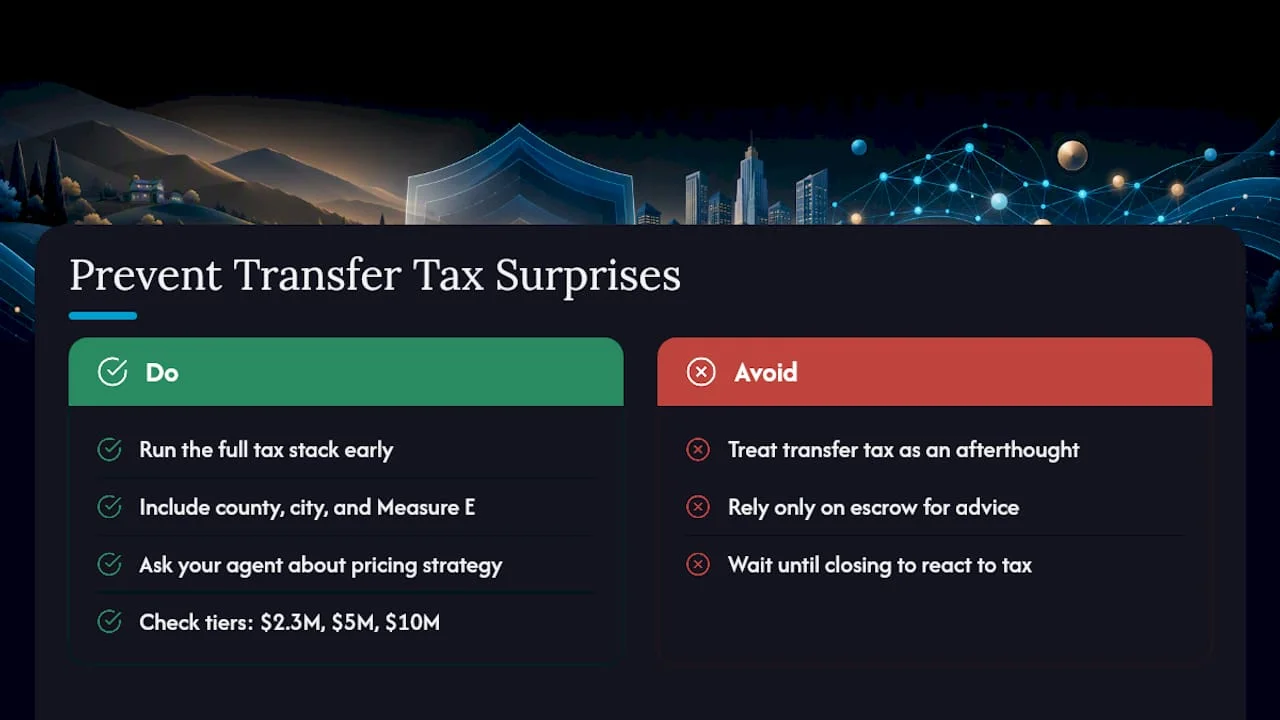
The conventional advice, “your escrow officer will handle it,” is technically true and practically insufficient. Escrow calculates the tax correctly based on the information it receives, but it doesn’t advise you on pricing strategy, exemption eligibility, or how a $50,000 price adjustment might push your sale into a higher Measure E tier. That’s a negotiation and pricing question, and it belongs with your agent well before you sign a listing agreement.
If you take one thing from this, prioritize running the full tax stack, county, city, and Measure E, at the same time you’re setting your list price or writing an offer. Reacting to the number at closing is too late to do anything useful with it.
— Mr
Get a Net-Proceeds Estimate Before You List or Offer
Laxmitoprealtor gives Santa Clara County sellers something most agents skip: a full net-proceeds model that layers county transfer tax, city conveyance tax, and Measure E exposure into your pricing strategy before you list, not after you’re under contract.

With more than $650 million in closed sales across Santa Clara County, Laxmi Penupothula’s concierge seller services include escrow coordination, negotiation support on who pays which portion of the transfer tax, and a customized net-proceeds estimate built around your property’s actual city and price point. Buyers get the same clarity on closing cost expectations before making an offer near a Measure E threshold. Request a free consultation and net-proceeds estimate through the seller resource page to see exactly what you’ll walk away with after transfer taxes, fees, and commissions.
Where to Verify These Rates and Rules
Confirm current rates directly with the Santa Clara County Clerk-Recorder, the City of San Jose’s Measure E page, or city finance offices. The Clerk-Recorder cannot give legal advice, so route exemption questions to your escrow officer or an attorney.
This article is general information, not a substitute for advice from a qualified financial advisor. Consult a qualified financial professional about your own circumstances before acting on anything here.
Sources
- Recording document fees | Office of the County Clerk-Recorder
- Measure E real property transfer tax (City of San Jose)
- Santa Clara County Transfer Tax Calculator for Home Sellers (HomeLight)
Recommended
- Santa Clara County Property Tax: What Buyers & Sellers Must Know
- Prop 19 Property Tax Calculator: Estimate Your Bay Area Savings
- Santa Clara County Housing Market: 2026 Guide
- Escrow Holdback for Repairs: A Santa Clara County Guide

Laxmi Penupothula
Top 1% Realtor SCCAOR, RealTrends Verified (2021–2025) • CA DRE #02047105
SCCAOR Top 1% Santa Clara County • Intero Chairman Circle 2023–2025 • \$650M+ Closed • 570+ Transactions
Silicon Valley & Bay Area Specialist — Cupertino, San Jose, Fremont, Milpitas, Sunnyvale & surrounding cities.
Get a Free Home Valuation →